
Operational Governance Resume Guide for Professionals 2026
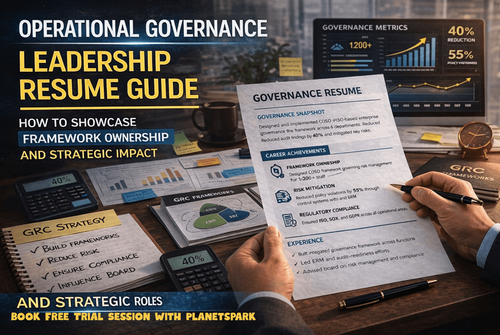

Operational Governance Leadership Resume Guide: How to Showcase Framework Ownership and Strategic Impact
If you work in governance, risk, compliance, or operations, chances are your resume does not reflect the true depth of your impact. You may have built frameworks, reduced audit risks, ensured regulatory compliance, or influenced board-level decisions—but your resume might still say things like “handled compliance” or “supported governance activities.”
Book your free trial session today with Planetspark.
Download for more details or PDF file.
The problem is not your experience. It is how that experience is presented.
Operational governance is one of the most misunderstood areas in resume writing. As highlighted in the guide, governance professionals often struggle to quantify their impact because their contributions are embedded in systems, controls, and risk mitigation rather than direct revenue outcomes.
This blog will show you how to transform your resume into a powerful, leadership-focused document that clearly communicates your governance expertise, scale, and strategic value.
Who Is This Blog For?
- Governance, risk, and compliance professionals
- Operations managers with governance responsibilities
- Compliance specialists transitioning into leadership roles
- Consultants and advisors in governance or risk functions
- Early-to-mid career professionals building governance-focused resumes
Why This Topic Matters Today?
Organisations today operate in increasingly complex regulatory and operational environments. Governance is no longer a support function—it is a strategic necessity.
Hiring managers are looking for professionals who can:
- Build and scale governance frameworks
- Ensure regulatory compliance across functions
- Provide board-level insights and reporting
- Embed governance into everyday operations
The guide emphasises that governance resumes often fail because they focus on duties instead of outcomes, making high-impact work invisible to recruiters.
In a market where recruiters scan resumes in seconds, clarity of governance impact is critical for career advancement.
Core Concept or Framework Explained
The central principle of this guide is:
Governance resumes must demonstrate framework ownership and measurable impact, not just responsibilities.
A strong governance resume should clearly show:
- What frameworks or systems you designed or implemented
- The scale of governance across business units or geographies
- The risks you mitigated or controls you improved
- The leadership influence you exercised
For example:
- Weak: Supported compliance activities
- Strong: Designed and implemented enterprise governance framework across 5 business units, reducing audit findings by 35%
The templates are structured around three key elements:
Framework-first positioning
Highlight governance frameworks such as COSO, ISO, SOX, or ITIL
Quantified governance impact
Show metrics such as audit reduction, policy coverage, or risk mitigation
Leadership and influence
Demonstrate cross-functional coordination and board-level engagement
How This Blog and Guidebook Help You?
This guidebook helps you reposition your governance experience into a compelling leadership narrative by:
- Structuring your resume around governance frameworks and outcomes
- Highlighting strategic contributions instead of operational tasks
- Aligning your profile with recruiter expectations in governance roles
- Improving ATS visibility with framework-specific language
- Helping you stand out in competitive governance hiring pipelines
It ensures your resume answers a key question: How did you strengthen the organisation’s governance system?
Step-by-Step Breakdown
Step 1: Identify Your Governance Leadership Role
Start by identifying your primary contribution area.
You may have worked in:
- Governance framework design
- Risk management and ERM
- Policy development and controls
- Compliance and regulatory operations
- Board reporting and executive communication
This defines your positioning.
Step 2: Choose the Right Scenario-Based Template
The guide provides 10 scenario-specific templates:
- Governance architect building frameworks from scratch
- Compliance professional transitioning to governance leadership
- Cross-functional operations director
- Risk-centric governance leader
- Policy and controls owner
- Board and executive reporting lead
- Regulated industry governance specialist
- Digital and IT governance leader
- Governance consultant
- Early-career governance professional
Each template aligns with a specific career scenario and hiring expectation.
Step 3: Highlight Framework Ownership
Your resume should clearly show ownership of governance systems.
Examples include:
- Designed enterprise governance frameworks
- Implemented risk management models
- Built policy lifecycle systems
Ownership signals leadership capability.
Step 4: Quantify Governance Impact
Metrics are essential—even in governance roles.
Include:
- Reduction in audit findings
- Policy coverage across employees or departments
- Risk mitigation outcomes
- Compliance rates
- Number of stakeholders or business units governed
For example:
- Reduced audit findings by 40% across 3 audit cycles
Step 5: Show Scale and Scope
Governance impact is defined by scale.
Clearly mention:
- Business units or geographies covered
- Team size or stakeholder groups
- Budget or operational scope
This strengthens your credibility.
Step 6: Demonstrate Risk and Control Impact
Governance is about preventing problems before they occur.
Your resume should reflect:
- Risk identification and mitigation
- Control implementation and monitoring
- Audit readiness and compliance
This highlights strategic value.
Step 7: Highlight Cross-Functional Influence
Governance leaders work across the organisation.
Show collaboration with:
- Finance and legal teams
- Business unit leaders
- Audit committees and boards
The guide stresses that governance leadership is defined by influence, not just execution.
Step 8: Use Framework-Specific Language
Avoid generic descriptions.
Instead, include recognised frameworks such as:
- COSO Enterprise Risk Management
- ISO standards
- SOX compliance
- COBIT or ITIL
Framework literacy is a key differentiator.
Step 9: Optimise for ATS and Readability
Follow these best practices:
- Use standard section headings
- Avoid complex formatting
- Mirror job description language
- Include full framework names
These steps improve searchability and readability.
Step 10: Apply the Select–Replace–Quantify–Export Workflow
The guide recommends a simple four-step process:
- Select the right template
- Replace placeholders with real data
- Quantify achievements
- Export as a clean, ATS-friendly file
This ensures consistency and effectiveness.
Common Mistakes or Pitfalls to Avoid
The guide highlights several critical mistakes:
- Listing governance duties without outcomes
- Using weak action verbs like “helped” or “assisted”
- Failing to mention frameworks or standards
- Not quantifying audit or compliance impact
- Hiding leadership scope and influence
These mistakes can significantly reduce your visibility.
How Should You Use This Guidebook Effectively?
To get the best results:
- Choose the template aligned with your career goal, not just your current role
- Spend 1–2 hours adding accurate and quantified data
- Focus on outcomes, not activities
- Tailor your resume for each application
- Keep updating your resume as you complete major governance initiatives
The templates are designed for immediate use—simply customise and apply.
Key Takeaways
- Governance resumes must highlight frameworks, scale, and outcomes
- Quantifying impact is essential, even in non-revenue roles
- Scenario-based templates improve positioning and clarity
- Cross-functional influence defines governance leadership
- Framework-specific language strengthens credibility
- Strong action verbs signal ownership and authority
- Tailored resumes outperform generic governance profiles
Your Next Step: Accelerate Your Career with PlanetSpark
Creating an impact-driven resume is not just about landing your next job—it’s about owning your professional story and presenting it with clarity, confidence, and credibility. When your resume clearly communicates value, results, and impact, opportunities follow naturally.
At PlanetSpark, we are committed to empowering working professionals with practical, outcome-focused resources that drive real career growth. From resume building and workplace communication to leadership presence and professional writing, our programs are designed to help you succeed in today’s fast-evolving job market.
Visit https://www.planetspark.in/resources to explore:
- Career and resume-building guides
- Workplace communication and professional writing resources
- Skill-development tools curated for working professionals
Want a deeper, hands-on experience?
You can also book a free trial session to learn more about PlanetSpark’s Working Professional Courses, designed to accelerate your career through personalised coaching, real-world practice, and expert guidance.
Your career deserves more than generic advice.
It deserves clarity, confidence, and measurable impact.
Personalized Communication Roadmaps
Record a video to get a AI generated personalized communication reports