
Operational Metrics Resume Guide for Working Professionals
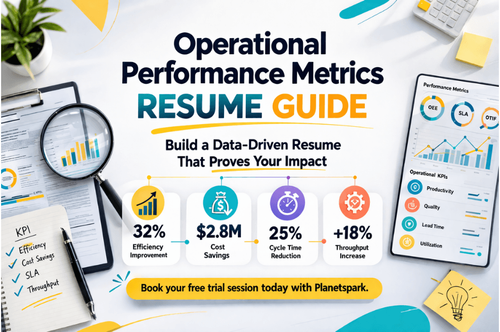

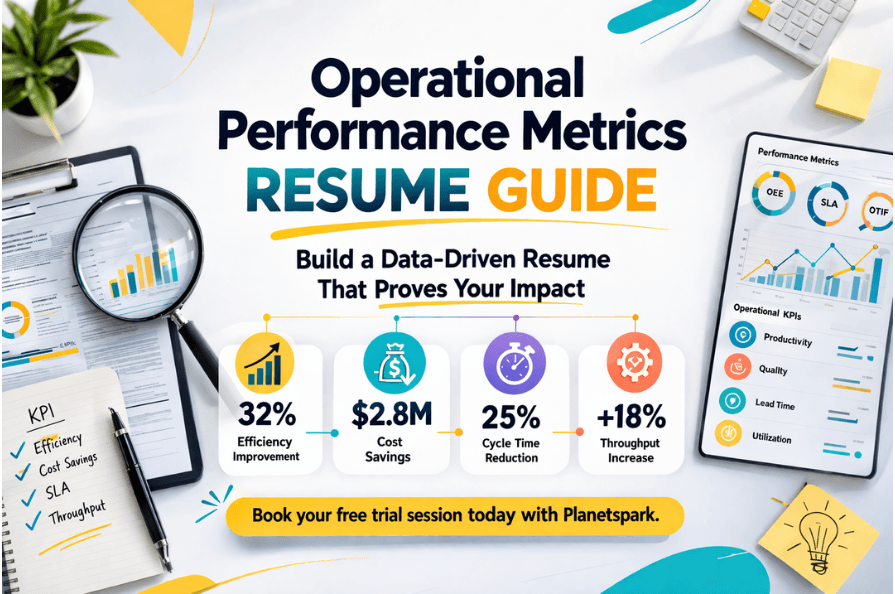
Operational Performance Metrics Resume Guide: Build a Data-Driven Resume That Proves Your Impact
In operations roles, your resume is not just a summary of your work—it is a performance report. Yet, many professionals still rely on generic descriptions that fail to capture the true value they deliver.
Statements like “managed operations” or “led teams” do not tell hiring managers anything about outcomes. They do not reveal efficiency improvements, cost savings, or performance gains. As a result, even high-performing professionals struggle to stand out in competitive hiring environments.
If your work has improved throughput, reduced costs, increased efficiency, or optimised performance, your resume must communicate those results clearly using metrics. This is where a structured, metrics-driven resume approach becomes essential.
Book your free trial session today with Planetspark.
Download for more details or PDF file.
Who Is This Blog For?
- Operations managers focused on efficiency and performance
- Supply chain and logistics professionals managing KPIs
- Process engineers and manufacturing leaders
- Customer operations and service delivery managers
- Consultants presenting ROI-driven project outcomes
- Early-career professionals building data-driven resumes
Why This Topic Matters Today?
In today’s data-driven business environment, hiring decisions are increasingly based on measurable outcomes. Recruiters and ATS systems are scanning for numbers—percentages, savings, improvements, and performance metrics.
As highlighted in the guide, a resume that lists responsibilities signals little value, while a resume that highlights measurable impact tells a compelling story.
Hiring managers are specifically looking for:
- Percentage improvements in efficiency or productivity
- Cost savings and budget optimisation
- Cycle time reductions and throughput increases
- Performance metrics such as SLA, OTIF, or OEE
Without these signals, your resume may fail to demonstrate your true contribution.
Core Concept or Framework Explained
The core principle of this guidebook is that operational resumes must be built around metrics, not tasks.
The resource provides 10 scenario-driven templates designed to highlight measurable performance across different roles and career stages.
These templates help professionals:
- Translate daily work into measurable outcomes
- Structure resumes around performance metrics
- Highlight key KPIs relevant to their role
- Align resumes with ATS and recruiter expectations
Examples include Efficiency Transformer, Cost-Reduction Champion, Supply Chain Metrics Leader, and Customer Operations Performance Leader. Each template ensures your resume tells a clear, data-driven story.
How This Blog and Guidebook Help You?
This guidebook helps you shift from a descriptive resume to a performance-driven document.
By applying its approach, you can:
- Clearly communicate your operational impact using numbers
- Demonstrate efficiency, cost savings, and productivity gains
- Improve ATS ranking through keyword and metric alignment
- Position yourself as a results-oriented professional
- Increase your chances of getting shortlisted
It enables you to present your experience as measurable business value.
Step-by-Step Breakdown
Understanding the Metrics-First Approach
The first step is understanding that every achievement must be expressed in measurable terms.
Instead of writing task-based statements, you should:
- Lead with a number
- Follow with the action taken
- Provide context for the result
For example, stating a percentage reduction in cycle time or a dollar value of savings immediately communicates impact.
Selecting the Right Scenario Template
The guide provides 10 templates aligned to different career scenarios, such as:
- Efficiency Transformer for process improvement roles
- Cost-Reduction Champion for budget-focused roles
- Supply Chain Metrics Leader for logistics professionals
- Plant Performance Driver for manufacturing leaders
- Customer Operations Leader for service environments
Choosing the right template ensures relevance and clarity.
Highlighting Key Performance Metrics
Each template includes a dedicated section for KPIs, making your impact visible at a glance.
Examples of metrics to include:
- Throughput and production output
- Cost savings and budget variance
- SLA compliance and customer satisfaction
- Inventory turnover and lead time reduction
- Equipment efficiency and uptime
These metrics act as proof of your performance.
Structuring Achievements Around Data
The guide recommends structuring every bullet point around measurable outcomes.
For example:
- Start with the metric achieved
- Describe the action taken
- Add context such as scale or timeframe
This structure ensures clarity and impact.
Providing Baseline and Outcome Comparison
One of the most powerful techniques is showing before-and-after comparisons.
Instead of just stating improvement, you should include:
- Baseline performance
- Target or achieved performance
- Percentage or absolute change
This makes your contribution tangible and credible.
Ensuring ATS Compatibility
All templates are designed to be ATS-friendly, ensuring your resume passes automated screening.
Best practices include:
- Using relevant keywords from job descriptions
- Maintaining simple formatting
- Avoiding complex layouts
- Keeping content structured and readable
This improves both visibility and readability.
Common Mistakes or Pitfalls to Avoid
The guide highlights several mistakes that weaken resumes:
- Writing responsibilities instead of results
- Omitting metrics or using vague language
- Failing to include scale such as team size or budget
- Burying key numbers within long sentences
- Ignoring baseline comparisons for improvements
Avoiding these mistakes ensures your resume communicates real impact.
How Should You Use This Guidebook Effectively?
To get the most value from this resource, follow these steps:
- Select the template that matches your role and experience
- Replace placeholders with real, measurable data
- Lead every bullet point with a metric
- Tailor your resume to each job description
- Maintain both ATS-friendly and formatted versions
The guide emphasises that specificity and quantification are the key differentiators between average and standout resumes.
Key Takeaways
- Your resume should function as a performance report
- Metrics are essential for demonstrating impact
- Scenario-based templates improve clarity and relevance
- Leading with numbers strengthens your narrative
- Baseline comparisons make achievements credible
- ATS-friendly structure improves visibility
- Data-driven resumes increase interview chances
Your Next Step: Accelerate Your Career with PlanetSpark
Creating an impact-driven resume is not just about landing your next job—it’s about owning your professional story and presenting it with clarity, confidence, and credibility. When your resume clearly communicates value, results, and impact, opportunities follow naturally.
At PlanetSpark, we are committed to empowering working professionals with practical, outcome-focused resources that drive real career growth. From resume building and workplace communication to leadership presence and professional writing, our programs are designed to help you succeed in today’s fast-evolving job market.
Visit https://www.planetspark.in/resources to explore:
- Career and resume-building guides
- Workplace communication and professional writing resources
- Skill-development tools curated for working professionals
Want a deeper, hands-on experience?
You can also book a free trial session to learn more about PlanetSpark’s Working Professional Courses, designed to accelerate your career through personalised coaching, real-world practice, and expert guidance.
Your career deserves more than generic advice.
It deserves clarity, confidence, and measurable impact.
Personalized Communication Roadmaps
Record a video to get a AI generated personalized communication reports