
Operational Process Design Resume Guide for Career Growth
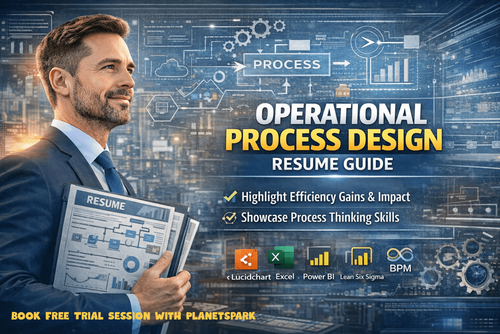

Operational Process Design Resume Guide: How to Showcase Process Thinking, Efficiency Gains, and Measurable Impact
Operational process design is one of the most valuable yet misunderstood skill areas in modern business. Organisations are constantly looking for professionals who can redesign workflows, eliminate inefficiencies, and build scalable systems—but most resumes fail to communicate this capability effectively.
Book your free trial session today with Planetspark.
Download for more details or PDF file.
Instead of showing real impact, many candidates simply list responsibilities.
The Resume Template Focused on Operational Process Design is built to solve this exact problem. It helps professionals present their work through the lens of transformation, efficiency, and measurable outcomes—so hiring managers instantly recognise their value.
Who Is This Blog For?
- Process analysts and operations professionals at any career stage
- Continuous improvement specialists and Lean practitioners
- Business transformation managers and consultants
- Supply chain, logistics, or operations leaders
- Professionals transitioning into process design roles
Why This Topic Matters Today?
Operational process design is no longer a niche skill—it is central to how organisations improve performance and scale operations.
However, as highlighted in the resource introduction (page 2), most professionals make a critical mistake: they describe what they did instead of what changed because of them.
Hiring managers are not looking for task descriptions. They are looking for:
- Measurable improvements (cost, time, efficiency)
- Structured methodologies (Lean, Six Sigma, BPM)
- Clear process thinking (mapping, redesign, optimisation)
- Business impact (productivity, compliance, scalability)
Without these, even strong experience can appear weak on paper.
Core Concept or Framework Explained
Outcome Over Activity
A strong process design resume focuses on outcomes, not duties. For example:
- Weak: “Responsible for process improvement”
- Strong: “Redesigned fulfilment workflows, reducing cycle time by 28%”
Methodology Visibility
Operational process design requires a specific vocabulary. Terms like:
- Value stream mapping
- SIPOC
- RACI frameworks
- Cycle time reduction
- SOP development
These are not buzzwords—they signal expertise to employers.
Scenario-Based Positioning
The template pack is structured around real-world scenarios, ensuring your resume aligns with your role and target job. From early-career analysts to transformation directors, each template reflects a specific career stage and context.
How This Blog and Guide Help You
This guide helps you:
- Convert generic experience into process-driven impact statements
- Use the right terminology to pass ATS filters
- Structure your resume based on real-world process design roles
- Highlight measurable outcomes instead of responsibilities
- Position yourself as a problem-solver, not just an operator
Step-by-Step Breakdown
1. Understanding the Right Scenario
The template pack includes 10 distinct resume scenarios (page 3), such as:
- Process Analyst (entry-level)
- Lean Practitioner Specialist
- Business Process Re-engineer
- Digital Process Transformation Lead
- Supply Chain Process Specialist
- Operational Excellence Manager
- Process Design Consultant
- Career Switcher into Process Design
- SOP & Standards Architect
- Transformation Programme Director
Choosing the right scenario ensures your resume feels highly targeted—not generic.
2. Building a Strong Professional Summary
Your summary should clearly communicate:
- Your experience level
- Your process design expertise
- Your methodology knowledge
- Your measurable impact
For example, early-career templates emphasise workflow mapping and KPI tracking, while senior templates highlight enterprise transformation and governance.
3. Structuring Process Design Experience
Every bullet point should follow a simple formula:
Action + Process + Outcome
Example from the templates:
- Mapped operational workflows, identifying redundant steps and reducing handling time
- Designed SOP frameworks that improved onboarding speed
- Introduced workflow changes that reduced errors or saved time
This ensures clarity and impact.
4. Highlighting Process Design Skills
The templates consistently emphasise key competencies such as:
- Process mapping (As-Is / To-Be)
- Root cause analysis (5-Why, Fishbone)
- Workflow optimisation
- KPI tracking and analytics
- Cross-functional collaboration
These are the core signals of a strong process design professional.
5. Showcasing Tools and Technologies
You should explicitly mention tools like:
- Visio, Lucidchart (process mapping)
- Excel, Power BI (analysis and reporting)
- ERP systems (SAP, Oracle, etc.)
- Workflow and project tools (Jira, Confluence)
This reinforces both technical and analytical capability.
Common Mistakes to Avoid
According to the “Common Mistakes” section (page 2), avoid:
- Writing responsibilities instead of outcomes
- Ignoring methodology credentials (Lean, Six Sigma, BPM)
- Hiding process achievements inside job descriptions
- Using one generic resume for all roles
- Not quantifying impact (team size, cost savings, scale)
These mistakes significantly reduce resume effectiveness.
How to Use This Guide Effectively
Follow the process shown in the diagram on page 2:
1. Choose the right scenario
2. Fill placeholders with real data
3. Tailor your summary for each role
4. Export and apply
Additionally, the checklist on page 14 highlights best practices:
- Include at least 3 quantified achievements
- Use job-specific keywords and methodologies
- Match tools and technologies with the job description
- Ensure every responsibility has a measurable outcome
- Save both PDF and editable versions for flexibility
Time Investment Tip
- Initial resume creation: 3–4 hours
- Customisation per job: 20–30 minutes
Key Takeaways
- Process design resumes must focus on outcomes, not tasks
- Methodology terms act as credibility signals
- Scenario-based templates improve relevance and targeting
- Quantification is critical for impact and trust
- Tools, frameworks, and metrics must be clearly visible
- Tailoring each application significantly increases success
Your Next Step: Build a Resume That Reflects Real Impact
A strong operational process design resume is more than a document—it’s proof of your ability to think systematically, solve problems, and deliver measurable business results.
When you clearly show what changed because of your work, you position yourself as a high-value professional—not just another applicant.
Explore more career-building resources at PlanetSpark and start creating a resume that truly reflects your impact.
Personalized Communication Roadmaps
Record a video to get a AI generated personalized communication reports