
Operational Turnaround Resume Guide for Career Growth 2026
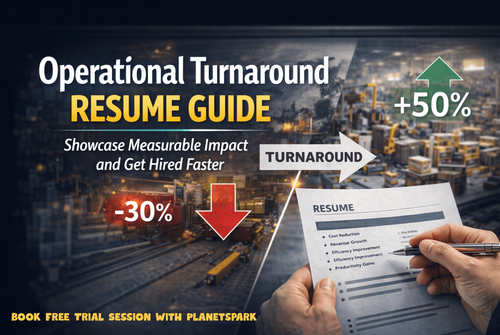

Operational Turnaround Resume Guide: Showcase Measurable Impact and Get Hired Faster
You may have reduced costs by crores, stabilised a failing supply chain, or transformed a loss-making unit into a profitable one. But if your resume doesn’t clearly communicate that impact, none of it matters.
Book your free trial session today with Planetspark.
Download for more details or PDF file.
This is one of the biggest challenges operations professionals face. Your experience is powerful—but buried under generic descriptions, it becomes invisible to recruiters. As highlighted in this guide, most resumes fail not because of lack of experience, but because they hide measurable outcomes inside vague responsibilities.
In high-stakes operational roles, hiring managers are not looking for activity—they are looking for proof of transformation. This blog will help you understand how to build a resume that clearly demonstrates your ability to diagnose problems, lead recovery, and deliver measurable results.
Who Is This Blog For?
- Operations managers and plant heads leading turnaround initiatives
- Supply chain professionals managing disruption and recovery
- Process improvement consultants using Lean or Six Sigma
- Business unit leaders responsible for P&L recovery
- Retail, logistics, and manufacturing professionals driving performance improvement
- Early to mid-career professionals aiming to highlight operational impact
Why This Topic Matters Today?
Operational efficiency and resilience have become critical priorities for organisations. Whether due to market volatility, supply chain disruptions, or internal inefficiencies, companies are actively seeking leaders who can fix problems and deliver results quickly.
Turnaround experience is a high-value signal in hiring. According to the guide, it demonstrates:
- Ability to diagnose operational failure
- Capability to align teams under pressure
- Skill in executing structured recovery plans
- Track record of measurable business impact
However, many professionals fail to present these strengths effectively. Common issues include:
- Writing generic job descriptions instead of impact statements
- Using vague words like improved or optimised without numbers
- Failing to explain the “before and after” context
- Ignoring the business stakes involved
In a competitive hiring environment, this disconnect can cost you opportunities.
Core Concept or Framework Explained
The central idea of this resource is simple but powerful: your resume must prove transformation, not just participation.
Operational turnaround roles are defined by outcomes. Hiring managers want to see:
- What problem you inherited
- What actions you took
- What measurable results you delivered
To help professionals communicate this clearly, the guide provides 10 scenario-based templates tailored to real-world operational contexts.
These include:
- Plant turnaround leader
- Supply chain crisis recovery specialist
- Process excellence consultant
- Retail operations revamp lead
- P&L recovery manager
- Workforce and culture transformation leader
- Technology-enabled operations turnaround leader
- Startup operations stabilisation specialist
- Interim or fractional turnaround manager
- Multi-site operations recovery director
Each template is designed to structure your experience in a way that highlights measurable impact and aligns with recruiter expectations.
How This Blog and Guidebook Help You?
This blog and the associated template pack help you convert your operational experience into a compelling narrative that gets noticed.
Key benefits include:
- Clear structure for presenting turnaround achievements
- Focus on measurable outcomes rather than responsibilities
- Alignment with ATS systems and recruiter screening criteria
- Scenario-based templates for different career paths
- Guidance on framing high-impact projects effectively
Instead of underselling your achievements, you learn how to position them as proof of capability.
Step-by-Step Breakdown
1. Identify Your Turnaround Story
Start by identifying your most impactful turnaround experience. This could be:
- Recovering a failing plant
- Stabilising a disrupted supply chain
- Turning a loss-making business unit profitable
- Improving workforce productivity or engagement
Your resume should centre around this story.
2. Choose the Right Template
The guide emphasises selecting a template that matches your specific scenario.
For example:
- Manufacturing recovery aligns with the Plant Turnaround template
- Supply chain disruption aligns with the Crisis Recovery template
- Financial recovery aligns with the P&L Recovery template
Choosing the right template ensures your experience is presented in the correct context.
3. Define the Turnaround Context
One of the most critical elements is clearly stating the starting point.
For example:
- Plant operating at low capacity with high losses
- Supply chain disrupted due to vendor failure
- Business unit facing declining margins
This context helps recruiters understand the scale and significance of your achievement.
4. Highlight Measurable Outcomes
Every achievement should include quantifiable results. The guide strongly emphasises:
- Cost reduction percentages
- Revenue growth figures
- Efficiency improvements
- Time reductions
- Productivity gains
For example:
- Reduced downtime from X percent to Y percent
- Improved service levels within a defined timeframe
- Generated additional revenue through process optimisation
Numbers make your impact visible and credible.
5. Structure Your Experience Clearly
Each template follows a structured approach:
- Header with professional positioning
- Summary highlighting turnaround expertise
- Core competencies aligned with operational recovery
- Experience section with context and achievements
- Education and certifications
This ensures clarity and consistency across your resume.
6. Demonstrate Tools and Methodologies
Operational turnaround often relies on structured frameworks. The templates highlight the importance of including:
- Lean and Six Sigma methodologies
- Process improvement tools
- ERP and digital transformation systems
- Data analysis and reporting tools
These signals strengthen your credibility.
7. Show Scale and Complexity
Recruiters evaluate not just results, but scale. Your resume should reflect:
- Size of operations managed
- Number of locations or teams
- Budget or P&L responsibility
- Geographic scope
This adds depth to your experience.
8. Ensure ATS Compatibility
The templates are designed to work with Applicant Tracking Systems. Best practices include:
- Using clean formatting and standard fonts
- Avoiding tables and complex layouts
- Using clear section headings
- Including relevant keywords from job descriptions
This increases your chances of passing automated screening.
Common Mistakes or Pitfalls to Avoid
The guide highlights several critical mistakes that weaken resumes:
- Listing responsibilities instead of outcomes
- Burying the turnaround context
- Using vague, non-quantified language
- Ignoring the business impact of your work
- Writing generic summary statements
- Failing to tailor the resume to the role
Each of these reduces clarity and makes your profile less compelling.
How Should You Use This Guidebook Effectively?
To maximise the value of this resource, follow a structured process:
- Select the template that best matches your scenario
- Replace all placeholders with real data
- Focus on quantified outcomes
- Clearly define the turnaround context
- Align your language with the job description
Suggested workflow:
- Spend 1–2 hours identifying key turnaround achievements
- Spend 2–3 hours customising the template
- Spend 30–60 minutes refining metrics and language
- Review for ATS compatibility before submission
As highlighted in the usage guide, every line of your resume should answer one question: what did this person actually deliver?
Key Takeaways
- Turnaround experience is a high-value signal in operations hiring
- Your resume must highlight outcomes, not responsibilities
- Always include the before-and-after context of your work
- Quantify every achievement using measurable data
- Use scenario-based templates to align with your career path
- Demonstrate tools, frameworks, and methodologies clearly
- Optimise your resume for ATS systems
- Tailor your resume for each role you apply to
Your Next Step: Accelerate Your Career with PlanetSpark
Creating an impact-driven resume is not just about landing your next job—it’s about owning your professional story and presenting it with clarity, confidence, and credibility. When your resume clearly communicates value, results, and impact, opportunities follow naturally.
At PlanetSpark, we are committed to empowering working professionals with practical, outcome-focused resources that drive real career growth. From resume building and workplace communication to leadership presence and professional writing, our programs are designed to help you succeed in today’s fast-evolving job market.
Visit https://www.planetspark.in/resources to explore:
- Career and resume-building guides
- Workplace communication and professional writing resources
- Skill-development tools curated for working professionals
Want a deeper, hands-on experience?
You can also book a free trial session to learn more about PlanetSpark’s Working Professional Courses, designed to accelerate your career through personalised coaching, real-world practice, and expert guidance.
Your career deserves more than generic advice.
It deserves clarity, confidence, and measurable impact.
Personalized Communication Roadmaps
Record a video to get a AI generated personalized communication reports