
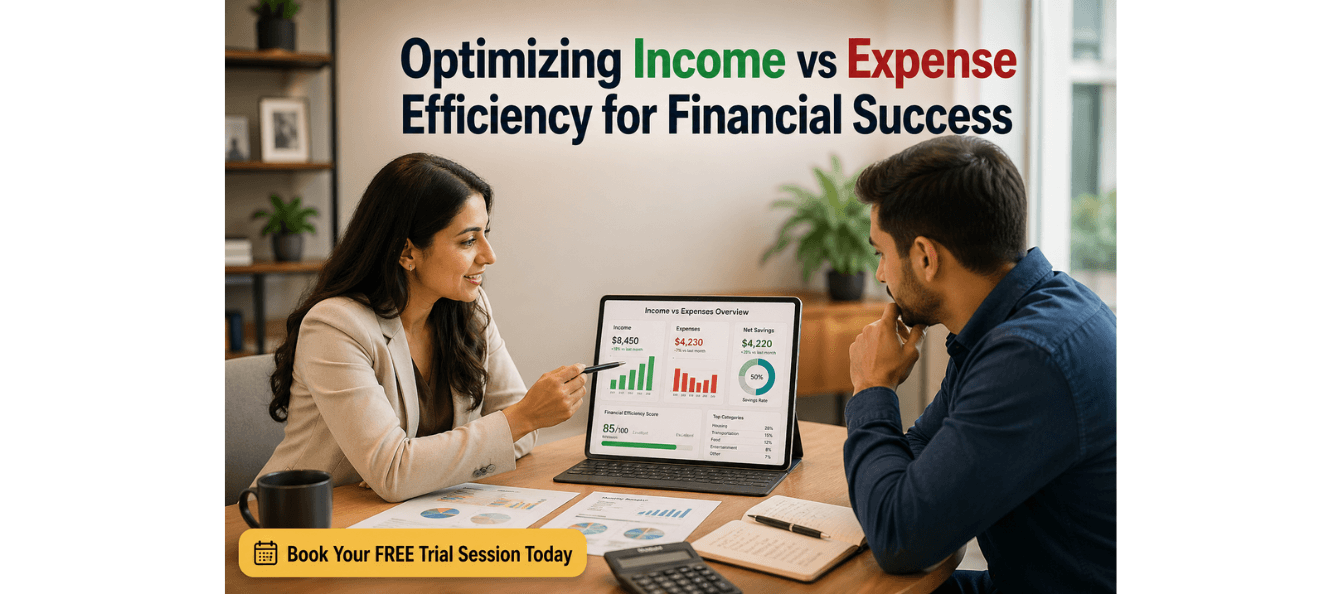
Optimizing Income vs Expense Efficiency for Financial Success
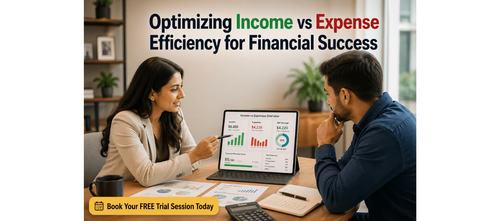

Understanding Income vs Expense Efficiency: A Practical System to Optimise Your Money, Boost Savings, and Build Long-Term Wealth
In today’s professional landscape, earning a good salary is often seen as the ultimate marker of financial success. Yet, many working professionals find themselves in a frustrating cycle—income increases, but savings barely move. Despite promotions, bonuses, or new opportunities, financial freedom still feels out of reach.
The real issue is not how much you earn, but how efficiently your income is being used. Without a clear system to track and optimise financial flows, money gets absorbed into fixed expenses, lifestyle upgrades, and unnoticed spending habits. Over time, this creates an invisible gap between income and actual financial progress.
Most professionals operate without a structured view of their finances. They make decisions in isolation—one subscription here, one upgrade there—without realising the cumulative impact. The result is a pattern where income grows, but wealth does not.
This is exactly where the Income vs Expense Efficiency framework becomes powerful. Instead of focusing only on earnings, it helps you evaluate how effectively your money is working for you. By mapping, measuring, and optimising your financial behaviour, you gain clarity, control, and direction.
Download these resources and apply them alongside your daily work for improved clarity, productivity, and professional growth. You can also book a free trial to gain expert guidance and enhance your communication, problem-solving, and decision-making skills. The materials are designed in a clear, structured format to help professionals learn efficiently and implement insights with confidence.
Who Is This Blog For?
- Working professionals who feel financially stuck despite stable income
- Early and mid-career individuals aiming to build savings and investments
- Freelancers and consultants managing irregular income streams
- Managers looking to improve financial discipline and planning
- Anyone seeking clarity and control over their money
Why This Topic Matters Today?
Financial stress is no longer limited to low-income groups. Even well-paid professionals often struggle with savings and long-term wealth creation. The core reason is a lack of visibility into how money flows through their lives.
Key challenges highlighted in the framework include:
- Income growth being offset by lifestyle inflation
- Lack of structured tracking of expenses
- Overdependence on a single income source
- Minimal focus on financial efficiency metrics
Today’s economy demands more than just earning—it requires managing money intelligently. Professionals who optimise their income-to-expense efficiency gain a significant advantage in building wealth, reducing stress, and achieving financial independence.
Core Concept or Framework Explained
At the heart of this guide is the concept of Income-Expense Efficiency—measuring how effectively your income is converted into savings, investments, and long-term financial stability.
The framework is built on three core pillars:
Income Visibility
Most professionals underestimate their income diversity. The framework encourages mapping every source of income—salary, freelance work, investments, and side projects—while also evaluating reliability.
This creates awareness of both opportunities and risks.
Expense Classification
Not all expenses are equal. The framework divides spending into four categories:
- Foundational expenses that are essential
- Growth expenses that build future earning potential
- Lifestyle expenses that enhance comfort
- Leakage expenses that provide little or no long-term value
This classification shifts your mindset from spending blindly to spending strategically.
Efficiency Measurement Through IEES
The Income-Expense Efficiency Score (IEES) combines:
- Savings rate
- Leakage ratio
- Growth investment ratio
This single score acts as a financial performance indicator, helping you track progress and identify gaps month after month.
How This Blog and Guidebook Help You?
This blog and the accompanying framework provide a structured approach to managing your finances effectively.
You will gain:
- A clear system to track income and expenses
- Tools to identify hidden inefficiencies in your spending
- A measurable score to evaluate financial progress
- Practical strategies to optimise without sacrificing quality of life
The outcome is not just better financial management, but a complete shift in how you think about money—from reactive to strategic.
Step-by-Step Breakdown
Step 1: Map Your Income Landscape
Start by listing every source of income, including salary, freelance work, rental income, and side projects.
Key actions:
- Record all income streams accurately
- Classify each source as active, passive, or variable
- Evaluate reliability on a scale
- Calculate total net monthly income
This step helps you understand both your earning potential and your dependency risks.
Step 2: Categorise and Classify Your Expenses
Next, analyse your spending over the past 30 days.
Divide expenses into:
- Foundational
- Growth
- Lifestyle
- Leakage
This exercise often reveals surprising patterns, especially the extent of leakage expenses that go unnoticed.
Step 3: Calculate Your Efficiency Score
Use your data to compute key metrics:
- Savings rate to measure how much you retain
- Leakage ratio to identify wasteful spending
- Growth ratio to evaluate future investment
These combine into your IEES, which reflects overall financial efficiency.
A higher score indicates better alignment between income and long-term goals.
Step 4: Identify Optimisation Opportunities
Once you have clarity, move to action.
Use the optimisation priority matrix:
- Quick wins with high impact and easy execution
- Planned cuts that require effort but deliver strong results
- Small improvements that add incremental value
- Low-impact changes that can be deprioritised
Focus on actions that deliver maximum results with minimal disruption.
Step 5: Apply Real-World Adjustments
The framework demonstrates how small changes can create significant impact.
Examples include:
- Automating savings before spending
- Reducing unnecessary subscriptions
- Setting limits on discretionary expenses
- Redirecting funds towards investments
Even without increasing income, these adjustments can dramatically improve financial outcomes.
Step 6: Avoid Common Financial Traps
Recognising mistakes is critical to long-term success.
Key pitfalls include:
- Planning based on gross income instead of net income
- Ignoring irregular or annual expenses
- Confusing lifestyle upgrades with growth investments
- Conducting one-time analysis instead of regular reviews
Avoiding these ensures sustained improvement.
Step 7: Build a Monthly Review System
Consistency is what drives results.
Establish a monthly routine:
- Review income and expenses
- Recalculate your efficiency score
- Identify new optimisation opportunities
- Track progress over time
This transforms financial management into a continuous improvement system.
Common Mistakes or Pitfalls to Avoid
Many professionals unknowingly sabotage their financial progress through avoidable errors.
Common mistakes include:
- Tracking income inaccurately or incompletely
- Overlooking small but recurring expenses
- Cutting growth investments to fund lifestyle spending
- Failing to assign a purpose to saved money
- Ignoring the need for regular financial reviews
A better approach is to:
- Focus on net income for planning
- Maintain clear expense categorisation
- Protect growth-related spending
- Assign every saved rupee a destination
- Build consistent financial habits
How Should You Use This Guidebook Effectively?
To maximise the value of this framework, follow a structured approach:
- Start with a complete financial audit using recent data
- Fill in all income and expense categories honestly
- Calculate your baseline efficiency score
- Identify top optimisation opportunities
- Implement changes gradually
Recommended workflow:
- Spend 30 minutes for the initial setup
- Allocate 20 minutes monthly for review and updates
Treat this as an ongoing system rather than a one-time exercise.
Key Takeaways
- Financial success depends on efficiency, not just income
- Mapping income sources reveals hidden risks and opportunities
- Expense classification creates clarity and control
- The IEES score provides a measurable performance metric
- Leakage expenses are the easiest optimisation starting point
- Growth investments should always be protected
- Monthly reviews ensure continuous improvement
- Small changes compound into significant long-term results
Your Next Step: Accelerate Your Career with PlanetSpark
Creating an impact-driven resume is not just about landing your next job—it’s about owning your professional story and presenting it with clarity, confidence, and credibility. When your resume clearly communicates value, results, and impact, opportunities follow naturally.
At PlanetSpark, we are committed to empowering working professionals with practical, outcome-focused resources that drive real career growth. From resume building and workplace communication to leadership presence and professional writing, our programs are designed to help you succeed in today’s fast-evolving job market.
Visit https://www.planetspark.in/resources to explore:
- Career and resume-building guides
- Workplace communication and professional writing resources
- Skill-development tools curated for working professionals
Want a deeper, hands-on experience?
You can also book a free trial session to learn more about PlanetSpark’s Working Professional Courses, designed to accelerate your career through personalised coaching, real-world practice, and expert guidance.
Your career deserves more than generic advice.
It deserves clarity, confidence, and measurable impact.
Start building that advantage today—with PlanetSpark.
Personalized Communication Roadmaps
Record a video to get a AI generated personalized communication reports