
Passive Job Search System for Employed Professionals
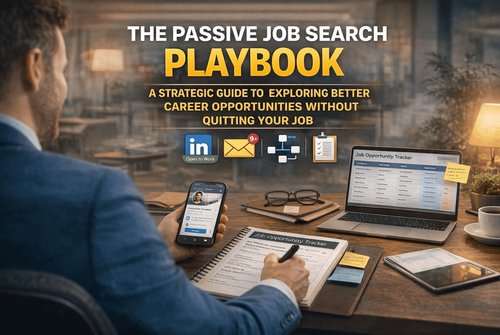

The Passive Job Search Playbook: A Strategic Guide to Exploring Better Career Opportunities Without Quitting Your Job
Many professionals reach a moment in their careers when a quiet question begins to surface: Is this really the right place for me long term? The challenge is that exploring new opportunities while already employed can feel risky. Updating your profile too aggressively, applying widely, or openly discussing your search may create unnecessary exposure at work.
Traditional job search advice assumes that candidates are unemployed and can search loudly and aggressively. But this approach does not work for professionals who want to maintain stability while exploring new possibilities.
This is where a structured passive job search strategy becomes invaluable. Instead of chaotic applications and reactive decisions, a passive search uses a deliberate system that runs quietly in the background of your professional life.
The Passive Job Search Playbook provides exactly that framework. It helps professionals clarify their goals, build discoverability, create a structured opportunity pipeline, and evaluate offers with confidence while remaining fully employed and professionally protected.
Who Is This Blog For?
This guide is designed for professionals who want to explore new opportunities while maintaining stability in their current roles.
- Working professionals with 0–15 years of experience exploring the next stage of their careers
- Managers, consultants, and specialists seeking better career growth opportunities
- Professionals who want to change roles without creating risk at their current workplace
- Career switchers exploring a new industry or functional path
- High-performing employees who want to stay prepared for future opportunities
Why This Topic Matters Today?
Career mobility has changed dramatically in recent years. Professionals today face a fast-moving job market, evolving industries, and increasingly competitive roles. Yet most career advice still focuses on aggressive job searching.
For employed professionals, the real challenge is different. They must explore new roles without disrupting their current position, reputation, or income.
According to the Passive Job Search Playbook, many professionals struggle because they try to apply traditional job search tactics while already employed. This often leads to scattered applications, unclear direction, and missed opportunities.
A passive search system solves this problem by focusing on four structured phases: Foundation, Signal, Pipeline, and Decision. These phases work together as a career operating system that helps professionals build momentum gradually and strategically.
When executed consistently, this system can start generating inbound recruiter interest within 60–90 days.
Core Concept or Framework Explained
The playbook introduces a simple but powerful framework that organizes a passive job search into four connected phases.
Foundation
The first phase focuses on clarity. Before starting a search, professionals must define what they actually want in their next role. This includes identifying target industries, compensation expectations, work models, and career priorities.
Signal
Once clarity is established, the next step is building discoverability. This means optimizing professional profiles, strengthening your network presence, and becoming visible to recruiters without announcing an active search.
Pipeline
A passive job search must still be structured. This phase focuses on building and tracking opportunities using a pipeline system that captures recruiter outreach, referrals, and potential roles.
Decision
The final phase ensures that when opportunities arise, professionals evaluate them carefully using structured criteria rather than emotional reactions.
Together, these phases create a sustainable job search system that can operate quietly in the background of a professional career.
How This Blog and Guidebook Help You?
Following this playbook helps professionals move from reactive job searching to strategic career management.
Key outcomes include:
- Greater clarity about career direction and role preferences
- Stronger visibility among recruiters and hiring managers
- A structured opportunity pipeline that prevents missed leads
- Better networking relationships and professional positioning
- Confidence in evaluating and negotiating job offers
Instead of hoping the right opportunity appears, professionals who follow this framework actively create momentum in their careers.
Step-by-Step Breakdown
Phase 1: Building the Foundation
Before starting any job search activity, professionals must clarify their career direction.
This begins with a structured self-audit.
Professionals are encouraged to review their recent performance feedback, identify projects that energized them, and list aspects of their current role that feel draining. These insights help define the type of work that aligns with their strengths and motivation.
Key clarity questions include:
- What type of work would I enjoy even if the compensation stayed the same?
- What management style allows me to perform at my best?
- What does success look like for me 18 months from now?
- What industry trends or changes excite me the most?
- What relocation or commute limitations exist for me?
This clarity exercise becomes the targeting brief that guides every decision in the job search process.
Without it, professionals risk applying to roles that appear attractive but ultimately fail to align with their long-term goals.
Phase 2: Creating the Right Signal
A passive job search requires visibility without exposure.
This means making it easier for recruiters and decision-makers to discover your profile while keeping your current employer unaware of your search.
LinkedIn plays a crucial role in this process.
Professionals should focus on optimizing several profile components:
- Headline that highlights skills and outcomes rather than just job title
- About section that tells a forward-looking career story
- Experience bullets that emphasize measurable impact
- Skills and keywords aligned with target roles
One particularly effective tactic is enabling the Open to Work setting but restricting visibility to recruiters only.
Beyond profile optimization, professionals should also activate their network gradually.
This can include:
- Re-engaging trusted colleagues
- Commenting on industry discussions
- Posting occasional insights or perspectives related to their field
These small signals keep professionals visible within their professional ecosystem without making their job search obvious.
Phase 3: Building a Job Opportunity Pipeline
Many job searches fail because professionals rely on memory or scattered notes instead of structured tracking.
A job search pipeline solves this problem.
A simple spreadsheet or project management tool can track opportunities using stages such as:
Researching
Application Sent
Recruiter Call
Interview Scheduled
Offer Stage
Each opportunity in the pipeline should include details such as:
- Company and role
- Source of the opportunity
- Fit score based on personal criteria
- Next action required
- Follow-up date
The playbook recommends conducting a weekly pipeline review, ideally on Sunday evening, to ensure every lead progresses forward.
During this review, professionals should:
- Update opportunity statuses
- Send follow-up messages
- Research new roles
- Prioritize high-fit opportunities
This consistent pipeline discipline prevents promising leads from going cold and keeps the job search moving forward.
Phase 4: Evaluating and Negotiating Offers
When an offer finally arrives, many professionals make decisions too quickly due to excitement or pressure from employers.
Instead, the playbook recommends using a structured evaluation framework.
Professionals should identify five to eight key criteria for their next role, such as:
- Compensation
- Career growth potential
- Manager quality
- Cultural alignment
- Work model flexibility
- Team quality
- Strategic brand value
Each criterion can be assigned a weight and scored across competing offers.
This approach ensures decisions are based on objective priorities rather than short-term emotions.
Negotiation is also a critical step.
Candidates are encouraged to begin negotiations with base salary, as it has the highest long-term impact on compensation growth.
If base salary flexibility is limited, professionals can negotiate other elements such as:
- Signing bonus
- Equity grants
- Remote work flexibility
- Professional development budgets
- Additional leave days
Negotiation should always be collaborative and professional rather than confrontational.
Common Mistakes or Pitfalls to Avoid
Even experienced professionals can unintentionally slow down their job search through common mistakes.
Some of the most frequent pitfalls include:
- Starting a job search without a clear career direction
- Dramatically changing LinkedIn profiles in ways that signal a search publicly
- Failing to track opportunities in a structured pipeline
- Using work email accounts for job search communication
- Speaking with recruiters without a clear positioning statement
- Applying to too many roles without prioritizing quality
- Skipping structured offer evaluation before accepting a role
- Telling too many people about the search and risking confidentiality
Recognizing these mistakes early helps professionals maintain a disciplined and effective search strategy.
How Should You Use This Guidebook Effectively?
The Passive Job Search Playbook is designed to function as an operating system rather than a one-time read.
To get the most value from it:
- Read the guide end-to-end once to understand the full framework
- Complete the Career Clarity Worksheet before taking external action
- Set up your opportunity tracker and weekly pipeline review ritual
- Revisit the guide every 90 days to update your strategy
One of the most effective habits recommended in the playbook is the 30-minute weekly job search ritual.
This weekly routine includes reviewing the pipeline, following up on leads, identifying new opportunities, reconnecting with network contacts, and maintaining professional visibility online.
Over time, this consistent process compounds into meaningful career progress.
Key Takeaways
- A passive job search allows professionals to explore opportunities without risking their current roles
- Career clarity must come before visible job search activity
- Strategic visibility helps recruiters discover you without announcing a search publicly
- Maintaining a structured opportunity pipeline keeps momentum consistent
- Relationships and networking play a larger role than job board applications
- Structured offer evaluation protects professionals from reactive decisions
- Consistency and discipline outperform sporadic bursts of job search activity
Your Next Step: Accelerate Your Career with PlanetSpark
Creating an impact-driven resume is not just about landing your next job—it’s about owning your professional story and presenting it with clarity, confidence, and credibility. When your resume clearly communicates value, results, and impact, opportunities follow naturally.
At PlanetSpark, we are committed to empowering working professionals with practical, outcome-focused resources that drive real career growth. From resume building and workplace communication to leadership presence and professional writing, our programs are designed to help you succeed in today’s fast-evolving job market.
Visit https://www.planetspark.in/resources to explore:
- Career and resume-building guides
- Workplace communication and professional writing resources
- Skill-development tools curated for working professionals
Want a deeper, hands-on experience?
You can also book a free trial session to learn more about PlanetSpark’s Working Professional Courses, designed to accelerate your career through personalised coaching, real-world practice, and expert guidance.
Your career deserves more than generic advice.
It deserves clarity, confidence, and measurable impact.
Personalized Communication Roadmaps
Record a video to get a AI generated personalized communication reports