
Performance Improvement Resume Guide for Career Growth

Resume Template Emphasizing Performance Improvement Initiatives: How to Showcase Measurable Impact and Stand Out in Competitive Roles
You’ve improved processes. Reduced costs. Increased efficiency. Delivered measurable results.
Book your free trial session today with Planetspark.
Download for more details or PDF file.
But your resume still reads like a list of responsibilities.
This is one of the biggest disconnects in modern job applications. Professionals who drive real business impact often fail to communicate it effectively—because traditional resume formats are not designed for performance improvement work.
If your resume says “managed process reviews” instead of “reduced error rates by 34%,” you are underselling your value.
This guide, built from a structured template pack, shows you how to transform your resume into an impact-driven document that highlights measurable performance improvement initiatives—so recruiters instantly see your contribution.
Who Is This Blog For?
- Professionals involved in process improvement, operations, or transformation roles
- Managers and consultants driving efficiency, cost reduction, or quality improvement
- Early-career professionals contributing to improvement initiatives
- Career switchers looking to highlight transferable performance improvement skills
- HR, supply chain, healthcare, or tech professionals working on optimisation projects
Why This Topic Matters Today?
In today’s job market, recruiters are not just looking for experience—they are looking for impact.
Especially in roles related to operations, consulting, quality, and leadership, hiring managers actively scan for:
- Measurable improvements
- Cost savings and efficiency gains
- Process redesign outcomes
- Business transformation results
However, most resumes fail to highlight this.
As explained in the resource, generic resumes focus on duties rather than outcomes—burying the most valuable part of your work.
For performance improvement professionals, this is a critical mistake.
Your value lies not in what you did—but in what changed because of what you did.
Resumes that clearly communicate transformation stand out instantly.
Core Concept or Framework Explained
The core principle behind performance improvement resumes is:
Baseline → Action → Impact
Baseline
What was the problem before your intervention.
Action
What you did to address the issue (methods, tools, strategies).
Impact
The measurable result of your work.
For example:
Instead of “Managed process improvement initiative”
Use:
“Redesigned fulfilment process, reducing error rate from 12% to 4% and saving $250K annually”
This structure creates clarity, credibility, and impact.
The template pack reinforces this by ensuring every improvement initiative is presented with:
- Context (baseline problem)
- Intervention (methodology used)
- Outcome (quantified result)
This is what recruiters are trained to look for.
How This Blog and Guidebook Help You?
This guide converts structured templates into practical strategies you can apply immediately.
By following these frameworks, you will:
- Turn generic experience into measurable impact statements
- Highlight performance improvement work clearly and strategically
- Align your resume with recruiter expectations
- Improve ATS visibility through keyword optimisation
- Strengthen your positioning for operations, consulting, and leadership roles
Instead of blending in, your resume will demonstrate real business value.
Step-by-Step Breakdown
Step 1: Choose the Right Performance Improvement Scenario
The template pack includes 10 scenario-driven templates such as:
- Lean and Six Sigma professional
- Turnaround executive
- Early-career contributor
- Continuous improvement consultant
- Cross-functional transformation leader
- Tech-enabled improvement specialist
- Healthcare quality improvement professional
- Supply chain optimisation expert
- HR performance improvement specialist
- Career switcher bridging industries
Selecting the right scenario ensures your resume aligns with your experience and career goals.
Step 2: Shift from Tasks to Transformations
One of the biggest mistakes is describing work without impact.
Weak example:
“Managed process reviews”
Strong example:
“Redesigned 3 fulfilment processes, reducing error rate by 34%”
Your resume should always answer:
What changed because of your work?
Step 3: Highlight Performance Improvement Initiatives Separately
Improvement work should not be buried under general responsibilities.
Instead:
- Create a dedicated section for improvement initiatives
- Clearly label each initiative
- Include baseline, action, and outcome
This makes your impact immediately visible.
Step 4: Use Strong, Ownership-Focused Language
Avoid passive language such as:
- Helped
- Assisted
- Supported
Use:
- Led
- Redesigned
- Delivered
- Implemented
- Transformed
Ownership signals credibility and leadership.
Step 5: Always Include Baseline Context
Improvement without context is meaningless.
Example:
“Reduced cycle time by 20%” is good
But
“Reduced cycle time from 10 days to 8 days (20% improvement)” is better
Baseline context shows the scale of improvement and strengthens your impact story.
Step 6: Quantify Every Outcome
Performance improvement is inherently measurable.
Examples:
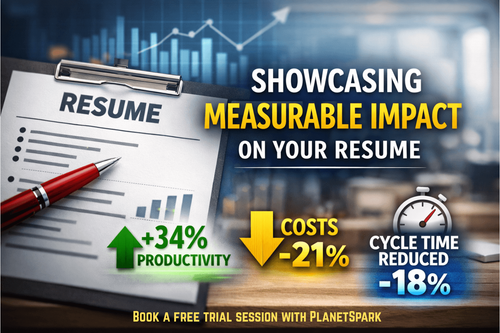
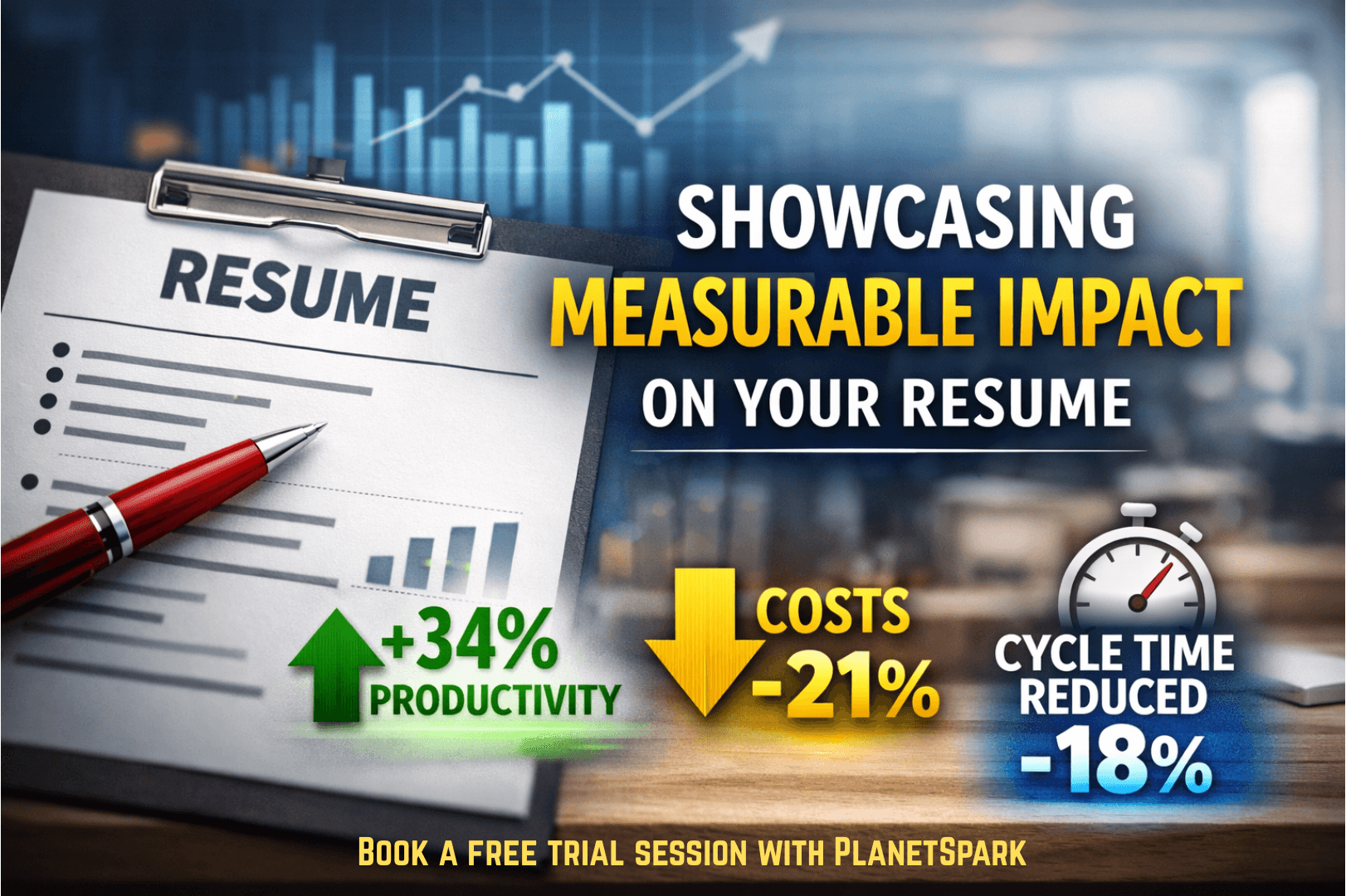
- Increased productivity by 34%
- Reduced costs by 21%
- Cut cycle time by 18%
- Improved engagement scores by 40%
The visual on page 1 highlights exactly this—with KPI improvements like productivity increase, cost reduction, and cycle time optimisation—reinforcing the importance of measurable outcomes.
Step 7: Align with Industry-Specific Metrics
Different roles require different metrics.
Examples:
Operations
- Cost savings
- Cycle time
- Throughput
Healthcare
- Patient outcomes
- Wait times
- Compliance metrics
Supply Chain
- Fill rate
- Inventory turnover
- Supplier performance
HR
- Engagement scores
- Attrition rates
- Time-to-productivity
Using the right metrics makes your resume more relevant.
Step 8: Showcase Tools and Methodologies
Highlight frameworks and tools such as:
- Lean and Six Sigma
- Root cause analysis (5-Why, Fishbone)
- Kaizen and value stream mapping
- ERP, RPA, or BI tools
This adds technical credibility to your impact.
Step 9: Structure Experience for Clarity
Each bullet point should follow:
Action → Problem → Result
This ensures your resume is easy to scan and persuasive.
Step 10: Customise for Each Role
Templates provide structure—but customisation drives success.
For each application:
- Align keywords with job description
- Highlight relevant initiatives
- Adjust metrics to match role priorities
This increases both ATS success and recruiter engagement.
Common Mistakes or Pitfalls to Avoid
- Describing responsibilities instead of outcomes
- Hiding improvement work within general experience
- Using vague or passive language
- Not including baseline context
- Failing to quantify results
- Overloading resume with tasks instead of impact
These mistakes make your resume appear generic—even when your work is not.
How Should You Use This Guidebook Effectively?
Follow this workflow:
- Identify your performance improvement scenario
- Select the relevant template
- Replace placeholders with real data and metrics
- Structure each initiative using baseline, action, and impact
- Align with job description keywords
- Review for clarity and brevity
Recommended approach:
- Spend 2–3 hours building your first version
- Refine for each job application
- Continuously update as you deliver new results
Think of your resume as a record of measurable impact—not just experience.
Key Takeaways
- Performance improvement resumes must focus on outcomes, not tasks
- The baseline–action–impact framework is essential
- Quantification is the strongest credibility driver
- Dedicated sections improve visibility of improvement work
- Strong language signals ownership and leadership
- Templates provide structure, but personalisation drives results
- Clear positioning significantly increases interview chances
Your Next Step: Accelerate Your Career with PlanetSpark
Creating an impact-driven resume is not just about landing your next job—it’s about owning your professional story and presenting it with clarity, confidence, and credibility. When your resume clearly communicates value, results, and impact, opportunities follow naturally.
At PlanetSpark, we are committed to empowering working professionals with practical, outcome-focused resources that drive real career growth. From resume building and workplace communication to leadership presence and professional writing, our programs are designed to help you succeed in today’s fast-evolving job market.
Visit https://www.planetspark.in/resources to explore:
- Career and resume-building guides
- Workplace communication and professional writing resources
- Skill-development tools curated for working professionals
Want a deeper, hands-on experience?
You can also book a free trial session to learn more about PlanetSpark’s Working Professional Courses, designed to accelerate your career through personalised coaching, real-world practice, and expert guidance.
Your career deserves more than generic advice.
It deserves clarity, confidence, and measurable impact.
Personalized Communication Roadmaps
Record a video to get a AI generated personalized communication reports