
Performance Management Resume Guide for Career Growth 2026
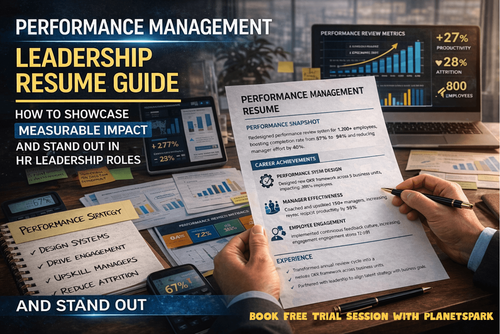

Performance Management Leadership Resume Guide: How to Showcase Measurable Impact and Stand Out in HR Leadership Roles
You may have managed performance reviews, coached managers, or designed goal-setting frameworks—but if your resume still reads like a list of HR responsibilities, your real impact is likely being ignored.
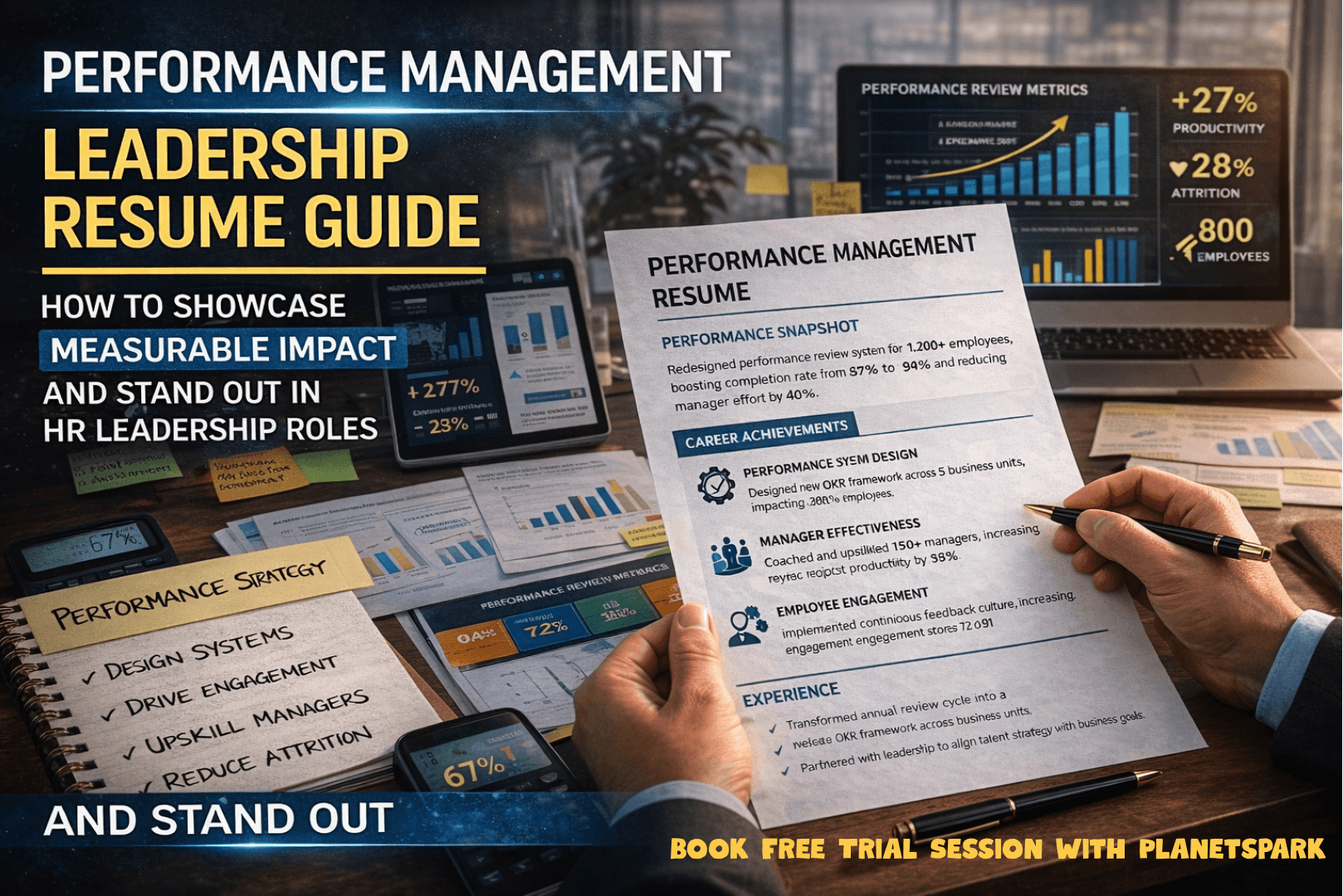
Book your free trial session today with Planetspark.
Download for more details or PDF file.
Performance management leadership is not about administration. It is about designing systems that shape organisational outcomes—driving productivity, improving engagement, and aligning talent strategy with business goals. Yet most resumes fail to communicate this level of influence.
As highlighted in the guide, hiring managers are not looking for candidates who “managed performance reviews.” They are looking for leaders who redesigned systems, improved completion rates, enhanced manager capability, and delivered measurable business outcomes.
This blog will help you transform your resume into a strategic, impact-driven document that clearly communicates your value as a performance management leader.
Who Is This Blog For?
- HR professionals transitioning into performance management roles
- Talent management and HR Business Partners aiming for specialised leadership roles
- Performance management leaders targeting Director, VP, or CPO-level positions
- HR professionals designing OKR, KPI, or appraisal frameworks
- Professionals involved in coaching, calibration, and performance transformation initiatives
Why This Topic Matters Today?
Performance management has evolved from annual appraisals to a strategic function that drives organisational success. Companies today expect performance leaders to:
- Design scalable frameworks such as OKRs and KPIs
- Improve manager effectiveness and feedback culture
- Align performance outcomes with business strategy
- Use data to drive talent decisions
The guide emphasises that performance management leaders are evaluated on measurable outcomes such as completion rates, engagement scores, and attrition reduction—not administrative efficiency.
In this environment, a generic HR resume is not enough. You must demonstrate systemic thinking, measurable impact, and leadership influence.
Core Concept or Framework Explained
The central idea of this guide is:
Performance management resumes must demonstrate system design, not process participation.
Instead of listing tasks, your resume should show:
- What performance system or framework you designed or improved
- The scale at which it operated
- The measurable outcomes it delivered
- The stakeholders you influenced
For example:
- Weak: Managed performance review cycle
- Strong: Redesigned performance review cycle for 1,200 employees, increasing completion rates from 67% to 94% and reducing manager effort by 40%
The templates are built around three core principles:
Outcome-first storytelling
Every bullet point highlights measurable results
Scale and scope visibility
Clearly define headcount, business units, or geographies impacted
Cross-functional influence
Show collaboration with leadership, finance, and business teams
How This Blog and Guidebook Help You?
This guidebook helps you reposition your HR experience into a high-impact leadership narrative by:
- Structuring your resume around measurable performance outcomes
- Highlighting system design and strategic contributions
- Aligning your profile with modern performance management expectations
- Improving your chances of shortlisting for specialised and senior roles
- Making your resume both ATS-friendly and recruiter-ready
It ensures your resume answers a critical question: How did you improve organisational performance?
Step-by-Step Breakdown
Step 1: Identify Your Performance Leadership Scenario
Start by identifying your core contribution area.
You may have worked in:
- Performance review cycles
- OKR or KPI framework design
- Manager coaching and capability building
- Compensation linked to performance
- Talent review and succession planning
This helps you select the right positioning.
Step 2: Choose the Right Scenario-Based Template
The guide includes 10 scenario-specific templates:
- First-time performance management specialist
- OKR and KPI framework designer
- Manager capability and coaching lead
- Performance-linked compensation architect
- Talent review and succession pipeline lead
- Performance tech and HRIS implementation lead
- HRBP transitioning to performance COE
- Performance management director (enterprise scale)
- Continuous performance transformation lead
- VP or Head of Performance (CPO track)
Each template aligns with a distinct career stage and role.
Step 3: Focus on System Design and Ownership
Your resume should clearly show what systems you designed or improved.
Examples include:
- Built an OKR framework across multiple business units
- Redesigned appraisal cycles
- Created performance calibration models
Ownership signals leadership.
Step 4: Quantify Every Outcome
Metrics are critical in performance management resumes.
Include:
- Headcount impacted
- Completion rates
- Engagement score improvements
- Attrition reduction
- Cycle time improvements
For example:
- Increased review completion rate from 70% to 95% across 800 employees
Step 5: Show Before-and-After Impact
Always provide context.
Explain:
- What the situation was before
- What improved after your intervention
This strengthens credibility and clarity.
Step 6: Highlight Manager and Leadership Influence
Performance management leaders influence behaviour across the organisation.
Your resume should show:
- Manager coaching programmes
- Leadership alignment
- Stakeholder collaboration
This demonstrates organisational impact.
Step 7: Demonstrate Cross-Functional Collaboration
Performance management is not limited to HR.
Highlight collaboration with:
- Finance for compensation alignment
- Legal for compliance
- Business leaders for goal alignment
This strengthens your positioning as a strategic partner.
Step 8: Use Strong Action-Oriented Language
Avoid passive phrases such as:
- Supported
- Assisted
- Coordinated
Replace them with:
- Designed
- Led
- Implemented
- Transformed
- Delivered
The guide clearly states that generic language weakens strong profiles.
Step 9: Optimise for ATS and Readability
Follow key ATS best practices:
- Use standard headings like Summary and Experience
- Mirror job description keywords
- Avoid complex formatting
- Keep resume length appropriate to experience
These steps improve visibility and ranking.
Step 10: Continuously Update Your Resume
Treat your resume as a living document.
After every major initiative:
- Add measurable outcomes
- Capture key metrics
- Update achievements
The guide recommends maintaining a “career archive” to track real impact over time.
Common Mistakes or Pitfalls to Avoid
The guide highlights several mistakes that reduce resume effectiveness:
- Using generic HR language instead of performance-specific impact
- Failing to include metrics such as percentages and headcount
- Hiding leadership scope and influence
- Treating performance management as administrative work
- Ignoring cross-functional collaboration
These mistakes can make strong candidates appear average.
How Should You Use This Guidebook Effectively?
To maximise the value of this resource:
- Select the template aligned with your target role
- Spend 1–2 focused hours inputting accurate data
- Quantify every achievement wherever possible
- Tailor your resume for each application
- Align your resume with LinkedIn and career narrative
The templates are designed for immediate use—simply customise and apply.
Key Takeaways
- Performance management resumes must highlight system design and outcomes
- Metrics such as completion rates, engagement scores, and attrition are critical
- Scenario-based templates improve clarity and positioning
- Cross-functional collaboration strengthens leadership credibility
- Strong action verbs signal ownership and impact
- Context and before-after comparisons improve clarity
- Tailored resumes outperform generic HR resumes
Your Next Step: Accelerate Your Career with PlanetSpark
Creating an impact-driven resume is not just about landing your next job—it’s about owning your professional story and presenting it with clarity, confidence, and credibility. When your resume clearly communicates value, results, and impact, opportunities follow naturally.
At PlanetSpark, we are committed to empowering working professionals with practical, outcome-focused resources that drive real career growth. From resume building and workplace communication to leadership presence and professional writing, our programs are designed to help you succeed in today’s fast-evolving job market.
Visit https://www.planetspark.in/resources to explore:
- Career and resume-building guides
- Workplace communication and professional writing resources
- Skill-development tools curated for working professionals
Want a deeper, hands-on experience?
You can also book a free trial session to learn more about PlanetSpark’s Working Professional Courses, designed to accelerate your career through personalised coaching, real-world practice, and expert guidance.
Your career deserves more than generic advice.
It deserves clarity, confidence, and measurable impact.
Personalized Communication Roadmaps
Record a video to get a AI generated personalized communication reports