
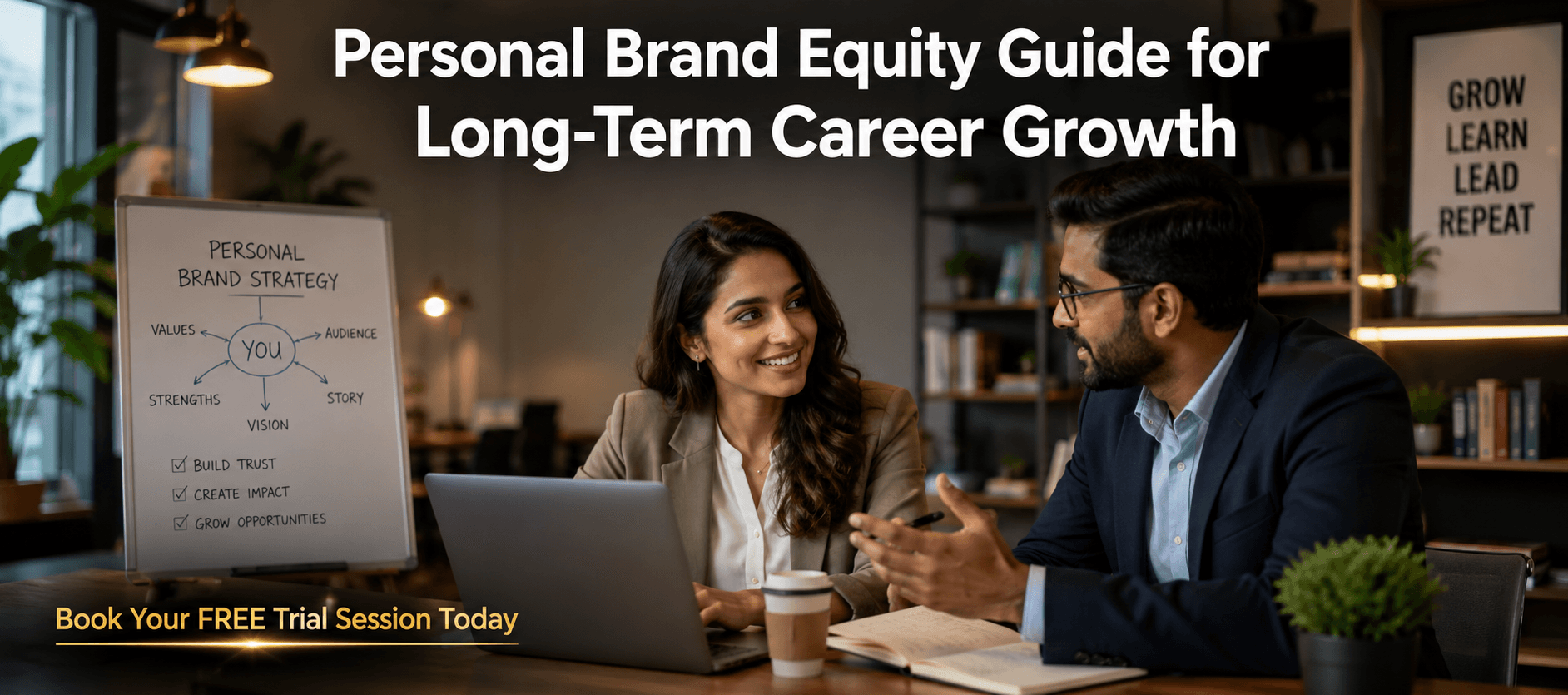
Personal Brand Equity Guide for Long-Term Career Growth


Build Brand Equity That Compounds Over Time: A Practical Guide for Professionals, Freelancers, Consultants, and Career Builders
Most professionals work hard to be seen, trusted, and remembered. They post on LinkedIn, update their profiles, attend networking events, deliver projects, collect testimonials, and try to become known for something meaningful. But after months of effort, many still face the same problem: their brand does not feel stronger. They may be more visible, but they are not necessarily more credible, more trusted, or more likely to attract better opportunities.
That is because brand equity is not built through random visibility. It is built through consistent perception, proof, trust, and relevance over time. A logo, tagline, bio, or LinkedIn banner may support your brand, but they are not your brand equity. Your brand equity is the cumulative value people associate with your name. It is what makes clients trust you before the sales call, hiring managers remember you after an interview, colleagues listen when you speak, and opportunities arrive without constant chasing.
The guidebook, How to Build Brand Equity That Compounds Over Time, gives professionals a structured way to define, grow, track, and strengthen that equity. It includes 10 practical templates covering self-audit, positioning, storytelling, content planning, feedback, visibility, milestone tracking, proposal writing, brand consistency, and annual review. Together, they form a complete system for building a professional brand that becomes more valuable with every intentional action.
Download these resources and apply them alongside your daily work for improved clarity, productivity, and professional growth. You can also book a free trial to gain expert guidance and enhance your communication, problem-solving, and decision-making skills. The materials are designed in a clear, structured format to help professionals learn efficiently and implement insights with confidence.
Who Is This Blog For?
This blog is designed for working professionals who want their reputation, credibility, and visibility to grow stronger over time. It is especially useful for:
- Consultants who want their expertise to generate trust before a client proposal
- Freelancers who want stronger positioning, referrals, and pricing power
- Managers preparing for promotion cycles, leadership visibility, or strategic influence
- Career switchers who need to reposition themselves clearly in a new industry
- Job seekers who want to stand out beyond qualifications and experience
- Executives who want their ideas to carry more weight in professional settings
- Content creators building thought leadership in a specific niche
- Professionals starting from zero and unsure how to define their brand
- Agency professionals helping clients build consistent brand equity
- Anyone who wants to move from being visible to being trusted
Why This Topic Matters Today?
In today’s professional world, talent alone does not guarantee opportunity. People choose, refer, promote, hire, and trust professionals based not only on what they can do, but on what they are known for. Your reputation travels before you enter the room.
The guidebook explains that brand equity is the difference between being chosen and being overlooked. For consultants and freelancers, it determines whether inbound leads arrive before they have to pitch. For managers and executives, it shapes whether their ideas carry weight. For career switchers and job seekers, it becomes an invisible credential that qualifications alone cannot create.
This matters because many professionals confuse visibility with credibility. They assume that posting more often, joining more platforms, or reaching more people automatically builds brand equity. But visibility without strategy creates noise. Brand equity compounds only when your audience repeatedly experiences clear positioning, consistent value, specific proof, and trustworthy communication.
The guidebook also highlights common mistakes that slow growth: treating brand equity as a one-time exercise, using inconsistent messaging across platforms, ignoring audience perception, building for breadth instead of depth, and failing to track progress. These mistakes are costly because brand-building takes time. Without structure, professionals can spend months or years creating activity without building authority.
Core Concept or Framework Explained
The core concept of the guidebook is that brand equity compounds when professionals build it through a deliberate three-phase system: foundation, acceleration, and compounding.
In the foundation phase, you define who you are, who you serve, and why your brand exists. This includes auditing your current brand equity, clarifying your positioning, and developing your signature story. The guidebook makes it clear that without a strong foundation, no amount of visibility will compound. You may attract attention, but not authority.
In the acceleration phase, you build content equity, measure perception, and activate visibility channels systematically. This is where consistency creates momentum. Instead of posting randomly or chasing trends, you create content and visibility actions that reinforce your brand pillars and audience relevance.
In the compounding phase, your brand begins to generate proof, trust, referrals, inbound opportunities, and pricing power. You track milestones, lead with brand credibility in proposals, maintain consistency through a style guide, and review year-over-year progress. The guidebook defines the first sign of compounding as the point when visibility activities start generating inbound opportunities rather than requiring constant outbound effort.
This framework is supported by five key principles:
- Depth before breadth
- Consistency over intensity
- Evidence over claims
- Perception is the product
- More opportunities with less effort is the real compounding test
How This Blog and Guidebook Help You?
This blog helps you understand how to use the guidebook as a practical brand-building system. Instead of treating brand equity as an abstract idea, it breaks the process into clear actions, templates, and review habits.
By applying the guidebook, you can:
- Understand your current brand equity before investing more effort
- Define a clear professional positioning statement
- Build a signature story that communicates differentiation
- Plan content that builds authority instead of short-term engagement
- Collect perception feedback from people who matter
- Create a visibility plan tied to professional outcomes
- Track milestones that prove your brand is gaining value
- Write proposals that lead with credibility and trust signals
- Maintain consistency across LinkedIn, email, proposals, bios, and presentations
- Review your brand annually and set compounding targets for the next year
The guidebook is especially valuable because it does not ask you to build a louder brand. It helps you build a clearer, more trusted, more consistent, and more valuable one.
Step-by-Step Breakdown
Step 1: Start with the Brand Equity Self-Audit Scorecard
The Brand Equity Self-Audit Scorecard is the recommended starting point for every professional. It gives you an honest baseline before you begin any brand-building strategy.
The audit measures four areas: professional identity, audience awareness, visibility and presence, and social proof. Each area is scored from 1 to 10, creating a total score out of 40.
A score between 0 and 15 places you in the foundation stage, where you should focus on positioning and storytelling. A score between 16 and 28 places you in the growth stage, where content and visibility become priorities. A score between 29 and 40 places you in the compounding stage, where milestone tracking and annual review become more important.
This audit prevents a common mistake: investing in visibility before you know what you want to be known for. If your audience is unclear, your message is vague, or your proof is weak, more visibility may simply amplify confusion.
Step 2: Define Your Identity with the Personal Brand Positioning Canvas
Once you understand your baseline, the next step is positioning. The Personal Brand Positioning Canvas helps you define who you are, who you serve, and what you do differently.
The template asks for your professional title, industry or niche, primary audience, secondary audience, audience frustration, unique approach, proof of differentiation, and three brand pillars. These details are then used to create a one-line positioning statement.
The formula is simple: I help a specific audience achieve a specific outcome through a unique method, unlike a common alternative.
This is powerful because it forces clarity. Many professionals describe themselves through job titles, but job titles rarely communicate value. A strong positioning statement tells people what problem you solve, who you solve it for, and why your approach is different.
Step 3: Build Emotional Connection with the Signature Story Framework
Brand equity is not only built through expertise. It is also built through connection. The Signature Story Framework helps professionals explain why their brand exists and what experience shaped their point of view.
The framework has four parts: the before, the turning point, the method, and the now.
The before describes your professional context before the defining moment. The turning point captures the challenge, failure, insight, or decision that changed your perspective. The method explains what you built or learned as a result. The now connects that journey to how you serve your audience today.
This is not a full biography. It is a strategic narrative that communicates differentiation and credibility. The guidebook recommends creating a 30-second verbal version that can be used in introductions, proposals, LinkedIn summaries, speaking engagements, and client conversations.
Step 4: Build Authority with the Content Equity Planner
The Content Equity Planner helps professionals design content that builds long-term trust and authority. It is different from a normal content calendar because it focuses on strategic value, not just posting frequency.
The template asks you to define your primary content channel, publishing goal, core brand pillar for the quarter, target audience segment, and the audience’s most urgent question. Then it helps you plan content themes, specific angles, formats, and brand equity goals across three months.
For example, a consultant may choose brand positioning as a quarterly pillar and publish content around why professionals confuse visibility with credibility. The goal is not just engagement. The goal is to establish a point of view.
The planner also includes content equity metrics such as profile views, newsletter subscribers, inbound direct messages, organic shares, speaking invitations, and unsolicited referrals. These signals show whether content is building equity, not just attention.
Step 5: Measure Reality with the Brand Perception Feedback Tracker
Your brand is not only what you say about yourself. It is what others say, remember, repeat, and refer you for. The Brand Perception Feedback Tracker helps you move from assumption to data.
The template guides you to collect feedback from clients, colleagues, managers, peers, collaborators, or hiring managers. It asks structured questions such as:
- In 3 words, how would you describe my professional brand?
- What is my most distinctive professional strength?
- What type of opportunity or project do you associate me with?
- Is there something people misunderstand about what I do?
- Would you refer me to someone in your network, and for what specifically?
The goal is to compare intended brand with perceived brand. If you want to be known as a strategic advisor but people describe you only as a reliable executor, that gap must be addressed through messaging, content, case studies, and social proof.
Step 6: Increase Reach with the Strategic Visibility Action Plan
Visibility is useful only when it is intentional. The Strategic Visibility Action Plan helps you map high-impact activities across the channels that matter most to your target audience.
The template begins with a visibility goal statement: by a target date, you want to be known for a specific expertise by a specific audience, so that a specific professional outcome becomes possible.
Then it maps actions across channels such as LinkedIn, newsletter, speaking, network, and social proof. Each action includes frequency, equity goal, owner, and deadline.
The visual framework in the guidebook groups brand equity visibility into areas such as thought leadership, speaking events, network activation, social proof, and digital presence. This reinforces an important point: brand equity is not built in one channel only. It grows when multiple touchpoints communicate the same positioning with consistency.
Step 7: Track Proof with the Brand Equity Milestone Tracker
Brand equity can feel invisible until you document it. The Brand Equity Milestone Tracker becomes your evidence repository.
It helps you record speaking invitations, unsolicited referrals, media requests, testimonials, public acknowledgements, awards, features, inbound leads, and other signs that your brand is creating value.
The template tracks milestones by quarter, type, description, brand equity signal, and date. It also includes categories such as inbound opportunities and recognition signals.
At the end of the year, you can calculate your annual brand equity score by reviewing total milestones, inbound-to-outbound ratio, biggest brand equity win, and evidence of year-over-year compounding.
This matters because documented proof gives you confidence, credibility, and material for proposals, performance reviews, bios, portfolios, and case studies.
Step 8: Lead with Trust Using the Client Trust-Building Proposal Template
For freelancers and consultants, proposals often jump too quickly into scope and pricing. The Client Trust-Building Proposal Template changes the order. It leads with brand credibility before deliverables and fees.
The structure includes brand introduction, why you understand the client’s problem, relevant track record, proposed approach, investment summary, and trust signals appendix.
This helps your brand equity do the heavy lifting. Instead of competing only on cost, you show why your perspective, experience, method, and proof reduce risk for the client.
The guidebook recommends including testimonials, case studies, media mentions, portfolio links, and specific outcomes. This is especially useful when competing against lower-cost alternatives who cannot match your credibility depth.
Step 9: Maintain Trust with the Personal Brand Consistency Style Guide
Consistency is one of the most underrated drivers of brand equity. When people experience the same voice, positioning, tone, and visual identity across every touchpoint, trust builds faster.
The Personal Brand Consistency Style Guide acts as an operating manual for your professional brand. It documents your full professional name, preferred title, tagline, brand voice, writing tone, speaking tone, colours, fonts, language standards, and platform-specific rules.
It also includes an always say and never say section. This helps you avoid weak, vague, or inconsistent phrases and replace them with language that reinforces your positioning.
The guidebook recommends auditing active platforms every 6 months, including LinkedIn, email signature, website bio, and proposal headers. Inconsistency creates confusion, and confusion weakens compounding.
Step 10: Review Progress with the Annual Brand Equity Review and Compounding Report
The Annual Brand Equity Review and Compounding Report helps professionals measure whether their brand is becoming more valuable over time.
The template tracks content pieces published, inbound opportunities, testimonials collected, speaking or media appearances, LinkedIn growth, newsletter growth, inbound leads per quarter, engagement, referrals, and speaking invitations.
It also asks deeper strategic questions:
- Which brand activity generated the highest return this year?
- Which activity required the most effort for the least return?
- When did inbound opportunities begin arriving without outbound effort?
- Is the brand producing more opportunities with less effort?
- What are the compounding targets for the next 12 months?
The guidebook ends this review with a commitment: to treat your brand as a long-term asset, prioritising depth over breadth, evidence over assumptions, and consistency over intensity.
Common Mistakes or Pitfalls to Avoid
The guidebook highlights several mistakes that prevent brand equity from compounding:
- Treating brand equity as a one-time exercise instead of a long-term asset
- Confusing visibility with credibility
- Creating inconsistent messaging across platforms
- Ignoring audience perception data
- Building for breadth instead of depth
- Failing to document testimonials, milestones, and recognition signals
- Making generic claims without evidence
- Posting intensely for a short period and then disappearing
- Trying to be known for too many topics at once
- Completing templates once and never reviewing them again
The better approach is to build patiently and deliberately. Choose a niche, define your audience, collect proof, communicate consistently, track milestones, and review progress quarterly.
How Should You Use This Guidebook Effectively?
Start with Template 1, the Brand Equity Self-Audit Scorecard. The guidebook notes that this takes approximately 20 minutes and can save months of unfocused effort by showing your biggest equity gaps.
Then choose your next templates based on your current situation:
- Starting from zero: use Templates 1, 2, and 3
- Switching careers or industries: use Templates 2, 3, and 9
- Building but feeling stuck: use Templates 1, 5, and 10
- Trying to win a client this month: use Templates 3, 8, and 6
- Building thought leadership: use Templates 4, 6, and 7
- Reviewing the year and planning ahead: use Templates 7, 10, and 5
Review foundational templates annually and tracking templates quarterly. Update your positioning as your work evolves, but avoid changing it so often that your audience never develops a stable association with your name.
Most importantly, replace every placeholder with specific, real-world details. Generic input produces generic output, and generic output does not build brand equity.
Key Takeaways
- Brand equity is the cumulative perception, trust, and credibility attached to your name over time.
- Visibility is not the same as credibility. Attention only compounds when it is supported by positioning and proof.
- The guidebook’s three-phase framework is foundation, acceleration, and compounding.
- Start with a self-audit before investing in visibility.
- A clear positioning statement helps people understand who you serve and what value you create.
- A signature story builds emotional connection and explains why your professional brand exists.
- Content equity comes from strategic thought leadership, not random posting.
- Perception feedback helps close the gap between how you want to be known and how others actually describe you.
- Strategic visibility should be tied to specific audiences, channels, and professional outcomes.
- Milestone tracking turns invisible brand growth into documented proof.
- Proposals become stronger when they lead with trust signals before pricing.
- Consistency across platforms strengthens recall, trust, and referrals.
- Annual reviews help you measure whether your brand is generating more opportunities with less effort.
- Brand equity compounds through depth, consistency, evidence, perception alignment, and long-term discipline.
Your Next Step: Accelerate Your Career with PlanetSpark
Creating an impact-driven resume is not just about landing your next job—it’s about owning your professional story and presenting it with clarity, confidence, and credibility. When your resume clearly communicates value, results, and impact, opportunities follow naturally.
At PlanetSpark, we are committed to empowering working professionals with practical, outcome-focused resources that drive real career growth. From resume building and workplace communication to leadership presence and professional writing, our programs are designed to help you succeed in today’s fast-evolving job market.
Visit https://www.planetspark.in/resources to explore:
- Career and resume-building guides
- Workplace communication and professional writing resources
- Skill-development tools curated for working professionals
Want a deeper, hands-on experience?
You can also book a free trial session to learn more about PlanetSpark’s Working Professional Courses, designed to accelerate your career through personalised coaching, real-world practice, and expert guidance.
Your career deserves more than generic advice.
It deserves clarity, confidence, and measurable impact.
Personalized Communication Roadmaps
Record a video to get a AI generated personalized communication reports