
Personal SWOT Analysis Guide for Career Growth in 2026
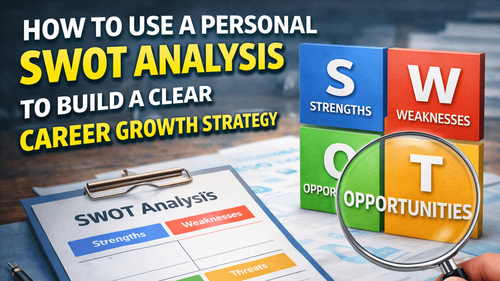

How to Use a Personal SWOT Analysis to Build a Clear Career Growth Strategy
Most professionals move through their careers reacting to opportunities instead of intentionally shaping them. You take on projects, accept roles, and follow paths that seem logical at the time—but without a clear understanding of your strengths, gaps, and market positioning, progress often feels slow or directionless.
This is where a Personal SWOT Analysis becomes a game-changing tool. Originally designed for business strategy, this framework helps you evaluate your career through four powerful lenses—Strengths, Weaknesses, Opportunities, and Threats.
The Personal SWOT Analysis Worksheet by PlanetSpark transforms this concept into a practical, structured system that helps working professionals gain clarity, build strategy, and take focused action.
Who Is This Blog For?
- Working professionals planning their next career move
- Job seekers preparing for interviews or role transitions
- Mid-career professionals aiming for promotions
- Career switchers exploring new industries or domains
- Consultants and freelancers building a personal brand
- Professionals feeling stuck or lacking direction
Why This Topic Matters Today?
Today’s job market is fast-moving, competitive, and constantly evolving. Skills become obsolete faster, industries shift rapidly, and new roles emerge almost overnight.
Yet most professionals struggle with:
- Inability to clearly articulate their strengths in interviews
- Lack of awareness about skill gaps
- Missing out on emerging opportunities
- Being unprepared for industry disruptions
The worksheet highlights a critical truth: most professionals do not have a structured understanding of where they stand. They rely on intuition instead of strategy, which leads to missed opportunities and reactive decision-making.
A Personal SWOT Analysis changes this by forcing clarity, honesty, and strategic thinking.
Core Concept or Framework Explained
The Personal SWOT Analysis framework is built around four quadrants that together create a complete picture of your professional reality.
Strengths
These are internal capabilities—skills, experiences, and advantages you control. They include technical skills, communication ability, reputation, and networks.
Weaknesses
These are internal gaps that limit your growth. They may be skill gaps, behavioural patterns, or lack of visibility.
Opportunities
These are external factors that can accelerate your career. They include industry trends, new roles, emerging skills, and relationships you can leverage.
Threats
These are external risks that could slow or derail your progress—automation, competition, industry changes, or burnout.
The real power of SWOT lies in the intersections:
- Strengths combined with Opportunities create growth strategies
- Weaknesses combined with Threats highlight risk areas
This turns a simple reflection exercise into a strategic career planning tool.
How This Blog and Guidebook Help You?
By using this framework, you move from vague self-awareness to structured clarity.
You will be able to:
- Clearly define your professional strengths with evidence
- Identify and prioritise skill gaps that matter
- Spot high-impact career opportunities
- Anticipate risks before they become problems
- Build a practical, time-bound action plan
Most importantly, you gain the ability to articulate your value confidently—in interviews, performance reviews, and career conversations.
Step-by-Step Breakdown
Mapping Your Strengths With Evidence
The worksheet emphasises that strengths are not personality traits—they are proven capabilities backed by evidence.
Instead of saying “I am a good communicator,” you identify specific examples such as leading presentations or influencing decisions.
A powerful method suggested is using Peak Performance Moments:
- Recall key achievements
- Extract the underlying skill
- Validate it with evidence
This approach ensures your strengths are actionable and credible.
Confronting Your Weaknesses Without Shame
Weaknesses are not flaws—they are gaps that can be addressed.
The worksheet categorises weaknesses into four types:
- Technical gaps such as missing hard skills
- Behavioural gaps such as poor delegation
- Knowledge gaps such as lack of domain understanding
- Visibility gaps such as being skilled but unnoticed
This categorisation helps you move from vague self-criticism to targeted improvement.
Scanning for Opportunities Like a Strategist
Most professionals focus only on their current role, missing larger industry signals.
The worksheet introduces five lenses for identifying opportunities:
- Industry trends
- Organisational changes
- Emerging skills
- Relationship capital
- Platform leverage
It also encourages thinking in timeframes:
- Immediate opportunities
- Medium-term positioning
- Long-term strategic moves
This ensures you are not just reacting—but planning ahead.
Identifying Threats Before They Identify You
Threats are external forces that can impact your career if ignored.
Key categories include:
- Technological disruption such as AI and automation
- Industry contraction
- Credential inflation
- Burnout and sustainability risks
The worksheet recommends rating threats by likelihood and impact to prioritise action.
This transforms fear into preparation.
Bringing It All Together With the SWOT Grid
Once all four quadrants are complete, the next step is synthesis.
You select your top 3–5 insights per quadrant and map connections between them.
This leads to two critical strategies:
- Growth strategies where strengths meet opportunities
- Risk strategies where weaknesses meet threats
This is where real career strategy begins.
Real-World Application Example
The worksheet includes a case study of Priya, a marketing manager transitioning into product management.
Her SWOT revealed:
- Strong analytical and communication strengths
- Gaps in product management experience
- Opportunities within her organisation
- Threats from experienced external candidates
By acting on these insights, she:
- Enrolled in a certification
- Took ownership of a product-related project
- Increased visibility with leadership
Within four months, she transitioned into the product team.
This example shows that SWOT does not create opportunities—it helps you see and act on them effectively.
Building a 30-60-90 Day Action Plan
A SWOT is only useful if it leads to action.
The worksheet introduces a structured planning approach:
30 Days
- Address one key weakness
- Take one immediate opportunity
- Initiate a strategic conversation
60 Days
- Build visible proof such as a project or certification
- Expand your network
- Demonstrate progress
90 Days
- Review and update your SWOT
- Measure progress
- Plan the next cycle
This ensures continuous growth rather than one-time reflection.
Common Mistakes or Pitfalls to Avoid
Being Too Vague
Generic statements like “good leadership” lack actionability.
Solution: Add context, examples, and outcomes.
Confusing Internal and External Factors
Mixing strengths with opportunities leads to poor strategy.
Solution: Clearly separate what you control vs what you do not.
Doing It Once and Forgetting It
Careers evolve, and so should your SWOT.
Solution: Revisit every 90 days.
Skipping the Action Step
Insight without execution creates no impact.
Solution: Always define at least one next action.
How Should You Use This Guidebook Effectively?
To get maximum value from the worksheet:
- Read each section fully before filling it
- Be brutally honest in your responses
- Aim for 3–5 high-quality entries per quadrant
- Focus on evidence, not assumptions
- Revisit the worksheet quarterly
- Share your SWOT with a mentor for feedback
Time Investment
- Initial completion: 60–90 minutes
- Quarterly review: 30–45 minutes
Suggested Workflow
- Complete one quadrant at a time
- Take breaks to reflect deeply
- Build your action plan immediately after
This ensures the exercise leads to real change, not just reflection.
Key Takeaways
- A clear career strategy starts with self-awareness
- Strengths must be evidence-based to be useful
- Weaknesses should be categorised and prioritised
- Opportunities require strategic scanning, not luck
- Threats must be anticipated and planned for
- The power of SWOT lies in connecting the quadrants
- Action is more important than analysis
- Revisit your SWOT every 90 days for continuous growth
Your Next Step: Accelerate Your Career with PlanetSpark
Creating an impact-driven resume is not just about landing your next job—it’s about owning your professional story and presenting it with clarity, confidence, and credibility. When your resume clearly communicates value, results, and impact, opportunities follow naturally.
At PlanetSpark, we are committed to empowering working professionals with practical, outcome-focused resources that drive real career growth. From resume building and workplace communication to leadership presence and professional writing, our programs are designed to help you succeed in today’s fast-evolving job market.
Visit https://www.planetspark.in/resources to explore:
- Career and resume-building guides
- Workplace communication and professional writing resources
- Skill-development tools curated for working professionals
Want a deeper, hands-on experience?
You can also book a free trial session to learn more about PlanetSpark’s Working Professional Courses, designed to accelerate your career through personalised coaching, real-world practice, and expert guidance.
Your career deserves more than generic advice.
It deserves clarity, confidence, and measurable impact.
Personalized Communication Roadmaps
Record a video to get a AI generated personalized communication reports