
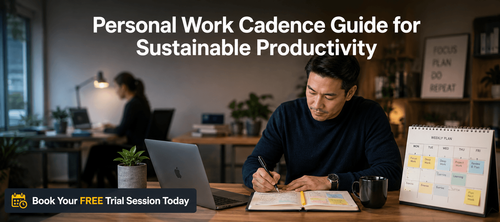
Personal Work Cadence Guide for Sustainable Productivity

Designing a Personal Work Cadence for Sustainable Output: A Practical Guide for Working Professionals
Most working professionals do not struggle because they lack skill, ambition, or discipline. They struggle because their work rhythm is broken. Back-to-back meetings, urgent messages, scattered tasks, and late-night catch-ups can make even talented professionals feel busy but unproductive.
The real problem is often not time management. It is cadence. A personal work cadence helps you decide when to do deep work, when to collaborate, when to recover, and how to protect your energy before burnout starts. This guidebook helps professionals design a work rhythm that supports sustainable output without relying on constant pressure.
Download these resources and apply them alongside your daily work for improved clarity, productivity, and professional growth. You can also book a free trial to gain expert guidance and enhance your communication, problem-solving, and decision-making skills. The materials are designed in a clear, structured format to help professionals learn efficiently and implement insights with confidence.
Who Is This Blog For?
This blog is useful for:
- Career changers who want to build a more stable professional routine
- Early and mid-career professionals managing growing responsibilities
- Consultants handling multiple clients, deadlines, and communication demands
- Managers who need to balance team meetings with strategic thinking
- Professionals who feel busy all day but struggle to complete high-value work
Why This Topic Matters Today?
Modern work often rewards fast responses more than meaningful output. Professionals are expected to attend meetings, answer messages, manage projects, think strategically, and stay available almost all the time.
The guidebook explains that many people do not have a productivity problem. They have a rhythm problem. Without a deliberate cadence, the day gets shaped by urgency instead of importance.
This leads to common challenges such as:
- Constant busyness with low-quality output
- Mid-week energy crashes
- Reactive work replacing proactive goals
- Difficulty protecting deep work
- Weak separation between work sprints and recovery
A personal work cadence helps professionals work smarter, not harder.
Core Concept or Framework Explained
A work cadence is a personal operating rhythm. It helps you organise tasks, attention, and energy across days, weeks, and months.
The guidebook explains that cadence is not a rigid schedule. It is a flexible system that aligns your energy, responsibilities, and goals. Instead of treating every hour as equal, it helps you match the right work to the right energy state.
The core framework includes:
- Auditing your current work rhythm
- Understanding your energy architecture
- Designing a weekly cadence blueprint
- Building daily work rituals
- Protecting deep work and recovery
- Reviewing and improving your cadence every quarter
The goal is not to work more hours. The goal is to design better conditions for your best work.
How This Blog and Guidebook Help You?
This blog and guidebook help you move from default working to designed working.
You will learn how to:
- Identify where your time and energy are going
- Protect your most focused hours for high-value work
- Reduce task-switching and reactive work
- Create daily rituals for better focus and recovery
- Build a weekly rhythm that supports both productivity and rest
- Review your cadence as your role and priorities change
For working professionals, this can improve clarity, decision-making, communication, and long-term performance.
Step-by-Step Breakdown
Step 1: Audit Your Current Cadence
Before improving your rhythm, you need to understand it.
The guidebook recommends tracking your work for five days in 30-minute blocks. For each block, record:
- What task you worked on
- Your energy level: high, medium, or low
- Whether the task was reactive or intentional
- Whether the output was high, medium, or low value
At the end of five days, review how much time was spent on intentional, high-value work. Many professionals discover that even in an 8 to 10 hour workday, fewer than two hours are spent on meaningful, focused work.
Step 2: Understand Your Energy Architecture
Your brain is not designed for constant output. The guidebook highlights that attention often works in roughly 90-minute focus cycles followed by natural dips.
Sustainable output depends on three energy dimensions:
Mental energy: Used for thinking, decision-making, problem-solving, and creative work.
Emotional energy: Used for collaboration, communication, conflict handling, and people management.
Physical energy: Built through sleep, movement, nutrition, and recovery.
The key is to place demanding work during your peak energy time instead of wasting your sharpest hours on email or admin.
Step 3: Design Your Weekly Cadence Blueprint
Once you understand your energy patterns, create a weekly structure.
The guidebook suggests this sample cadence:
Monday: Orientation day for planning, priorities, and alignment.
Tuesday and Wednesday: Deep work core for high-cognitive-demand tasks.
Thursday: Collaboration zone for meetings, reviews, check-ins, and stakeholder work.
Friday: Consolidation day for wrap-up, admin, review, and planning the next week.
This weekly blueprint should remain flexible. It is a default structure, not a strict law.
Step 4: Build Your Daily Rhythm Rituals
Daily rituals make your cadence easier to follow because they reduce decision fatigue.
The guidebook recommends four simple rituals:
Morning start ritual: Spend 15 to 20 minutes reviewing your top three priorities, checking your calendar, and choosing one Most Important Task.
Mid-day reset: Step away from your screen, move briefly, and check if your priorities still make sense.
Transition ritual: Use a short reset between deep work and meetings so your attention does not carry residue from one task into another.
Shutdown ritual: End the workday by reviewing completed work, moving unfinished tasks, noting one win, and closing the day consciously.
These rituals help create boundaries between focus, collaboration, and recovery.
Step 5: Protect Deep Work and Recovery
The guidebook explains that sustainable output depends on two neglected practices: deep work and recovery.
Deep work means distraction-free work that creates real value. It needs at least 90 uninterrupted minutes to reach productive flow.
To protect deep work:
- Block it visibly on your calendar
- Mark it as busy or focus time
- Communicate your focus hours to your team
- Turn off notifications
- Keep only required tabs and tools open
- Use a timer for the session
Recovery is equally important. It should be planned, not left to chance.
The guidebook explains three recovery levels:
- Micro-recovery: 5 to 10 minute breaks every 90 minutes
- Daily recovery: A fixed work stop time and shutdown ritual
- Weekly recovery: At least one full day without work tasks
Recovery is not a reward. It is a requirement for consistent performance.
Real-World Example: Priya’s Cadence Transformation
The guidebook shares the example of Priya, a 31-year-old product manager in Bengaluru. She was managing a growing team, attending stakeholder calls, handling Slack notifications, and trying to contribute to strategy. Even after working 10 to 11 hour days, she felt behind and creatively drained.
Before redesigning her cadence, Priya had no protected deep work, meetings spread across the day, email first thing in the morning, no shutdown ritual, and no weekly planning block.
After redesigning her cadence, she added Tuesday and Wednesday morning deep work, batched meetings on Thursday, used a morning MIT ritual, shut down work at 6:30 PM, and planned her week every Monday.
Within three weeks, she produced one of her best strategy documents in years, during focused morning hours instead of late at night.
Common Mistakes or Pitfalls to Avoid
Mistake 1: Designing the perfect cadence but never starting
Better approach: Start with one change, such as adding a Monday planning block.
Mistake 2: Making the cadence too rigid
Better approach: Treat your cadence as a default template and keep 20 percent buffer time.
Mistake 3: Skipping recovery because there is too much to do
Better approach: Build recovery into your day before depletion compounds.
Mistake 4: Never reviewing the cadence
Better approach: Schedule a 30-minute quarterly cadence review.
Mistake 5: Using peak energy for low-value work
Better approach: Save your sharpest hours for deep work, strategy, writing, or analysis.
How Should You Use This Guidebook Effectively?
Use the guidebook as a practical planner, not just reading material.
Start with the 5-day energy audit. Track your real work pattern honestly. Then use the worksheet to define your peak energy time, natural dip time, main energy depleter, recovery activity, weekly deep work blocks, and shutdown time.
A simple workflow could be:
- Day 1 to 5: Complete the energy audit
- Day 6: Identify your peak energy and biggest work drains
- Day 7: Block one 90-minute deep work session
- Week 2: Add a morning ritual and shutdown ritual
- Month 1: Build your weekly cadence blueprint
- Every quarter: Review and update your cadence
The guidebook works best when you implement one change at a time.
Key Takeaways
- Sustainable output comes from better work architecture, not longer hours
- A 5-day audit helps reveal where your time and energy really go
- Peak energy should be reserved for high-value work
- Weekly cadence helps separate planning, deep work, collaboration, and review
- Daily rituals reduce decision fatigue and improve focus
- Deep work needs visible calendar protection
- Recovery must be planned at micro, daily, and weekly levels
- Your cadence should be reviewed every quarter
- Start with one small change and build from there
Your Next Step: Accelerate Your Career with PlanetSpark
Creating an impact-driven resume is not just about landing your next job—it’s about owning your professional story and presenting it with clarity, confidence, and credibility. When your resume clearly communicates value, results, and impact, opportunities follow naturally.
At PlanetSpark, we are committed to empowering working professionals with practical, outcome-focused resources that drive real career growth. From resume building and workplace communication to leadership presence and professional writing, our programs are designed to help you succeed in today’s fast-evolving job market.
Visit https://www.planetspark.in/resources to explore:
- Career and resume-building guides
- Workplace communication and professional writing resources
- Skill-development tools curated for working professionals
Want a deeper, hands-on experience?
You can also book a free trial session to learn more about PlanetSpark’s Working Professional Courses, designed to accelerate your career through personalised coaching, real-world practice, and expert guidance.
Your career deserves more than generic advice.
It deserves clarity, confidence, and measurable impact.
Personalized Communication Roadmaps
Record a video to get a AI generated personalized communication reports