
Plan Your Global Skill Growth Strategy


Crafting a Personal Global Skill Development Plan: A Practical Roadmap for Career Growth and Global Opportunities
The modern workplace is evolving faster than ever before. Professionals who once relied on experience alone are now expected to adapt to rapid technological change, communicate across cultures, work with global teams, and continuously upgrade their capabilities. Whether you work in technology, marketing, finance, consulting, healthcare, or creative industries, the expectations have shifted dramatically.
Today, employers are no longer hiring only for technical expertise. They are hiring professionals who demonstrate global readiness, adaptability, communication skills, leadership potential, and digital fluency. Yet many working professionals still approach learning in a reactive way. They complete random online courses, attend occasional workshops, or rely entirely on company-provided training programs without a structured long-term strategy.
The result is often frustrating:
- Learning without measurable career progress
- Skill development without direction
- Inconsistent growth habits
- Difficulty competing in an increasingly global market
- Lack of confidence in high-visibility opportunities
This is where a Personal Global Skill Development Plan becomes essential. A structured skill development plan helps professionals identify where they currently stand, define where they want to go, and create a practical roadmap to bridge the gap strategically over the next 12–24 months.
Instead of treating learning as a collection of disconnected activities, this framework turns development into a focused, measurable, and career-oriented process. It helps professionals build globally transferable skills, create consistent learning systems, and align personal growth with real-world career opportunities.
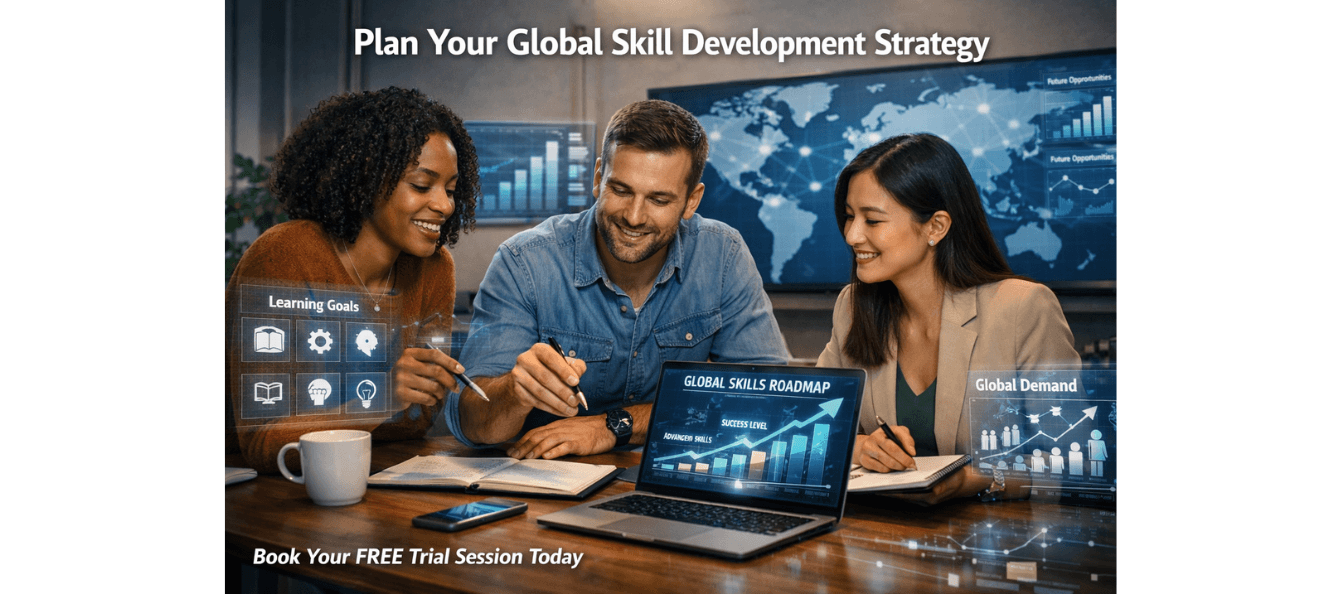
Download these resources and apply them alongside your daily work for improved clarity, productivity, and professional growth. You can also book a free trial to gain expert guidance and enhance your communication, problem-solving, and decision-making skills. The materials are designed in a clear, structured format to help professionals learn efficiently and implement insights with confidence.
Who Is This Blog For?
This blog is designed for professionals who want to grow intentionally instead of relying on chance career progression.
It is especially valuable for:
- Mid-career professionals seeking global career opportunities
- Managers preparing for leadership roles
- Professionals working with international clients or teams
- Employees planning career transitions into future-ready industries
- Individuals who feel stuck despite years of experience
- Professionals looking to improve communication, leadership, and executive presence
- Job seekers wanting globally competitive skills
- Remote workers navigating cross-cultural collaboration
- Professionals preparing for promotions or international opportunities
- Lifelong learners who want a structured development framework
Why This Topic Matters Today?
The global job market has fundamentally changed. Employers increasingly prioritise professionals who can adapt, communicate effectively, and contribute across diverse business environments.
Several major shifts are driving this transformation:
- AI and automation are changing traditional job requirements
- Remote and hybrid work models require stronger communication skills
- Cross-border collaboration has become common across industries
- Employers value adaptability and continuous learning more than static qualifications
- Competition is no longer local; professionals compete globally
One of the biggest challenges professionals face today is unstructured learning. Many people consume endless content without clear direction or measurable outcomes. This creates a scattered skill portfolio that does not translate into stronger positioning, promotions, or better opportunities.
Another major issue is inconsistent learning habits. Professionals often begin courses enthusiastically but struggle to maintain momentum because they lack accountability systems and measurable milestones.
The guidebook addresses these issues directly by helping professionals:
- Conduct an honest skill audit
- Identify globally valuable competencies
- Prioritise high-impact skill gaps
- Create a realistic 12-month roadmap
- Build sustainable learning systems
- Measure progress consistently
In an economy where change is constant, professionals who learn strategically gain a significant competitive advantage.
Core Concept or Framework Explained
The foundation of this framework is the Personal Global Skill Development Plan (PGSDP). This is not simply a learning checklist. It is a structured career growth system designed to help professionals align learning with long-term career goals.
The framework revolves around five major stages:
- Auditing current skills
- Defining a career North Star
- Mapping skill gaps
- Building a learning roadmap
- Tracking progress through accountability systems
The first principle of the framework is self-awareness. Most professionals either underestimate their strengths or overestimate their weaknesses. Without an accurate understanding of current capabilities, development efforts become inefficient.
The framework categorises skills into four core areas:
- Technical and functional skills
- Global communication skills
- Leadership and influence skills
- Future-ready adaptive skills
This approach ensures professionals develop balanced, globally relevant capabilities rather than focusing narrowly on technical expertise alone.
The second major concept is the “North Star.” Instead of vague ambitions, professionals define a precise 12–24 month career destination. This includes:
- Target role
- Industry
- Geography
- Level of responsibility
- Type of organisation
- Critical skills required
For example, the guidebook shares a sample North Star statement focused on becoming a Senior Product Manager at a global SaaS company while developing expertise in AI-assisted product strategy, stakeholder communication, and agile delivery.
The third key concept is the Global Skills Gap Map. This comparison framework helps professionals identify the exact gap between their current skill levels and the requirements of their target role.
This structured analysis prevents random learning and creates strategic prioritisation.
How This Blog and Guidebook Help You?
This framework helps professionals move from reactive learning to intentional career growth.
By following the process outlined in the guidebook, professionals can:
- Gain clarity about their career direction
- Identify high-impact skills that matter globally
- Avoid wasting time on low-value learning activities
- Build consistent learning habits
- Improve workplace performance through practical application
- Strengthen leadership and communication abilities
- Increase visibility in professional networks
- Position themselves for promotions and global opportunities
One of the most valuable aspects of this framework is that it focuses on realistic implementation. Instead of expecting professionals to completely redesign their lives, the system integrates learning into existing schedules through manageable weekly routines.
The framework also emphasises visible growth. In today’s market, skills alone are often not enough. Professionals must demonstrate and communicate their capabilities through projects, presentations, networking, and thought leadership.
Step-by-Step Breakdown
Step 1: Audit Your Current Skill Landscape
Every effective development plan begins with an honest assessment.
The framework recommends evaluating skills across four major categories:
Technical and Functional Skills
These include role-specific capabilities such as:
- Programming
- Financial modelling
- Project management
- UX research
- Analytics
- Certifications
Global Communication Skills
These skills determine how effectively professionals operate across diverse teams and cultures. This includes:
- Professional communication
- Presentation skills
- Negotiation
- Cross-cultural collaboration
- Influence
Leadership and Influence Skills
Modern organisations increasingly require professionals who can lead without formal authority. Important skills include:
- Conflict resolution
- Delegation
- Stakeholder management
- Executive presence
Future-Ready Adaptive Skills
These skills prepare professionals for changing business environments:
- AI literacy
- Data-driven decision-making
- Design thinking
- Agility
- Self-directed learning
The guidebook recommends rating each skill from 1–5 and identifying which improvements would create the greatest impact over the next year.
Step 2: Define Your Global Career North Star
Without a clear destination, learning becomes unfocused.
The North Star framework encourages professionals to answer four critical questions:
- Where do I want to be in 12–24 months?
- What does “global” mean in my career context?
- Who is already doing what I want to do?
- Which skills repeatedly appear in my target job descriptions?
This exercise creates specificity and direction.
Instead of saying:
“I want career growth.”
Professionals define goals such as:
“I want to become a Senior Product Marketing Manager working with global SaaS teams within 18 months.”
This level of clarity helps prioritise learning decisions effectively.
Step 3: Map Your Global Skills Gap
This stage compares current capabilities against target role requirements.
Professionals create a structured table containing:
- Skill area
- Current level
- Target level
- Gap size
- Priority level
For example:
- Executive communication may move from 2/5 to 5/5
- AI fluency may move from 1/5 to 3/5
- Cross-cultural collaboration may move from 2/5 to 4/5
The framework strongly recommends focusing on only 2–3 high-priority skills at a time.
This prevents burnout and promotes deeper mastery.
Step 4: Build Your 12-Month Learning Roadmap
The roadmap transforms goals into a practical execution plan.
Months 1–3: Foundation
- Complete the audit
- Identify top priority skills
- Begin structured learning
- Establish daily learning habits
Months 4–6: Application
- Apply learning at work
- Take stretch assignments
- Pursue certifications where relevant
Months 7–9: Expansion
- Add secondary skills
- Join global professional communities
- Build visible work outputs
Months 10–12: Integration
- Reassess progress
- Update professional profiles
- Conduct a new skills audit
- Define the next North Star
The guidebook also introduces a Weekly Learning Architecture:
- Absorb: Courses, podcasts, books
- Apply: Real-world practice
- Reflect: Journaling and self-assessment
This creates consistency without overwhelming professionals.
Step 5: Set Milestones, Metrics and Accountability
The framework treats development like a measurable project.
Professionals track:
- Learning hours
- Skill progression
- Real-world applications
- Network growth
- Credentials earned
- Feedback received
The accountability system operates on three levels:
- Self-accountability
- Peer accountability
- Mentor or coach accountability
This layered structure helps maintain momentum during periods of low motivation.
Real-World Example: Priya’s Transformation
The guidebook shares the example of Priya, a marketing manager aiming to transition into a global-facing Product Marketing role.
Her challenges included:
- Limited global exposure
- Low confidence in presentations
- Weak international network
- Minimal AI tool knowledge
Instead of trying to improve everything at once, Priya focused on:
- Communication skills
- AI fluency
She:
- Joined a communication coaching programme
- Completed an AI marketing course
- Presented strategies to leadership teams
- Collaborated on international projects
- Published LinkedIn content consistently
Within 14 months:
- Her communication skills improved significantly
- She built a global network
- Recruiters began reaching out proactively
- She secured a Senior Product Marketing role at a UK-headquartered SaaS company
This example demonstrates the power of focused, visible, and strategic skill development.
Common Mistakes or Pitfalls to Avoid
Trying to Develop Too Many Skills Simultaneously
Many professionals attempt to improve six or seven skills at once. This usually leads to shallow learning and burnout.
Better approach:
- Focus on 2–3 high-impact skills at a time
Learning Without Application
Watching courses and consuming content without implementation creates theoretical knowledge without capability.
Better approach:
- Apply every new skill within two weeks in a real workplace context
Keeping Growth Invisible
Professionals often learn privately without showcasing progress.
Better approach:
- Publish articles
- Present internally
- Share projects
- Participate in professional communities
Skipping the Initial Audit
Many professionals begin learning before identifying actual gaps.
Better approach:
- Conduct the audit first to avoid misdirected effort
How Should You Use This Guidebook Effectively?
The guidebook works best when used as an active working document rather than passive reading material.
Recommended approach:
- Spend 45–60 minutes completing the initial audit
- Write a detailed North Star statement
- Identify only 2–3 priority skills initially
- Create a weekly learning schedule
- Track monthly progress metrics
- Conduct quarterly reviews and adjustments
Suggested weekly workflow:
- 3 learning sessions for knowledge absorption
- 2 application sessions for practice
- 1 reflection session for consolidation
Professionals should also revisit the roadmap every quarter to adjust priorities based on new opportunities, industry shifts, or career developments.
Consistency matters more than intensity. Small, focused learning habits sustained over time create long-term career transformation.
Key Takeaways
- Strategic skill development creates stronger career outcomes than random learning
- Global employers increasingly value communication, adaptability, and digital fluency
- An honest skills audit is the foundation of effective growth
- A clear North Star creates direction and prioritisation
- Focused development of 2–3 skills produces deeper results
- Real-world application is essential for skill retention
- Visibility strengthens professional positioning
- Accountability systems improve consistency
- Learning should fit into your life realistically
- Continuous skill development is now essential for long-term career success
Your Next Step: Accelerate Your Career with PlanetSpark
Creating an impact-driven resume is not just about landing your next job—it’s about owning your professional story and presenting it with clarity, confidence, and credibility. When your resume clearly communicates value, results, and impact, opportunities follow naturally.
At PlanetSpark, we are committed to empowering working professionals with practical, outcome-focused resources that drive real career growth. From resume building and workplace communication to leadership presence and professional writing, our programs are designed to help you succeed in today’s fast-evolving job market.
Visit https://www.planetspark.in/resources to explore:
- Career and resume-building guides
- Workplace communication and professional writing resources
- Skill-development tools curated for working professionals
Want a deeper, hands-on experience?
You can also book a free trial session to learn more about PlanetSpark’s Working Professional Courses, designed to accelerate your career through personalised coaching, real-world practice, and expert guidance.
Your career deserves more than generic advice.
It deserves clarity, confidence, and measurable impact.
Personalized Communication Roadmaps
Record a video to get a AI generated personalized communication reports