
Post-Interview Reflection Guide for Continuous Career Growth
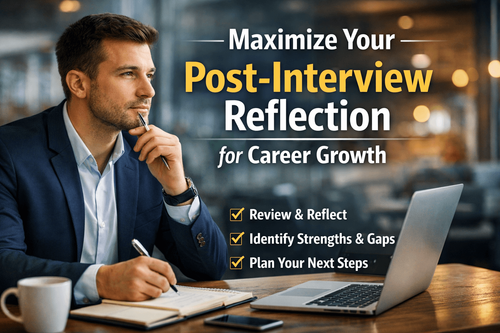

How to Maximize Your Post-Interview Reflection for Career Growth: A Strategic Guide
After an interview, many professionals either rush to move on or spiral into self-doubt. But what if the most crucial growth opportunity lies in those 30 minutes immediately after you leave the room? Structured reflection can accelerate your professional development far more effectively than simply replaying the experience in your mind.
In this guide, we'll show you how to turn every interview into a strategic advantage by using a structured, action-oriented approach. Whether you’re a career changer, consultant, or job seeker, you can use these insights to sharpen your skills, address gaps, and enter your next interview with greater confidence. Book your free trial session today with Planetspark.
Download for more details or PDF file.
Who Is This Blog For?
This guide is perfect for anyone
who is serious about improving their interview performance and leveraging every interview as a learning experience. Specifically, it's for:
- Working professionals looking to level up their career growth
- Job seekers struggling with repeated interview mistakes
- Career changers preparing for new roles or industries
- Consultants and managers aiming for senior positions or client engagements
- Individuals who want to build a more structured approach to interview performance.
Why This Topic Matters Today?
In today’s competitive job market, where hiring decisions are often made within minutes, structured post-interview reflection is a game changer. Research in performance psychology highlights that individuals who reflect strategically after high-stakes events improve faster than those who don’t. Yet, most professionals either don’t reflect or do so inefficiently, leading to repetitive mistakes and missed opportunities.
The good news? This reflection process can be streamlined with the right framework, turning every interview into an opportunity for significant growth—whether you land the role or not.
Core Concept or Framework Explained:
The core of this post-interview reflection guide revolves around four key steps: capture the facts, self-assessment, identifying bright and blind spots, and follow-up strategy.
1. Capture the Facts
Immediately after an interview, your memory is sharpest. Log the interview details: who was present, what questions were asked, your responses, and any surprises or discomforts. This is the raw data that fuels the next steps in your reflection process.
2. Honest Self-Assessment
This step is uncomfortable for many, but it’s where the most valuable insights lie. Assess your performance on four key areas: content and substance, structure and clarity, presence and connection, and the questions you asked. Giving yourself a score from 1-5 with a written rationale allows you to gain clarity on where you excelled and where you can improve.
3. Identify Bright Spots and Blind Spots
Bright spots are the moments where you performed well. Blind spots, on the other hand, are patterns of weakness you may not notice. By identifying both, you can replicate the moments of success and address the gaps that are holding you back.
4. The Follow-Up Strategy
Most candidates treat the interview as a one-time event, but the follow-up is where you can solidify a lasting impression. Send a personalized thank-you email, connect on LinkedIn, and update your interview log. These actions, when done thoughtfully, make you memorable, whether you get the job or not.
How This Blog and Guidebook Help You?
This blog and the accompanying worksheet offer clear steps to refine your interview performance and ensure you're not just learning from your mistakes, but also actively studying your wins. These actionable insights can help you:
- Analyze your performance and pinpoint areas of improvement
- Strengthen your storytelling with frameworks like STAR (Situation, Task, Action, Result)
- Ensure every interview, regardless of outcome, leads to measurable professional growth.
Step-by-Step Breakdown:
Step 1: Capture the Facts
Right after your interview, use a structured capture method to note:
- Interview basics: Date, company, role, format, and interviewer details
- Questions asked and your answers: Summarize them concisely
- Surprises and observations: Any moments that felt off or were unexpected
Step 2: Honest Self-Assessment
Be precise and not just honest about your performance:
- Content & Substance: Did your answers showcase your knowledge and experience?
- Structure & Clarity: Did your responses have a clear flow?
- Presence & Connection: How well did you build rapport with the interviewer?
- Questions You Asked: Did your questions demonstrate engagement and preparedness?
Step 3: Identify Bright Spots and Blind Spots
Identify key moments:
- Bright Spots: Moments where you excelled—be specific.
- Blind Spots: Where did you struggle or feel disengagement?
Step 4: The Follow-Up Strategy
Follow these steps in the 48 hours post-interview:
- Thank-you email: Send within 2 hours, referencing a key moment from the conversation.
- LinkedIn connection: Add the interviewer with a personal note.
- Interview log: Update your master log to track patterns for improvement.
Common Mistakes or Pitfalls to Avoid:
- Mistake 1: Waiting Too Long to Reflect
Don’t wait for the “right mood.” Commit to a 20-minute reflection within 60 minutes of every interview.
- Mistake 2: Focusing Only on What Went Wrong
Balance your reflection by acknowledging your bright spots.
- Mistake 3: Sending a Generic Thank-You Email
Personalize your follow-up by referencing specific parts of the conversation.
- Mistake 4: Not Tracking Patterns Across Interviews
Maintain a master interview log to track performance patterns and improvement areas.
- Mistake 5: Confusing Outcome with Performance
Understand that rejection or acceptance doesn’t automatically reflect your interview performance.
How Should You Use This Guidebook Effectively?
- Read through once for context.
- Complete the worksheet after every interview.
- Apply insights immediately to improve your next interview.
- Revisit the guide for continuous growth and refinement.
Key Takeaways:
- Capture the facts immediately after each interview.
- Conduct an honest, detailed self-assessment.
- Identify both bright and blind spots for deeper learning.
- Follow up strategically within 48 hours to reinforce your connection.
Your Next Step: Accelerate Your Career with PlanetSpark.
Creating an impact-driven resume is not just about landing your next job—it’s about owning your professional story and presenting it with clarity, confidence, and credibility. When your resume clearly communicates value, results, and impact, opportunities follow naturally.
At PlanetSpark, we are committed to empowering working professionals with practical, outcome-focused resources that drive real career growth. From resume building and workplace communication to leadership presence and professional writing, our programs are designed to help you succeed in today’s fast-evolving job market.
Visit https://www.planetspark.in/resources to explore:
- Career and resume-building guides
- Workplace communication and professional writing resources
- Skill-development tools curated for working professionals.
Want a deeper, hands-on experience?
You can also book a free trial session to learn more about PlanetSpark’s Working Professional Courses, designed to accelerate your career through personalised coaching, real-world practice, and expert guidance.
Your career deserves more than generic advice.
It deserves clarity, confidence, and measurable impact.
Start building that advantage today—with PlanetSpark.
Personalized Communication Roadmaps
Record a video to get a AI generated personalized communication reports