
Power Words Guide: Fix Weak Language in Your Cover Letter
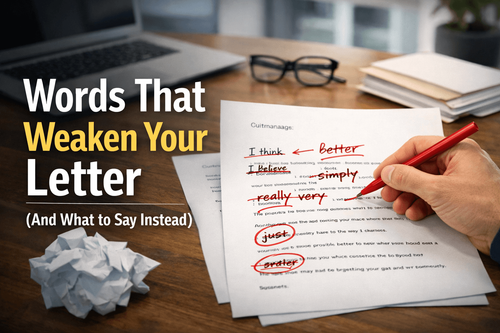

Strategies for Eliminating Weak Language from Your Cover Letter
A cover letter is not just
a formality—it is a positioning document. In a few short paragraphs, it must communicate confidence, competence, and value.
Yet many cover letters fail not because of poor experience, but because of weak language. Words like “I believe,” “I feel,” “I think,” or “I am responsible for” dilute authority. Overused phrases and vague descriptors reduce impact. Apologetic tones undermine credibility.
Recruiters notice this immediately. Weak language signals hesitation. Strong language signals readiness.
This guide explains how to eliminate ineffective wording from your cover letter and replace it with confident, results-driven language that strengthens your professional brand.
Who Is This Blog For?
This blog and guidebook are designed for:
- Working professionals applying for new roles
- Mid-career professionals targeting leadership positions
- Candidates struggling with low response rates
- Career switchers repositioning themselves confidently
- Anyone who wants their cover letter to sound powerful, not passive
If your cover letter feels “fine” but not compelling, language may be the issue.
Why This Topic Matters Today?
Modern hiring is competitive and fast. Recruiters scan applications quickly and subconsciously evaluate tone, clarity, and confidence.
Weak language can create the impression that you:
- Lack conviction
- Are unsure of your value
- Have limited ownership
- Are exaggerating without proof
- Are writing generically
Strong, decisive language communicates:
- Authority
- Accountability
- Results orientation
- Strategic thinking
- Professional maturity
In high-stakes hiring environments, tone directly influences perception.
Core Concept or Framework Explained
The Power Language Shift Framework (P.L.S.)
This framework helps you systematically upgrade your cover letter language across four areas:
- Certainty over hesitation
- Action over responsibility
- Specificity over vagueness
- Impact over intention
Each shift strengthens authority and clarity.
How This Blog and Guidebook Help You?
Together, this blog and guidebook help you:
- Identify weak words that reduce credibility
- Replace passive phrases with confident alternatives
- Eliminate filler expressions
- Strengthen achievement statements
- Improve clarity and conciseness
- Elevate your professional tone
The result is a cover letter that reads like a value proposition—not a request.
Step-by-Step Breakdown
Step 1: Replace Hesitation with Confidence
Weak phrasing often includes qualifiers such as:
- I believe
- I feel
- I think
- I hope
- I would like
These phrases create uncertainty.
Weak example:
“I believe I would be a good fit for this role.”
Stronger version:
“My background in data analytics and process optimisation aligns directly with the requirements of this role.”
Remove hesitation. State alignment confidently.
Step 2: Replace Responsibilities with Achievements
Another common mistake is describing duties instead of outcomes.
Weak example:
“I was responsible for managing a team.”
Stronger version:
“Led a cross-functional team of 12 members, improving project delivery timelines by 25% within six months.”
Achievements demonstrate value. Responsibilities do not.
Step 3: Eliminate Generic Adjectives
Words like:
- Hardworking
- Dedicated
- Passionate
- Motivated
- Team player
are overused and unsupported.
Instead of claiming qualities, demonstrate them through examples.
Weak example:
“I am a highly motivated professional.”
Stronger version:
“Delivered three major client projects ahead of schedule, contributing to a 15% revenue increase.”
Evidence replaces adjectives.
Step 4: Remove Apologetic or Defensive Tone
Avoid phrases such as:
- Although I do not have direct experience…
- While I may not meet all requirements…
- I understand I lack…
These statements shift focus to limitations.
Reframe positively.
Instead of highlighting gaps, emphasise transferable strengths and measurable achievements.
Step 5: Cut Filler and Redundant Phrases
Examples of filler:
- In order to
- Due to the fact that
- It is important to note that
- I am writing this letter to
Concise writing demonstrates professionalism.
Replace:
“I am writing this letter to express my interest in the position.”
With:
“I am applying for the Project Manager position to contribute my expertise in process optimisation and stakeholder management.”
Clarity enhances impact.
Step 6: Strengthen Action Verbs
Begin achievement statements with strong verbs such as:
- Spearheaded
- Implemented
- Optimised
- Transformed
- Delivered
- Accelerated
- Streamlined
- Negotiated
Strong verbs project leadership and ownership.
Common Mistakes or Pitfalls to Avoid
The guidebook highlights recurring language errors:
- Overusing personal pronouns
- Repeating resume content verbatim
- Writing overly long paragraphs
- Using clichés without evidence
- Sounding overly aggressive instead of confident
- Mixing informal and formal tone
Balance is essential. Confidence should never turn into arrogance.
How Should You Use This Guidebook Effectively?
To maximise impact:
1. Draft your cover letter without overthinking
2. Review it using the Power Language Shift Framework
3. Highlight weak phrases
4. Replace them with specific, measurable statements
5. Remove unnecessary qualifiers
6. Conduct a final read focused purely on tone
Time investment:
- Initial draft: 45–60 minutes
- Language refinement: 30 minutes
- Final polish: 15 minutes
Small adjustments can significantly elevate professionalism.
Key Takeaways
- Weak language reduces authority
- Hesitation signals uncertainty
- Responsibilities should be replaced with results
- Generic adjectives lack credibility
- Strong action verbs increase impact
- Concise writing improves readability
- Confidence should be clear but professional
- Language directly shapes recruiter perception
Powerful language transforms a standard cover letter into a compelling value statement.
Your Next Step: Accelerate Your Career with PlanetSpark
Professional communication is a critical career skill. The way you articulate your value can influence interview calls, promotions, and leadership opportunities. Strong writing reflects strong thinking.
At PlanetSpark, we empower working professionals to communicate with clarity, confidence, and strategic impact. From resume writing and interview preparation to executive presence and workplace communication, our programs are designed to drive measurable career growth.
Visit https://www.planetspark.in/resources to explore:
- Cover letter and resume mastery guides
- Interview communication frameworks
- Professional writing toolkits
- Career development resources
You can also book a free trial session to learn more about PlanetSpark’s Working Professional Courses, built to help you communicate powerfully and advance confidently.
Your experience deserves strong language.
Refine your message. Strengthen your impact.
Start building your advantage today—with PlanetSpark.