
Process Improvement Resume Guide for Career Growth in 2026
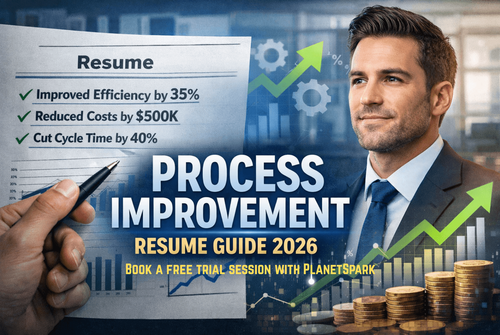

Process Improvement Resume Guide: How to Showcase Measurable Impact and Stand Out in 2026
If your work is about making systems faster, cheaper, and more efficient—your resume should reflect that clearly.
Book your free trial session today with Planetspark.
Download for more details or PDF file.
But most process improvement professionals make one critical mistake: they describe what they did instead of what changed because of them.
That’s exactly the problem this resource solves.
The PlanetSpark Resume Template Focusing on Process Improvement Achievements is built to help professionals present their work as a portfolio of measurable transformations—not just responsibilities.
Who Is This Blog For?
- Lean Six Sigma professionals (Green Belt, Black Belt)
- Operations and supply chain managers
- Business process analysts (BPO, shared services)
- ITSM / DevOps / process engineers
- Healthcare, finance, HR, and retail operations professionals
- Anyone involved in workflow redesign, automation, or efficiency improvement
Why This Topic Matters Today?
In today’s hiring landscape, efficiency and cost optimisation are top priorities for organisations.
But here’s the catch:
Recruiters don’t hire based on “process improvement experience.”
They hire based on measurable impact.
According to the guide, most professionals weaken their resumes by:
- Listing duties instead of outcomes
- Not quantifying improvements (cost, time, error reduction)
- Using jargon without results
- Ignoring scope (teams, processes, scale)
This leads to resumes that look busy—but not impactful.
Core Concept or Framework Explained
The core idea behind this resource is simple but powerful:
A process improvement resume is not a job history—it is a transformation portfolio.
Every bullet point should answer:
“What improved because of me?”
Your resume should clearly show:
- What process you improved
- What method you used (Lean, Six Sigma, RCA, automation)
- What measurable result you delivered
For example:
Instead of: “Responsible for process reviews”
Write: “Reduced review cycle time by 40% using DMAIC methodology.”
This shift alone can completely change how your profile is perceived.
How This Blog and Guidebook Help You?
This resource helps you:
- Convert operational work into measurable achievements
- Highlight business impact (cost savings, efficiency, accuracy)
- Structure your resume using scenario-based templates
- Align with ATS requirements using relevant keywords
- Position yourself for higher-impact roles in operations, consulting, and leadership
Step-by-Step Breakdown
Lean Six Sigma Black Belt: How to Showcase Transformation at Scale?
This template is designed for certified professionals in manufacturing or operations.
It focuses on:
- DMAIC project outcomes
- Cost savings and defect reduction
- OEE and cycle time improvements
Example from the template:
Reducing defect rates, improving efficiency, and delivering measurable cost savings across multiple projects.
Business Process Analyst: How to Show Workflow Impact?
For BPO and shared services professionals.
It highlights:
- AHT reduction
- SLA improvements
- Automation outcomes
The template even structures achievements in a table format (page 5) linking initiative → method → outcome, making impact extremely clear.
Operations Manager (Supply Chain): How to Demonstrate Cost and Efficiency Gains?
This template focuses on:
- Vendor TAT reduction
- Inventory optimisation
- Logistics efficiency
For example, improving delivery timelines, freeing working capital, and reducing costs across supply chain operations.
Healthcare Process Improvement: How to Show Patient and System Impact?
For healthcare professionals, the focus shifts to:
- Patient wait time reduction
- Discharge efficiency
- Compliance improvements
It translates operational improvements into patient and system-level outcomes.
IT Process Engineer: How to Highlight Technical Efficiency?
For IT and DevOps professionals.
It focuses on:
- MTTR reduction
- Deployment frequency increase
- SLA improvements
The structured table format (page 8) clearly connects process changes to measurable technical outcomes.
Continuous Improvement Consultant: How to Reframe Your Experience?
For professionals transitioning into consulting.
This template helps you:
- Reframe past roles into improvement contributions
- Highlight transferable skills
- Showcase project-based impact
Quality Assurance Lead: How to Prove Quality Improvements?
This template highlights:
- Defect rate reduction
- First-pass yield improvement
- Audit and compliance success
It positions quality professionals as cost-saving and efficiency drivers.
Retail Operations Analyst: How to Show Store-Level Impact?
For retail professionals.
It focuses on:
- Shrinkage reduction
- Inventory accuracy
- Workforce optimisation
It ties operational improvements directly to business performance.
Finance Process Improvement Lead: How to Show Speed and Accuracy Gains?
For finance professionals.
It highlights:
- Faster month-end close cycles
- Automation of reconciliations
- Reduction in reporting errors
It positions finance as a process-driven function, not just reporting.
HR Operations Specialist: How to Quantify People Processes?
For HR professionals.
It focuses on:
- Time-to-hire reduction
- Onboarding efficiency
- HRMS optimisation
It reframes HR as a measurable, data-driven function.
Common Mistakes or Pitfalls to Avoid
- Writing “responsible for” instead of showing results
- Not including numbers (%, time saved, cost saved)
- Ignoring methodologies used (Lean, DMAIC, etc.)
- Not tailoring resume to specific roles
- Burying certifications instead of highlighting them
These are explicitly highlighted in the guide as key reasons resumes get rejected.
How Should You Use This Guidebook Effectively?
Step 1: Select the right template based on your role
Step 2: Replace placeholders with real project outcomes
Step 3: Quantify everything—time, cost, efficiency, errors
Step 4: Add methodologies used (Lean, Kaizen, RCA, etc.)
Step 5: Tailor the resume for each job application
The workflow visual on page 2 clearly shows:
Select Template → Fill Placeholders → Quantify Achievements → Export Document
Also, before submitting, follow the checklist on page 14:
- Every bullet must include a measurable outcome
- Certifications should be clearly visible
- ATS keywords must be included naturally
- Resume must be tailored for the role
Key Takeaways
- Your resume must show transformation, not tasks
- Quantification is non-negotiable
- Methodology + outcome = strong impact
- Scenario-based templates improve clarity and relevance
- ATS optimisation increases visibility
- Tailoring for each role significantly improves success
Your Next Step: Turn Your Experience into Measurable Career Growth
A strong resume is not about writing more—it’s about showing impact clearly and convincingly. When you present your work as measurable transformation, you position yourself for better roles, higher compensation, and faster career growth.
At PlanetSpark, we help working professionals build exactly that edge. Our resources and programs are designed to help you communicate your value, improve professional writing, and accelerate your career trajectory.
Explore more resources at:
https://www.planetspark.in/resources
You’ll find:
- Resume and career growth guides
- Professional communication tools
- Skill-building frameworks for modern workplaces
Want personalised support?
Book a free trial session to explore PlanetSpark’s Working Professional Courses—designed to help you turn your experience into real career outcomes.
Because in today’s market, the professionals who grow fastest are not just the ones who do the work—
they’re the ones who can clearly prove the impact of their work.
Personalized Communication Roadmaps
Record a video to get a AI generated personalized communication reports