
Professional Growth Tracking Guide for Career Advancement 2026

Track Your Professional Growth Effectively: A Monthly System That Actually Works
Most professionals want to grow in their careers. Very few can clearly prove that they are.
That’s the gap.
Career growth doesn’t stall because of lack of ambition — it stalls because there’s no system to measure, track, and improve progress consistently. Promotions feel unpredictable, feedback feels vague, and skill development becomes reactive instead of intentional.
The Professional Growth Tracking Sheet solves this problem by giving you a structured, low-effort system to track what truly matters — your skills, your progress, and your direction.
If you’ve ever felt like you’re “working hard but not moving forward,” this system is designed for you.
Who Is This Blog For?
- Working professionals (0–15 years of experience)
- Career switchers looking to build targeted skills
- Managers aiming for promotions or leadership roles
- Professionals who feel stuck despite consistent effort
- Anyone who wants structured, measurable career growth
Why This Topic Matters Today?
Here’s an uncomfortable truth highlighted in the guide:
Most professionals spend more time planning their weekends than planning their careers.
Not because they don’t care — but because they lack a system that fits into a busy schedule.
Without a tracking system:
- Skills remain undefined and unmeasured
- Growth becomes inconsistent
- Feedback gets ignored or forgotten
- Career progress depends on chance, not strategy
Over time, this leads to stagnation — even for high-performing professionals.
The solution is not more effort. It’s deliberate tracking.
Core Concept or Framework Explained
The Professional Growth Tracking Sheet is built on a simple but powerful idea:
You don’t track to feel productive — you track to see clearly.
The system combines four levels of structured reflection:
- Daily awareness (micro learning moments)
- Weekly application and reflection
- Monthly tracking and review
- Quarterly strategic recalibration
As shown in the visual framework on page 19, these layers work together to create a complete growth engine — from daily practice to long-term direction.
This transforms growth from a vague ambition into a measurable system.
How This Blog and Guidebook Help You?
This system helps you:
- Identify your real skill gaps (not assumed ones)
- Focus on one high-impact skill at a time
- Build consistent growth habits without overwhelm
- Use feedback as a structured improvement tool
- Track visible progress month after month
- Create evidence for promotions, role changes, or career transitions
Instead of asking “Am I improving?”, you’ll know exactly how and where you’re growing.
Step-by-Step Breakdown
Step 1: Establish Your Growth Baseline
Before setting goals, you need clarity on your starting point.
The baseline audit (page 3–4) helps you:
- Identify your strongest skills
- Recognize your skill gaps
- Define your target role or career direction
- Pinpoint your single most important growth area
This step ensures that your efforts are aligned with what actually matters.
Step 2: Set Monthly Growth Goals That Stick
Most professionals fail because their goals are either too ambitious or too vague.
The tracker introduces a powerful monthly goal formula:
“This month I will develop [Skill] by doing [Action] so that I can demonstrate [Outcome].”
This ensures:
- Clarity
- Measurability
- Real-world application
Monthly goals are short enough to stay relevant but long enough to show real progress.
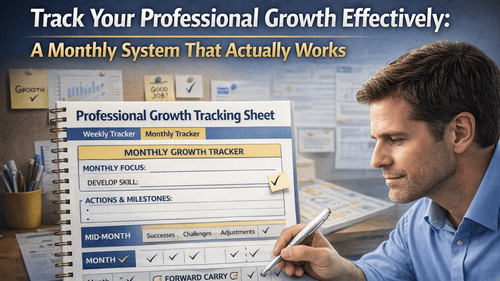
Step 3: Use the Monthly Tracker System
The core of this resource is the Monthly Growth Tracker (page 6–7).
It includes five key zones:
- Monthly focus (one skill only)
- Actions and milestones
- Mid-month progress check
- End-of-month review
- Forward carry (next month planning)
This system takes less than 30 minutes per month — but delivers continuous clarity.
Step 4: Track Skills, Not Just Tasks
One of the most powerful ideas in this guide:
Tasks are temporary. Skills are cumulative.
The Skill Depth Scale (page 8) shows four levels of growth:
- Awareness
- Understanding
- Application
- Mastery
The goal is not to master everything — but to move one level per quarter in your priority skill.
That’s how real career growth compounds.
Step 5: Build a Weekly Growth Rhythm
Growth doesn’t happen monthly — it happens weekly.
The system introduces a simple 3-step weekly loop:
- Monday: Set intention
- Wednesday: Apply the skill
- Friday: Reflect
This takes under 15 minutes per week but creates continuous learning momentum.
Step 6: Capture and Use Feedback
Most professionals ignore the most valuable growth signal — feedback.
This system categorizes feedback into:
- Solicited (you asked for it)
- Observed (what you noticed)
- Inferred (patterns in outcomes)
Tracking feedback monthly helps you identify patterns that would otherwise take years to notice.
Step 7: Review Quarterly for Strategic Growth
Monthly tracking builds momentum. Quarterly reviews build direction.
Every 3 months, you evaluate:
- What improved
- What stalled
- What patterns emerged
- What to focus on next
This ensures your growth stays aligned with your long-term career goals.
Common Mistakes or Pitfalls to Avoid
- Tracking too many skills at once
- Setting goals without scheduling actions
- Skipping mid-month check-ins
- Ignoring negative or uncomfortable feedback
- Waiting for feedback instead of asking for it
- Treating growth as separate from real work
- Never doing quarterly reviews
Each of these reduces the effectiveness of your growth system.
How Should You Use This Guidebook Effectively?
To get real results:
- Complete your baseline audit first
- Choose one skill per month
- Schedule all growth actions in your calendar
- Follow the weekly rhythm consistently
- Log feedback regularly
- Review progress monthly
- Conduct quarterly reviews without fail
The system is designed to be lightweight — but only works if used consistently.
Key Takeaways
- Career growth requires a system, not just effort
- Tracking creates clarity and direction
- Focus on one skill at a time for faster progress
- Monthly goals are more effective than vague long-term plans
- Feedback is the fastest path to improvement
- Weekly consistency drives long-term results
- Growth is about progress, not perfection
Your Next Step: Accelerate Your Career with PlanetSpark
Creating an impact-driven resume is not just about landing your next job—it’s about owning your professional story and presenting it with clarity, confidence, and credibility. When your resume clearly communicates value, results, and impact, opportunities follow naturally.
At PlanetSpark, we are committed to empowering working professionals with practical, outcome-focused resources that drive real career growth. From resume building and workplace communication to leadership presence and professional writing, our programs are designed to help you succeed in today’s fast-evolving job market.
Visit https://www.planetspark.in/resources to explore:
- Career and resume-building guides
- Workplace communication and professional writing resources
- Skill-development tools curated for working professionals
Want a deeper, hands-on experience?
You can also book a free trial session to learn more about PlanetSpark’s Working Professional Courses, designed to accelerate your career through personalised coaching, real-world practice, and expert guidance.
Your career deserves more than generic advice.
It deserves clarity, confidence, and measurable impact.
Personalized Communication Roadmaps
Record a video to get a AI generated personalized communication reports