
Professional Positioning Guide to What You Are Known For
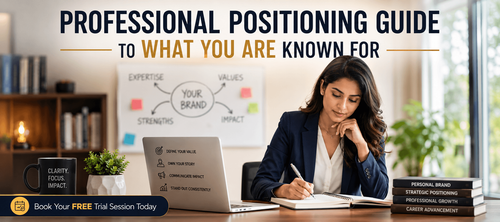

Identify What You Want to Be Known For Professionally and Build a Clear Personal Brand
Most professionals work hard for years, build useful skills, deliver results, and collect strong experience. Yet when someone asks, "What do you want to be known for professionally?" they often pause. The answer is rarely as simple as a job title. Being known as a product manager, consultant, marketer, analyst, educator, or team lead is not enough. The real question is: What specific problem do you solve, who do you solve it for, and why should people remember you?
This matters because professional visibility does not come only from experience. It comes from clarity. Without a clear professional identity, talented professionals can become invisible in competitive job markets, undervalued inside organisations, or overlooked for projects, promotions, clients, and leadership opportunities. The guidebook How to Identify What You Want to Be Known For Professionally was created to solve this exact challenge through 10 scenario-specific templates that help working professionals define, articulate, and own their professional identity with clarity and confidence.
The resource is especially useful because it does not ask you to write a generic personal brand statement from scratch. It guides you through internal reflection, reputation mapping, strengths synthesis, LinkedIn rewriting, career pivot positioning, promotion conversations, client introductions, networking scripts, thought leadership planning, and brand consistency checks. In short, it helps you move from professional ambiguity to professional clarity.
Download these resources and apply them alongside your daily work for improved clarity, productivity, and professional growth. You can also book a free trial to gain expert guidance and enhance your communication, problem-solving, and decision-making skills. The materials are designed in a clear, structured format to help professionals learn efficiently and implement insights with confidence.
Who Is This Blog For?
This blog is for working professionals who want to become more intentional about how they are perceived, remembered, and valued.
It is especially useful for:
- Job seekers who want a sharper resume, LinkedIn profile, and interview narrative
- Career switchers who need to explain who they are becoming without dismissing their past experience
- Managers preparing for promotion conversations or annual reviews
- Freelancers and consultants who need to communicate their specialisation clearly to clients
- Professionals attending networking events, conferences, or industry meetings
- Thought leaders who want to write, speak, or publish around a recognisable area of expertise
- Employees who feel their current reputation does not match their desired career direction
- Professionals who struggle to answer what they want to be known for
- Anyone whose LinkedIn profile reads like a job description instead of a clear professional identity
Why This Topic Matters Today?
Professional identity has become a career advantage. In a crowded job market, people do not remember every qualification or every responsibility listed on a profile. They remember clarity. They remember the person who can explain exactly what problem they solve and who they solve it for.
The guidebook highlights a common reality: many professionals have skills, results, and experience, but still struggle to answer the core question of what they want to be known for. Without that answer, career growth becomes reactive. You accept roles, tasks, and opportunities based on what others assign to you, not based on the reputation you want to build.
This is why professional identity matters across multiple career moments. Before updating LinkedIn or a resume, you need to know what message those platforms should communicate. Before a promotion conversation, you need to know what value your manager should associate with you. Before pitching a client, you need to know what you specialise in. Before publishing thought leadership content, you need to know the topic area you want to own.
The guidebook also warns against common mistakes such as defining yourself by your job title, using vague language like "passionate" or "results-driven" without proof, copying job description language, skipping internal reflection, and trying to appeal to everyone. These mistakes weaken professional identity because they make you sound interchangeable.
A clear professional identity helps you become easier to refer, promote, hire, recommend, and remember.
Core Concept or Framework Explained
The core concept of the guidebook is simple but powerful: internal clarity must come before external communication.
Most professionals start in the wrong place. They immediately rewrite their LinkedIn headline, resume summary, or bio without first understanding what they actually want to be known for. The guidebook reverses that process. It begins with reflection and evidence, then moves into positioning and communication.
The framework follows a practical sequence.
First, you identify your signature professional moments. These are the projects, achievements, or situations where your work created real impact and where you felt energised by the process. These moments reveal patterns about your natural strengths, values, and preferred problems.
Second, you map your current reputation. This means understanding how colleagues, clients, managers, or collaborators already perceive you. You may be known as the safe pair of hands, the firefighter, the data person, the strategic thinker, or the person who brings teams together. Some of these labels may help you. Others may limit you.
Third, you define your desired reputation. A strong desired reputation includes three elements: your expertise domain, your signature quality, and the outcome you create. For example, instead of saying "I am an HR professional," a clearer identity might be: "I help high-growth companies build HR systems that scale without losing the human element."
Fourth, you convert this identity into outward-facing assets. That includes LinkedIn, resumes, networking introductions, promotion scripts, client one-pagers, thought leadership topics, and email signatures.
Finally, you audit consistency. A professional identity only becomes memorable when the same core message appears across multiple touchpoints.
How This Blog and Guidebook Help You?
This blog helps you turn the guidebook into a practical professional branding process. The goal is not to create a catchy tagline. The goal is to build a clear, evidence-backed identity that supports your next career move.
The guidebook helps you:
- Clarify what you want to be known for professionally
- Identify your strongest professional moments and recurring strengths
- Understand the gap between current reputation and desired reputation
- Replace generic language with specific, verifiable claims
- Rewrite LinkedIn so it reflects identity, not just job history
- Reframe your experience during a career pivot
- Prepare a stronger promotion conversation
- Create a client introduction sheet as a freelancer or consultant
- Build a 60-second networking introduction
- Choose thought leadership topics aligned with your expertise
- Audit all professional touchpoints for consistency
The most important outcome is confidence. When you know what you want to be known for, your resume becomes sharper, your LinkedIn becomes clearer, your conversations become more focused, and your career decisions become more intentional.
Step-by-Step Breakdown
Step 1: Start With a Professional Identity Self-Audit
The first template in the guidebook is the Professional Identity Self-Audit. It is designed for professionals who have experience, skills, and a track record but no clear sense of what they want to be known for.
The audit begins with basic information such as your current role, years of experience, industry, and function. Then it asks you to write your goal for the exercise in one sentence. For example: "I want to be known as the go-to expert in sustainable supply chain transformation."
The most valuable part of this step is the Signature Moments Inventory. You list five professional moments where you created impact and felt aligned with your natural abilities. For each moment, you identify the skills you used and the outcome created.
This helps you find patterns. If several of your best moments involve simplifying complexity, leading cross-functional work, mentoring people, or solving urgent operational problems, those patterns are clues to your professional identity.
The template also includes values identification across performance values, people values, and impact values. This ensures your identity is not based only on what you can do, but also on what drives your best work.
Step 2: Map Your Current Reputation
The Professional Reputation Clarity Map helps you understand how you are currently perceived. This is important because your reputation already exists, whether you have shaped it intentionally or not.
The guidebook recommends asking 3–5 trusted colleagues what three words they would use to describe your professional reputation. You then look for patterns in their responses.
Next, you reflect on how you currently show up at work. What problems do people bring to you most often? What tasks are you assigned that others are not? What skills are recognised in performance reviews? What label are you most often given?
This step can be revealing. You may discover that people value you for reliability, but you want to be known for strategy. You may be known for execution, but you want to be recognised for leadership. You may be seen as a generalist, but you want to build authority in a specific domain.
Once you identify the gap, you can take targeted action to close it.
Step 3: Define Your Desired Reputation Statement
A desired reputation should not be vague. The guidebook recommends building it around three elements:
- Expertise domain
- Signature quality
- Outcome you create
Your expertise domain is the field, function, or discipline you want to own. Your signature quality is the distinctive way you think or work. Your outcome is the result or transformation you create for others.
A strong statement might sound like: "I want to be known as the professional who simplifies complex go-to-market challenges through clear operating systems so that teams can scale revenue without confusion."
This is stronger than saying, "I am a results-driven marketing professional." It tells people what you do, how you do it, and why it matters.
Step 4: Identify Your Signature Strengths
The Signature Strengths Positioning Sheet helps you move from a long list of skills to a concise set of strengths that define your professional value.
The guidebook asks you to list five strengths and provide evidence for each. The key instruction is to avoid generic descriptors. Instead of writing "communication," you might write "turning complex technical ideas into decision-ready executive summaries." Instead of "leadership," you might write "aligning cross-functional teams around high-pressure launches."
After listing five strengths, you narrow them to your signature three. These should be strengths that are unique to you, relevant to your future direction, and consistently demonstrated across contexts.
The positioning statement then brings these strengths together: "I am a professional who brings signature strength one, signature strength two, and signature strength three to a specific target context. My work consistently results in a clear outcome."
The guidebook offers a strong test: could someone else in your field copy your statement word-for-word and have it be equally true? If yes, it is not specific enough.
Step 5: Rewrite LinkedIn Around Identity
The LinkedIn Personal Brand Rewrite Brief helps professionals rewrite their profile so it reflects what they want to be known for, not just what they have done.
The guidebook treats the LinkedIn headline as one of the most important lines on your profile. It should communicate your expertise, audience, and value, not just your job title.
The formula is:
- What you do
- Who you do it for
- The outcome or transformation
Your About section should then follow a clear structure. It should open with a hook that captures your identity, explain your core expertise, include measurable proof points, and close with a specific call to action.
For example, instead of opening with your work history, you might begin with: "For the past 8 years, I have been the person companies call when they need to transform their sales function, not just improve it."
This instantly positions you around a professional identity rather than a chronological resume.
Step 6: Reframe Your Identity During a Career Pivot
The Career Pivot Identity Statement Builder is for professionals switching industries, functions, or career directions.
The template uses a From to To mapping. You identify where you are coming from and where you are going. This includes previous industry, target industry, previous function, target function, previous role level, current reputation, and desired new reputation.
The most important part is transferable strengths reframing. Your existing skills are not irrelevant. They simply need to be translated into the language of your target field.
For example, managing credit risk portfolios could be reframed as applying financial risk frameworks to sustainability-linked investment performance and regulatory exposure.
The career pivot identity statement helps you explain who you are becoming without dismissing who you have been. It also encourages authenticity. Instead of saying you are passionate about a new field, show evidence through courses, projects, research, or practical exposure.
Step 7: Prepare for Promotion Conversations
The Promotion Conversation Positioning Script helps professionals prepare for performance reviews, promotion conversations, or next-step career discussions.
The guidebook recommends using an Identity-Evidence-Impact framework.
Identity means stating what you want to be known for in the organisation. Evidence means presenting specific proof points with numbers. Impact means showing how your work extends beyond your formal role through mentoring, cross-functional leadership, strategic input, or expanded scope.
The template also helps prepare answers to likely questions such as:
- Why do you think you are ready for this role?
- What would you do differently in the new role?
- What are you still developing?
This is important because promotion conversations should not sound like a list of tasks completed. They should show that you are already operating with the identity, judgement, and impact expected at the next level.
Step 8: Build a Freelancer or Consultant Client Intro Sheet
For freelancers and consultants, professional identity must be immediately client-facing. The guidebook includes a Freelancer or Consultant Client Intro Sheet that replaces a generic bio with a precise one-page positioning document.
The core statement answers:
- Who you work with
- What challenge they face
- What outcome you help them achieve
- Who you are not the right fit for
That last part is powerful. Defining who you do not serve builds credibility because it shows you are not trying to appeal to everyone.
The client sheet also includes signature services and selected client results. This helps potential clients understand not only what you offer, but what working with you produces.
Step 9: Create a 60-Second Networking Introduction
The Networking Introduction Script helps professionals answer "So, what do you do?" without rambling, underselling, or relying only on a job title.
The structure has four beats:
- The Hook: who you are and what you want to be known for
- The Context: where you do this work
- The Proof: one specific example or result
- The Bridge: why you are at the event or what conversation you want to open
For example, a strong introduction might begin with: "I help mid-size healthcare companies turn operations data into cost savings without the 18-month IT project."
This is more memorable than simply saying, "I work in healthcare operations."
Step 10: Build Thought Leadership Around Three Pillars
The Thought Leadership Topic Planner is for professionals who want to build visibility through LinkedIn posts, articles, speaking, newsletters, or podcasts.
The guidebook asks you to define your expertise domain, audience, desired reader action, and unique point of view. Then it organises your content into three pillars:
- Core expertise
- Differentiated perspective
- Proof and process
This ensures your content builds a recognisable identity over time. Instead of posting randomly, you create a body of work that reinforces what you want to be known for.
Common Mistakes or Pitfalls to Avoid
The guidebook identifies seven common professional identity mistakes. The most important ones include defining yourself by your job title, trying to appeal to everyone, skipping internal reflection, and using generic language.
Defining yourself by job title is limiting because a title describes your function, not your identity. "Senior Product Manager" is less memorable than explaining the specific product problem you solve and the outcome you create.
Trying to appeal to everyone makes your profile broad and forgettable. The more specific your audience, the more relevant your message becomes.
Skipping reflection leads to weak external communication. You cannot write a strong LinkedIn headline or resume summary if you have not clarified your identity anchor.
Using generic language weakens trust. Phrases like "results-driven professional," "strong communicator," or "passionate about innovation" need evidence. If you cannot prove a claim, do not include it.
Another common mistake is building thought leadership around topics that are interesting but disconnected from your desired professional identity. If your content does not reinforce what you want to be known for, it may create visibility without positioning.
How Should You Use This Guidebook Effectively?
Use the guidebook in sequence. Start with Template 01 and Template 02 before rewriting any outward-facing material. These internal reflection templates create the foundation for everything else.
Set aside 60–90 minutes each for the Self-Audit and Reputation Map. Do not rush this stage. The quality of your LinkedIn, resume, networking script, or client intro depends on the depth of your reflection.
Next, complete the Signature Strengths Positioning Sheet. Share your draft statement with 2–3 trusted colleagues and ask whether it sounds specific, believable, and clearly yours.
Then update your highest-priority touchpoints. For most professionals, that means LinkedIn headline, LinkedIn About section, and resume summary. For consultants and freelancers, it may mean the client intro sheet, website bio, and proposal introduction. For professionals seeking promotion, it may mean the promotion conversation script.
Finally, complete the Personal Brand Consistency Checklist. Audit LinkedIn, resume, email signature, professional bio, portfolio, event bio, and other visible touchpoints. Score each one from 1–5 based on alignment with your identity.
The guidebook recommends a 30-day sprint: Days 1–5 for internal clarity, Days 6–10 for strengths synthesis, Days 11–20 for updating key touchpoints, and Days 21–30 for consistency audit and activation.
Key Takeaways
- Professional identity is not the same as a job title
- A strong identity explains what problem you solve, who you solve it for, and what outcome you create
- Internal clarity should come before LinkedIn, resume, bio, or outreach rewrites
- Signature moments reveal the strengths and values that define your best work
- Your current reputation may not match your desired reputation
- A strong desired reputation includes expertise domain, signature quality, and outcome
- Generic claims should be replaced with specific proof points
- LinkedIn should communicate identity, audience, value, and measurable proof
- Career pivots require reframing past experience in the language of the target field
- Promotion conversations should use identity, evidence, and impact
- Consultants and freelancers need precise positioning, not generic bios
- Networking introductions should include a hook, context, proof, and bridge
- Thought leadership works best when organised around clear content pillars
- Professional identity should be reviewed every quarter as your career evolves
Your Next Step: Accelerate Your Career with PlanetSpark
Creating an impact-driven resume is not just about landing your next job—it’s about owning your professional story and presenting it with clarity, confidence, and credibility. When your resume clearly communicates value, results, and impact, opportunities follow naturally.
At PlanetSpark, we are committed to empowering working professionals with practical, outcome-focused resources that drive real career growth. From resume building and workplace communication to leadership presence and professional writing, our programs are designed to help you succeed in today’s fast-evolving job market.
Visit https://www.planetspark.in/resources to explore:
- Career and resume-building guides
- Workplace communication and professional writing resources
- Skill-development tools curated for working professionals
Want a deeper, hands-on experience?
You can also book a free trial session to learn more about PlanetSpark’s Working Professional Courses, designed to accelerate your career through personalised coaching, real-world practice, and expert guidance.
Your career deserves more than generic advice.
It deserves clarity, confidence, and measurable impact.
Personalized Communication Roadmaps
Record a video to get a AI generated personalized communication reports