
Professional Skills Assessment Guide for Career Growth 2026
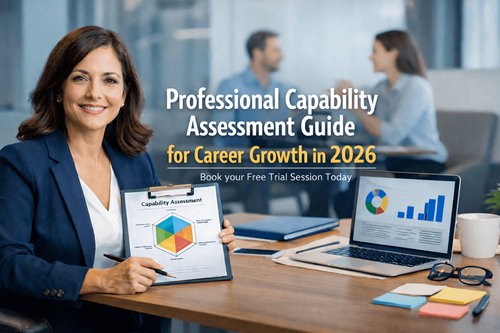

A Comprehensive Guide to Evaluating Capabilities and Accelerating Career Growth
Most professionals spend their days delivering
results, meeting deadlines, and managing stakeholders efficiently. They are reliable, productive, and often seen as valuable contributors within their teams. However, when asked a deeper question — “What exactly are your strongest capabilities, and where do you need to grow next?” — many find themselves unsure or unable to answer with clarity. This lack of precise self-awareness quietly limits career progression.
This gap does not exist because professionals lack skill, intelligence, or ambition. Instead, it stems from the absence of a structured system to evaluate themselves. Most people have never been taught how to objectively assess their strengths, identify blind spots, or connect their current capabilities to future career goals. As a result, they operate on assumptions rather than insights.
The consequences of this are significant. Professionals often remain stuck in roles they have outgrown, miss out on promotions, or struggle to position themselves effectively during performance reviews and interviews. Even highly capable individuals can be overlooked simply because they cannot clearly articulate their value or demonstrate intentional growth.
This is where a structured Professional Capability Assessment becomes powerful. It provides a clear, practical framework to evaluate where you stand today and what you need to do next. Instead of vague self-reflection, it enables data-driven clarity — helping you move from working hard to growing strategically and accelerating your career with confidence.
Book your free trial session today with Planetspark.
Download for more details or PDF file.
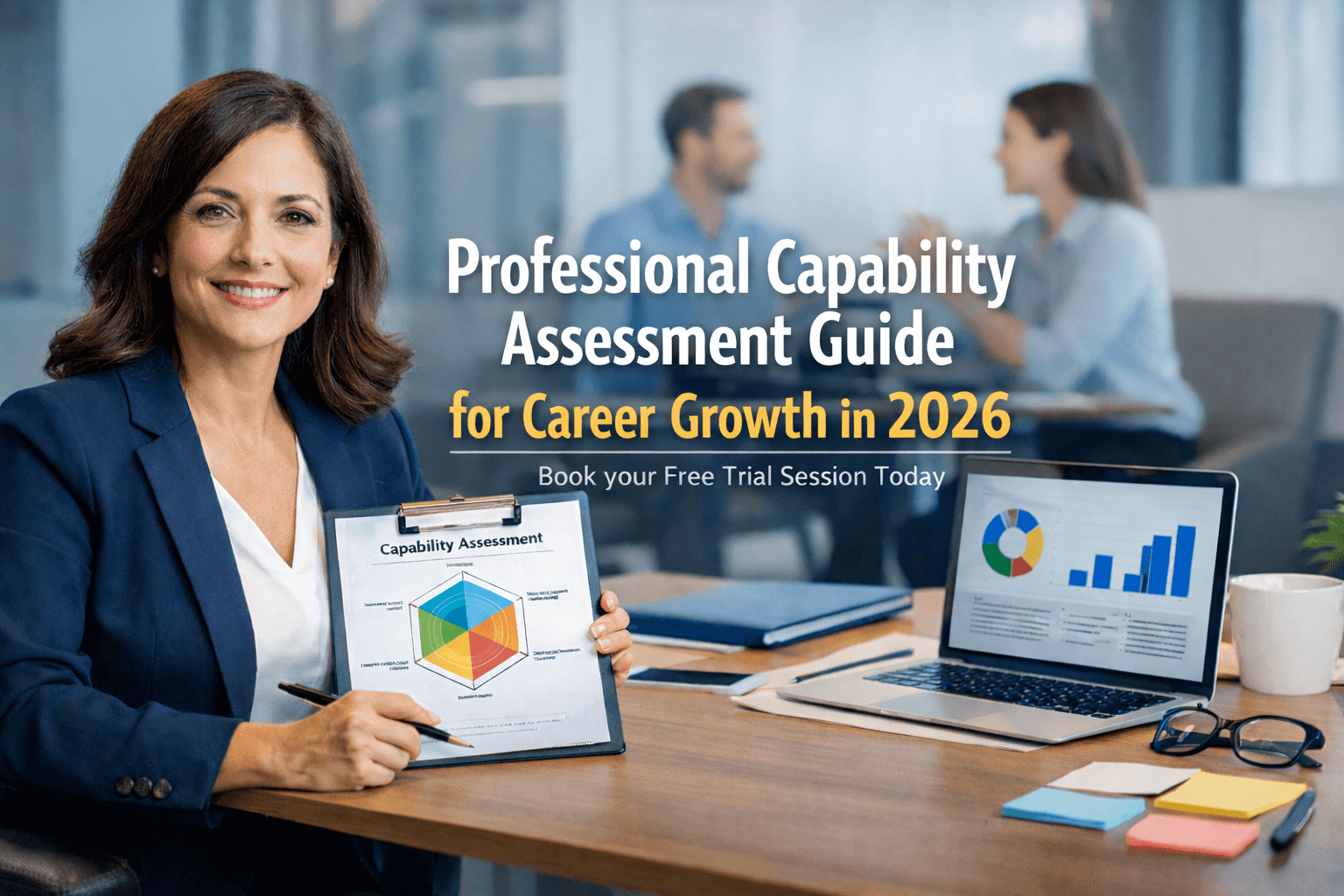
Who Is This Blog For?
- Professionals with 0–15 years of experience seeking clarity in their career path
- Career changers looking to identify and articulate transferable skills
- Managers preparing for leadership roles
- Consultants building a strong value narrative
- Job seekers aiming for interview-ready self-awareness
Why This Topic Matters Today?
The modern workplace is evolving faster than ever. Skills become outdated quickly, and roles demand more than just technical expertise. Professionals today are expected to demonstrate a combination of technical skills, communication, leadership, strategic thinking, and adaptability.
However, most professionals:
- Cannot clearly articulate their strengths
- Undersell their capabilities during interviews or performance reviews
- Lack visibility into their development gaps
- Struggle to create a structured growth plan
This leads to stalled growth, missed promotions, and lack of confidence in career conversations. A structured capability assessment bridges this gap by turning vague self-perception into measurable insights.
Core Concept or Framework Explained
At the heart of this approach is the Five Capability Dimensions Framework. This framework provides a complete picture of professional effectiveness by evaluating five critical areas:
Technical and Functional Skills
This includes your domain knowledge, tools, certifications, and expertise required to perform your role effectively.
Communication and Influence
Your ability to communicate clearly, persuade stakeholders, and adapt your message across different audiences.
Leadership and Collaboration
How you take ownership, support others, build trust, and contribute to team success — regardless of your title.
Strategic Thinking
Your ability to think beyond immediate tasks, connect ideas, anticipate outcomes, and contribute to bigger business goals.
Adaptability and Growth Mindset
How effectively you learn, handle change, respond to feedback, and navigate uncertainty.
Each dimension is assessed on a scale of 1 to 5:
- 1 indicates basic awareness
- 3 indicates independent competence
- 5 indicates mastery and ability to guide others
The real insight lies not in individual scores, but in the pattern across all five dimensions.
How does this blog and Guidebook Help You?
This structured approach helps you move from guesswork to clarity. By using this framework, you can:
- Build a clear, data-driven understanding of your capabilities
- Identify strengths to highlight in interviews and reviews
- Pinpoint exact areas that need development
- Create a focused 30-day improvement plan
- Develop the language to articulate your value confidently
The outcome is simple but powerful: clarity, confidence, and direction in your career.
Step-by-Step Breakdown
Step 1: Assess Your Technical and Functional Skills
Start by evaluating the core skills that define your role. These are the capabilities that establish your professional credibility.
Ask yourself:
- How strong is my domain knowledge?
- How proficient am I with tools and systems?
- Can I perform effectively under pressure?
- Am I staying updated with industry trends?
- Do I have cross-functional awareness?
A powerful reflection exercise includes identifying:
- Your technical superpower
- Your most pressing technical gap
This gap often represents your roadmap to the next role.
Step 2: Evaluate Communication and Influence
Communication is the most visible skill in any professional setting. Every email, presentation, and conversation shapes how others perceive your competence.
Break it into four areas:
- Written communication
- Verbal and presentation skills
- Stakeholder influence and persuasion
- Active listening and feedback reception
One key insight is the difference between intent and impact. Many professionals believe they communicate effectively because their intent is clear, but what matters is how the message is received.
A useful exercise is to ask a colleague to rate you. A gap between your rating and theirs reveals critical blind spots.
Step 3: Measure Leadership and Collaboration
Leadership is not defined by title. It is defined by behavior.
Evaluate yourself on:
- Ownership of outcomes
- Ability to support and develop others
- Conflict resolution
- Trust-building through consistency
- Creating psychological safety
- Delegation effectiveness
Reflect on a real situation where your actions influenced a team outcome. This helps translate abstract leadership concepts into concrete behaviors.
Step 4: Analyse Strategic Thinking
Strategic thinking separates high performers from future leaders. It involves seeing the bigger picture and making decisions that align with long-term goals.
Assess your ability to:
- Connect your work to broader organizational goals
- Anticipate risks and opportunities
- Prioritise effectively under pressure
- Understand cross-functional perspectives
A powerful prompt is to identify one industry trend that others are underestimating and analyse its impact. If this feels difficult, it highlights a key area for development.
Step 5: Evaluate Adaptability and Growth Mindset
In today’s fast-changing world, learning agility is as important as existing skills.
Assess yourself on:
- Proactively learning new skills
- Seeking and acting on feedback
- Handling ambiguity
- Recovering from setbacks
The goal is not to avoid challenges, but to respond to them with curiosity and resilience.
Step 6: Build Your Capability Radar
Once all assessments are complete, consolidate your scores into a single view.
This gives you:
- A clear snapshot of your strengths
- Visibility into development gaps
- Insight into your overall professional profile
Score interpretation typically falls into three categories:
- 18–25: Leading edge
- 10–17: Building momentum
- 5–9: Foundation stage
Most professionals fall into the middle range, which is where focused improvement creates the biggest impact.
Step 7: Create a 30-Day Development Plan
Insight without action leads nowhere.
Choose your top two development priorities and create a structured plan:
- Define the specific skill to improve
- Set a measurable target
- Identify daily or weekly actions
- Choose resources such as courses or mentors
- Track progress with clear metrics
- Assign an accountability partner
Focused effort over 30 days creates visible progress and builds momentum.
Step 8: Track Progress Quarterly
Growth is not always visible in the short term but becomes clear over time.
Reassess yourself every 90 days to:
- Track improvements
- Identify recurring gaps
- Adjust your development plan
Over time, this creates a powerful record of your professional growth.
Common Mistakes or Pitfalls to Avoid
- Aspirational scoring instead of honest evaluation
- Comparing yourself to junior peers instead of target roles
- Avoiding low scores in uncomfortable areas
- Treating the assessment as a one-time exercise
- Not sharing your development plan with anyone
These mistakes reduce the effectiveness of the entire process. Honest reflection and accountability are essential for real growth.
How Should You Use This Guidebook Effectively?
To get the most value from this framework, follow a structured approach:
- Choose a mode based on your time availability
- Quick scan for 20 minutes
- Deep reflection for 60–90 minutes
- Quarterly review every 90 days
- Set a clear intention before starting
- Reflect honestly rather than rushing
- Document specific examples as evidence
- Focus on one or two development priorities at a time
A realistic time investment of 60–90 minutes for the first deep assessment can deliver insights that impact your career for years.
Key Takeaways
- Professional capability can be measured across five key dimensions
- The pattern of your strengths and gaps matters more than individual scores
- Evidence-based self-assessment leads to clarity and confidence
- Focused development outperforms scattered effort
- A 30-day action plan drives real, visible improvement
- Quarterly reassessment ensures continuous growth
- Sharing your plan increases accountability and results
Your Next Step: Accelerate Your Career with PlanetSpark
Creating an impact-driven resume is not just about landing your next job—it’s about owning your professional story and presenting it with clarity, confidence, and credibility. When your resume clearly communicates value, results, and impact, opportunities follow naturally.
At PlanetSpark, we are committed to empowering working professionals with practical, outcome-focused resources that drive real career growth. From resume building and workplace communication to leadership presence and professional writing, our programs are designed to help you succeed in today’s fast-evolving job market.
Visit https://www.planetspark.in/resources to explore:
- Career and resume-building guides
- Workplace communication and professional writing resources
- Skill-development tools curated for working professionals
Want a deeper, hands-on experience?
You can also book a free trial session to learn more about PlanetSpark’s Working Professional Courses, designed to accelerate your career through personalised coaching, real-world practice, and expert guidance.
Your career deserves more than generic advice.
It deserves clarity, confidence, and measurable impact.
Start building that advantage today—with PlanetSpark.
Personalized Communication Roadmaps
Record a video to get a AI generated personalized communication reports