
Professionals Must Know How to Create a Personal Landing Page
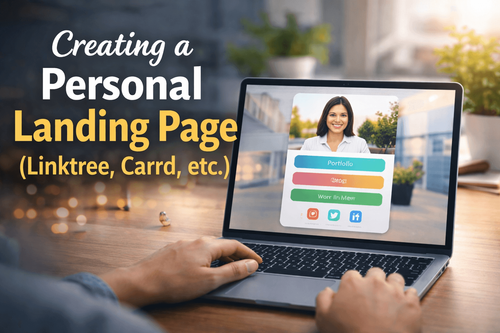

Build Your Personal Landing Page to Create Your Digital Professional Hub
You submit your CV for an
exciting opportunity. A recruiter searches your name online. A potential client wants to verify your expertise. A conference organiser considers you for a speaking role. What they find—or fail to find—shapes their decision in seconds.
Today, professional credibility extends far beyond a resume. Yet most working professionals have a fragmented online presence. Their LinkedIn profile is incomplete, their portfolio is scattered across platforms, and their achievements remain hidden in disconnected spaces. As a result, valuable opportunities are often lost before conversations even begin.
A personal landing page changes this reality. It acts as your digital headquarters—a single, shareable space that presents your value, showcases your work, and communicates your professional identity clearly. This guide explains how to build a powerful personal landing page quickly and strategically, helping you take control of your online presence and accelerate your career growth.
Who Is This Blog For?
This blog and the accompanying guidebook are designed for:
- Working professionals seeking stronger visibility and career opportunities
- Job seekers and career changers building a compelling online presence
- Consultants and freelancers showcasing services and expertise
- Managers and specialists strengthening personal brand credibility
- Creatives and knowledge workers building a professional portfolio
- Professionals struggling to present their achievements clearly online
Why This Topic Matters Today?
Professional visibility has become a critical career advantage. Recruiters, clients, and collaborators routinely research candidates online before making decisions. When professionals lack a clear digital presence, they risk losing opportunities to peers who are easier to evaluate and verify.
A fragmented online footprint creates several challenges:
- First impressions are formed from incomplete information
- Professional achievements remain difficult to discover
- Personal brand messaging becomes inconsistent
- Credibility appears weaker compared to competitors
- Career opportunities move toward more visible professionals
On the other hand, a well-structured personal landing page provides a single source of truth about your professional identity. It allows you to control how you are perceived, present your strongest work, and communicate value instantly. In a market driven by speed, clarity, and credibility, this level of visibility is no longer optional.
Core Concept or Framework Explained
The central idea behind building a personal landing page is creating a Digital Professional Hub—a single destination that consolidates your work, communicates your value, and guides visitors toward a clear action.
This approach focuses on intentional positioning rather than scattered online activity. Instead of maintaining disconnected profiles, you create a structured experience that answers key questions every visitor has:
- Who are you?
- What value do you provide?
- Why should someone trust you?
- What should they do next?
The guidebook introduces several practical frameworks to support this process:
- Purpose-first approach: Define your goal and audience before choosing tools or design
- Six-section page structure: A proven layout that builds trust progressively
- PAGE writing framework: A method for writing clear and persuasive professional copy
- Identity statement formulas: Structured approaches to communicating value quickly
- Design principles: Simple rules for creating professional visual presentation
Together, these frameworks help transform your professional presence into a strategic asset rather than a collection of disconnected information.
How This Blog and Guidebook Help You?
By following this blog and guidebook, you can:
- Clarify your professional positioning and personal brand
- Build a structured and credible online presence
- Present achievements in a compelling and measurable way
- Create a strong first impression for recruiters and clients
- Increase professional visibility and inbound opportunities
- Maintain a professional asset that evolves with your career
The result is greater control over your professional narrative and stronger positioning in competitive environments.
Step-by-Step Breakdown
Step 1: Define Your Purpose Before Building
Every effective landing page begins with clarity of intent. Many professionals choose platforms or templates before defining what their page should accomplish, which leads to unfocused results.
Start by identifying:
- Your primary audience such as recruiters, clients, or collaborators
- The main action you want visitors to take
- The impression you want to create
Purpose shapes your content, design, and structure. A job seeker’s page prioritises achievements and career history, while a consultant’s page focuses on services and results. Clear intent ensures every element supports your professional goals.
Step 2: Choose the Right Platform for Your Needs
There is no universally perfect platform. The best choice depends on your technical comfort, goals, and desired level of customisation.
Different platforms serve different purposes:
- Simple link hubs for social profiles and quick sharing
- Clean one-page sites for professional portfolios
- Knowledge-based pages for consultants and specialists
- Design-heavy platforms for creative professionals
When choosing a platform, consider:
- Setup time and ease of use
- Level of customisation required
- Cost and scalability
- Mobile responsiveness
- Feature compatibility with your goals
Avoid over-engineering your solution. A simple, functional page often delivers more value than a complex design.
Step 3: Build the Six Essential Page Sections
High-performing professional pages follow a consistent structure that builds credibility step by step.
Key sections include:
- Hero section presenting your name, identity statement, and primary action
- Positioning statement explaining your value and audience
- Proof of work demonstrating results and achievements
- Social proof such as testimonials or credentials
- Curated links to professional platforms and resources
- Clear call-to-action guiding visitor behaviour
This structure creates a logical journey from introduction to action, improving engagement and conversion.
Step 4: Write Clear and Persuasive Copy Using the PAGE Framework
Design attracts attention, but words drive action. The PAGE framework helps professionals write effective copy:
- Problem: Identify the challenge your audience faces
- Approach: Explain how you address it
- Gains: Highlight the outcomes or benefits
- Evidence: Provide proof of results
This method replaces vague descriptions with clear value propositions and measurable impact. Strong copy communicates expertise quickly and builds trust.
Step 5: Apply Simple Design Principles for Professional Impact
Professional design does not require advanced skills. Following a few consistent principles can dramatically improve visual credibility.
Focus on:
- Mobile-first layout for accessibility
- Clean spacing and minimal clutter
- Limited colour palette
- Consistent typography
- Clear visual hierarchy
Professional design emphasises clarity and restraint. Removing unnecessary elements often improves effectiveness more than adding new ones.
Step 6: Craft a Strong Professional Identity Statement
Your identity statement is the most visible element of your page. It communicates your value in a single sentence.
Effective identity statements typically include:
- Your role or expertise
- Your target audience
- The outcome you deliver
The goal is clarity and specificity. Instead of listing job titles, communicate how you create impact.
Step 7: Curate Proof of Work Strategically
Proof of work establishes credibility faster than claims alone. Select a small number of high-impact examples rather than presenting everything you have done.
Strong proof includes:
- Quantified results and outcomes
- Work samples or case studies
- Recognisable associations or clients
- External validation such as awards or recognition
Quality and relevance matter more than volume. Focus on demonstrating measurable value.
Step 8: Validate Quality Before Launch
Before publishing your page, review content, design, and functionality.
Verify:
- Accuracy of information and links
- Professional presentation and formatting
- Clear call-to-action visibility
- Mobile compatibility
- Search visibility settings
A structured review process ensures your page meets professional standards.
Common Mistakes or Pitfalls to Avoid
Several common mistakes reduce the effectiveness of personal landing pages:- Using job titles instead of value-focused identity statements
- Overloading pages with excessive links or information
- Neglecting professional visuals such as headshots
- Providing no clear call-to-action
- Ignoring mobile optimisation
- Writing generic or jargon-heavy content
- Failing to update the page regularly
- Copying others instead of building an authentic identity
Avoiding these issues improves clarity, credibility, and engagement.
How Should You Use This Guidebook Effectively?
To maximise results, follow a structured implementation approach:
- Read the guide once to understand the overall framework
- Define your purpose and audience before building
- Draft your identity statement and positioning
- Build your page using the recommended structure
- Review quality using checklists and validation steps
- Allocate 2–4 focused hours for initial setup
- Update your page regularly as your career evolves
Treat your landing page as a long-term professional asset rather than a one-time project.
Key Takeaways
- A personal landing page strengthens professional visibility and credibility
- Define your purpose before choosing platforms or design
- Structure your page to guide visitors from introduction to action
- Use clear frameworks to communicate value effectively
- Demonstrate impact through measurable proof of work
- Apply simple design principles for professional presentation
- Maintain and update your page regularly
- Treat your digital presence as a strategic career investment
Your Next Step: Accelerate Your Career with PlanetSpark
Creating an impact-driven resume is not just about landing your next job—it’s about owning your professional story and presenting it with clarity, confidence, and credibility. When your resume clearly communicates value, results, and impact, opportunities follow naturally.
At PlanetSpark, we are committed to empowering working professionals with practical, outcome-focused resources that drive real career growth. From resume building and workplace communication to leadership presence and professional writing, our programs are designed to help you succeed in today’s fast-evolving job market.
Visit https://www.planetspark.in/resources to explore:
- Career and resume-building guides
- Workplace communication and professional writing resources
- Skill-development tools curated for working professionals
Want a deeper, hands-on experience?
You can also book a free trial session to learn more about PlanetSpark’s Working Professional Courses, designed to accelerate your career through personalised coaching, real-world practice, and expert guidance. Your career deserves more than generic advice. It deserves clarity, confidence, and measurable impact.
Start building that advantage today—with PlanetSpark.