
Program Management Leadership Resume Guide for Professionals

Resume Template Highlighting Program Management Leadership: How to Showcase Strategic Delivery, Governance, and Cross-Functional Impact
You’ve led multiple projects. Coordinated teams. Delivered outcomes across departments.
Book your free trial session today with Planetspark.
Download for more details or PDF file.
But your resume still reads like a project manager’s—not a program leader’s.
That’s the gap.
Program management is not about executing a single initiative. It is about orchestrating multiple workstreams, aligning stakeholders, managing governance, and delivering business outcomes at scale.
If your resume does not clearly communicate programme-level leadership—portfolio ownership, cross-functional complexity, and strategic impact—you risk being perceived as a project executor rather than a program leader.
This guide, built from a structured template pack, shows you how to position your program management experience with clarity, authority, and measurable results—so recruiters and hiring managers immediately recognise your leadership capability.
Who Is This Blog For?
- Program managers aiming for senior or director-level roles
- PMO leads and portfolio managers
- Project managers transitioning into program leadership
- Transformation and delivery leaders
- Consultants moving into program or PMO roles
- Professionals managing cross-functional or multi-workstream initiatives
Why This Topic Matters Today?
Program management has become one of the most strategically critical roles in modern organisations.
Companies are not just hiring people to deliver projects—they are hiring leaders who can:
- Align multiple initiatives to business strategy
- Manage cross-functional dependencies
- Govern large portfolios and budgets
- Influence senior stakeholders and executives
However, most resumes fail to reflect this level of responsibility.
As highlighted in the resource, common mistakes include:
- Listing tasks instead of programme-level outcomes
- Ignoring governance structures and portfolio scale
- Using generic language instead of leadership-focused wording
- Not quantifying team size, budget, or complexity
This leads to a major problem: experienced professionals appear junior on paper.
Your resume must reflect the true scale of your work.
Core Concept or Framework Explained
The foundation of a strong program management resume is:
Portfolio → Governance → Outcome
Portfolio
The scope of programmes—number of initiatives, teams, regions, or budget.
Governance
How you structured and managed delivery—frameworks, reporting, risk management.
Outcome
The measurable business impact—efficiency, revenue, transformation success.
For example:
Instead of “Managed multiple projects”
Use:
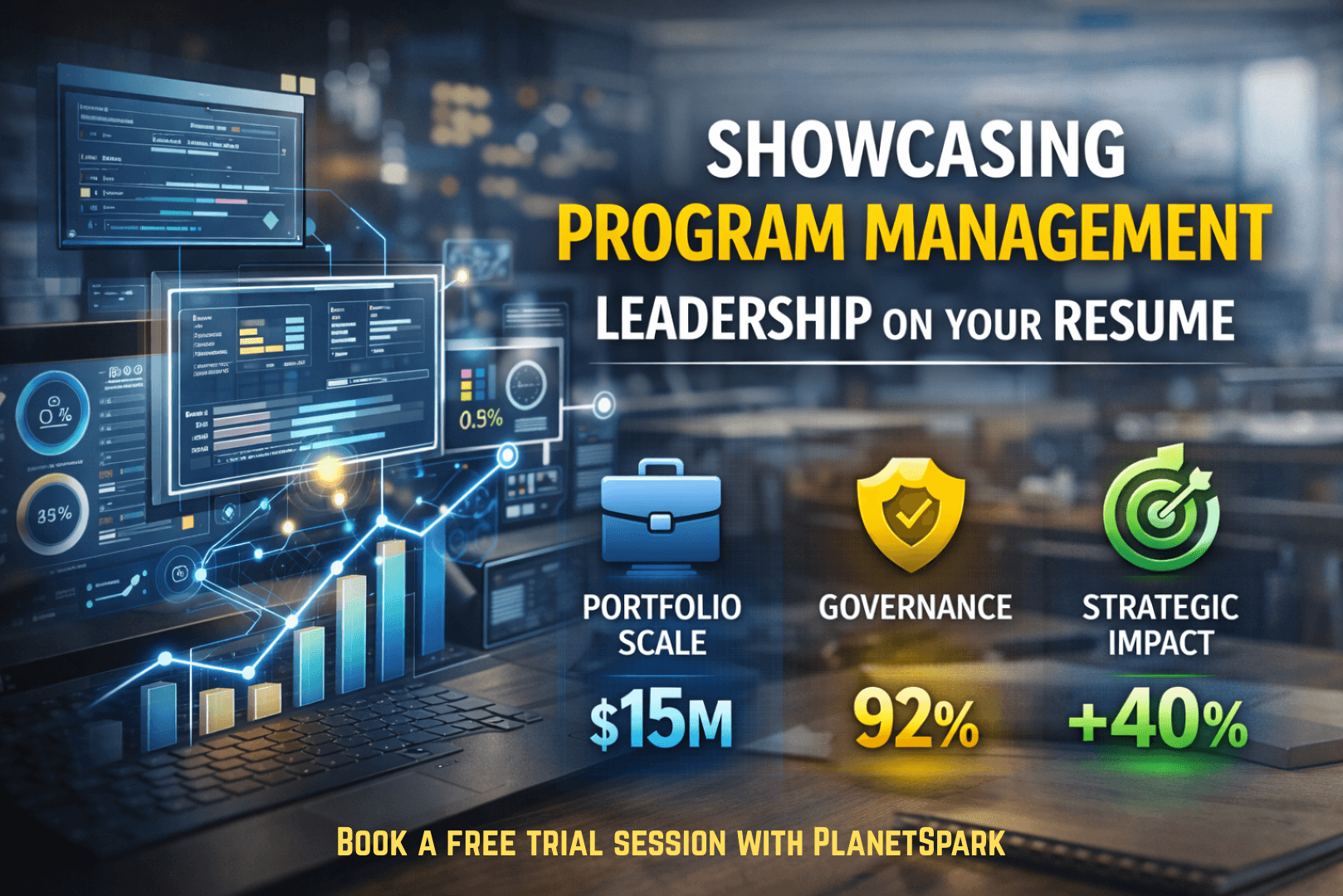
“Governed portfolio of 12 strategic programmes worth $15M, achieving 92% on-time delivery through structured PMO governance”
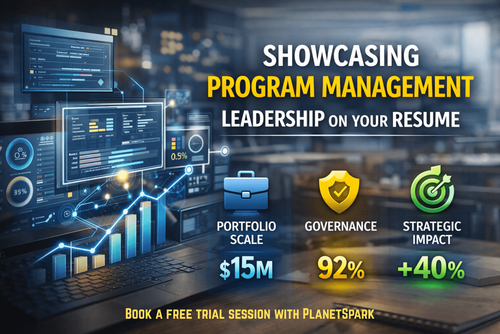
The illustration on page 1 visually reinforces this idea by showing interconnected dashboards, timelines, and project streams—highlighting that program management is about coordinated, multi-layered delivery rather than isolated execution.
Every section of your resume should reflect this portfolio-level thinking.
How This Blog and Guidebook Help You?
This guide transforms structured templates into actionable strategies.
By applying these frameworks, you will:
- Position yourself as a program leader, not just a project manager
- Highlight governance, stakeholder management, and portfolio ownership
- Improve ATS visibility with relevant keywords
- Align your resume with recruiter expectations for senior roles
- Increase interview calls for leadership positions
Instead of listing activities, you will demonstrate strategic impact.
Step-by-Step Breakdown
Step 1: Choose the Right Program Leadership Scenario
The template pack includes 10 scenario-based templates such as:
- PMO Director entry role
- Enterprise transformation programme lead
- Agile programme manager
- Cross-functional programme architect
- Infrastructure and capital programme lead
- Career switcher into programme leadership
- Executive stakeholder-facing programme director
- Re-entry programme manager
- Freelance or fractional programme lead
- Global programme delivery head
Choosing the right scenario ensures your resume reflects your career context accurately.
Step 2: Highlight Portfolio Scale Clearly
Always include:
- Number of programmes managed
- Budget size
- Team size
- Business impact
Example:
“Governed portfolio of 8 programmes across 5 business units with $10M combined budget”
This immediately signals seniority.
Step 3: Showcase Governance and Structure
Program leaders are defined by governance.
Highlight:
- PMO frameworks
- Reporting systems (RAID logs, dashboards)
- Risk and issue management
- Stage-gate processes
This shows your ability to manage complexity.
Step 4: Emphasise Cross-Functional Leadership
Program management is about influence, not authority.
Include:
- Teams across departments
- Stakeholder alignment
- Dependency management
This demonstrates leadership maturity.
Step 5: Quantify Programme Outcomes
Numbers validate your impact.
Examples:
- Delivered 95% on-time programme completion
- Reduced delivery delays by 30%
- Managed $20M transformation programme
- Improved stakeholder alignment scores by 40%
Quantification is essential for credibility.
Step 6: Use Leadership-Focused Language
Avoid weak phrases like:
- Helped
- Assisted
- Worked on
Use:
- Governed
- Orchestrated
- Directed
- Delivered
- Aligned
Strong language signals authority.
Step 7: Highlight Stakeholder and Executive Engagement
Senior program roles require visibility at the top.
Include:
- C-suite reporting
- Board presentations
- Executive decision-making support
This differentiates you from project managers.
Step 8: Align with ATS Keywords
Use keywords such as:
- Programme governance
- Portfolio management
- Stakeholder alignment
- Benefits realisation
- Transformation delivery
This improves ATS performance.
Step 9: Structure Experience Around Program Impact
Each bullet point should answer:
- What did you govern?
- What was the scale?
- What was the outcome?
Structure:
Action + Portfolio Scope + Result
This ensures clarity and impact.
Step 10: Customise for Each Role
Templates provide structure—but customisation drives results.
For each application:
- Align keywords with job description
- Highlight relevant programmes
- Emphasise industry-specific experience
This increases both ATS success and recruiter engagement.
Common Mistakes or Pitfalls to Avoid
- Writing resumes focused on project-level tasks
- Not showing portfolio or programme scale
- Ignoring governance structures
- Using weak or generic language
- Not quantifying outcomes
- Failing to highlight stakeholder complexity
These mistakes reduce your perceived seniority.
How Should You Use This Guidebook Effectively?
Follow this workflow:
- Identify your program leadership scenario
- Select the most relevant template
- Replace placeholders with quantified outcomes
- Structure experience around portfolio and impact
- Align keywords with job description
- Review for clarity and ATS compatibility
Recommended approach:
- Spend 2–3 hours building your first draft
- Customise for each application
- Update regularly as you lead new programmes
Think of your resume as a leadership portfolio—not just a career summary.
Key Takeaways
- Program management resumes must reflect portfolio-level thinking
- Governance and stakeholder alignment are critical signals
- Quantification strengthens credibility and impact
- Leadership language differentiates you from project managers
- Templates provide structure, but customisation drives results
- ATS optimisation is essential for visibility
- Clear positioning significantly increases interview chances
Your Next Step: Accelerate Your Career with PlanetSpark
Creating an impact-driven resume is not just about landing your next job—it’s about owning your professional story and presenting it with clarity, confidence, and credibility. When your resume clearly communicates value, results, and impact, opportunities follow naturally.
At PlanetSpark, we are committed to empowering working professionals with practical, outcome-focused resources that drive real career growth. From resume building and workplace communication to leadership presence and professional writing, our programs are designed to help you succeed in today’s fast-evolving job market.
Visit https://www.planetspark.in/resources to explore:
- Career and resume-building guides
- Workplace communication and professional writing resources
- Skill-development tools curated for working professionals
Want a deeper, hands-on experience?
You can also book a free trial session to learn more about PlanetSpark’s Working Professional Courses, designed to accelerate your career through personalised coaching, real-world practice, and expert guidance.
Your career deserves more than generic advice.
It deserves clarity, confidence, and measurable impact.
Personalized Communication Roadmaps
Record a video to get a AI generated personalized communication reports