
PSU Technical Assistant Biodata Guide for Professionals
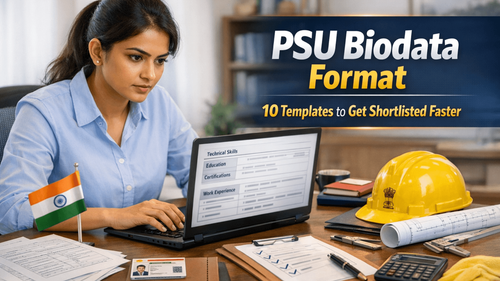

Best Biodata Format for PSU Technical Assistant Roles: 10 Templates to Get Shortlisted Faster
If you are applying for a PSU Technical Assistant role, your biodata is more than just a document — it is your first evaluation stage.
Recruiters in public sector units often spend only a few seconds scanning each application before deciding whether to proceed. In that short time, your document must clearly communicate your technical skills, qualifications, and relevance to the role.
Many qualified candidates lose opportunities simply because their biodata lacks structure, clarity, or alignment with PSU expectations.
The PlanetSpark Biodata Template Pack for PSU Technical Assistant Roles solves this problem by providing 10 professionally structured templates tailored for different career stages and technical scenarios.
Who Is This Blog For?
- Engineering and diploma graduates applying for PSU technical assistant roles
- Professionals transitioning from private sector to government jobs
- Mid-career engineers seeking stable PSU opportunities
- Freelancers and consultants applying for contractual PSU roles
- Candidates applying through online portals or ATS systems
- Research professionals targeting R&D roles in PSUs
Why This Topic Matters Today?
Public Sector Unit (PSU) jobs are among the most competitive and structured career opportunities in India. Unlike private sector roles, PSU recruitment focuses heavily on:
- Structured documentation and formal presentation
- Technical qualifications and certifications
- Compliance with government application formats
In this environment, a generic resume often fails. A well-structured biodata ensures:
- Clear presentation of technical competencies
- Alignment with recruiter expectations and ATS systems
- Better readability during shortlisting
Given that recruiters often scan applications in 6–10 seconds, structure and clarity become critical decision factors.
Core Concept or Framework Explained
The template pack is built on a scenario-based framework, recognising that PSU applicants come from diverse backgrounds.
Instead of a single format, it provides 10 distinct templates, each designed for a specific professional situation.
These templates are based on three core principles:
- Role-specific structuring: Each template aligns with a real-world PSU application scenario
- Technical-first presentation: Focus on skills, tools, certifications, and measurable outcomes - Recruiter-friendly layout: Designed for clarity, scannability, and ATS compatibility
For example:
- ATS-Optimised templates improve keyword matching for online applications
- Skills-First templates highlight competencies over career timeline
- Project-Based templates emphasise large-scale technical work and achievements
This structured approach ensures your biodata matches both human and automated evaluation systems.
How This Blog and Guidebook Help You?
This guide helps you:
- Identify the most relevant biodata format for your career stage
- Present technical skills and experience effectively
- Avoid formatting mistakes that reduce readability
- Align your biodata with PSU recruitment standards
- Save time using ready-to-use, professionally designed templates
Ultimately, it helps you position yourself as a competent, organised, and job-ready technical professional.
Step-by-Step Breakdown
Step 1: Choose the Right Template for Your Scenario
The pack includes 10 templates designed for different use cases:
- Classic PSU Biodata for standard applications
- ATS-Optimised Biodata for online submissions
- Skills-First Profile for competency-driven presentation
- Fresh Graduate Biodata for entry-level roles
- Career Switch Biodata for transitioning professionals
- Project-Based Biodata for engineers with large project experience
- Mid-Career Specialist Biodata for experienced professionals
- Freelance/Contractual Biodata for consultants
- Research & Development Biodata for academic profiles
- Bilingual Biodata for regional applications
Choosing the right template ensures your application is relevant and targeted.
Step 2: Add Personal and Contact Information
Include:
- Full name, date of birth, and category
- Contact details and address
- Identification and eligibility-related information
Accuracy and consistency with official documents are critical.
Step 3: Present Educational Qualifications Clearly
PSU recruiters place strong emphasis on academic background.
Include:
- Degree or diploma details (B.Tech, ITI, etc.)
- Institution name, year of passing, and scores
- GATE or other competitive exam scores if applicable
Keep this section structured and easy to scan.
Step 4: Highlight Technical Skills and Tools
This is the most important section for PSU roles.
Include:
- Domain-specific skills such as electrical systems, PLC programming, or civil design
- Software tools like AutoCAD, MATLAB, or ERP systems
- Compliance and safety standards knowledge
Templates like the Skills-First and ATS-Optimised formats prioritise this section. :contentReference[oaicite:4]{index=4}
Step 5: Showcase Work Experience or Projects
Depending on your background:
- Freshers should highlight academic projects and internships
- Experienced professionals should include job roles and achievements
- Project-based professionals should detail project scope, scale, and outcomes
Use measurable results wherever possible.
Step 6: Include Certifications and Credentials
Certifications strengthen your profile significantly.
Examples include:
- Technical certifications (AutoCAD, PLC, etc.)
- Safety certifications and compliance training
- GATE scores or PSU-specific exam results
These validate your expertise and readiness.
Step 7: Add Role-Specific Sections
Different templates include specialised sections such as:
- Project portfolios for EPC and infrastructure roles
- Research publications for R&D positions
- Availability and engagement history for freelancers
Customising these sections improves relevance.
Step 8: Add Declaration and Final Details
End your biodata with:
- A declaration confirming accuracy
- Place, date, and signature
This is mandatory for most PSU applications.
Common Mistakes or Pitfalls to Avoid
- Using a generic resume instead of a PSU-specific biodata
- Ignoring ATS optimisation for online applications
- Listing skills without supporting experience or results
- Overcomplicating formatting or changing template structure
- Leaving sections incomplete or blank
- Not tailoring the biodata to the specific role
These mistakes can reduce your chances of shortlisting.
How Should You Use This Guidebook Effectively?
To get maximum value:
- Select the template that best matches your career stage
- Replace placeholders with accurate and relevant information
- Maintain the original structure for readability
- Customise content based on the role and PSU requirements
- Convert the final document into PDF before submission
The templates are designed for quick customisation and clean conversion to Word or Google Docs, ensuring flexibility across application formats.
Key Takeaways
- A structured biodata is essential for PSU technical roles
- Different career stages require different biodata formats
- Technical skills and certifications are the most critical sections
- ATS-friendly formatting improves online application success
- Project and experience details should be measurable and relevant
- A well-designed biodata increases your chances of shortlisting
Your Next Step: Accelerate Your Career with PlanetSpark
Creating an impact-driven resume is not just about landing your next job—it’s about owning your professional story and presenting it with clarity, confidence, and credibility. When your resume clearly communicates value, results, and impact, opportunities follow naturally.
At PlanetSpark, we are committed to empowering working professionals with practical, outcome-focused resources that drive real career growth. From resume building and workplace communication to leadership presence and professional writing, our programs are designed to help you succeed in today’s fast-evolving job market.
Visit https://www.planetspark.in/resources to explore:
- Career and resume-building guides
- Workplace communication and professional writing resources
- Skill-development tools curated for working professionals
Want a deeper, hands-on experience?
You can also book a free trial session to learn more about PlanetSpark’s Working Professional Courses, designed to accelerate your career through personalised coaching, real-world practice, and expert guidance.
Your career deserves more than generic advice.
It deserves clarity, confidence, and measurable impact.
Personalized Communication Roadmaps
Record a video to get a AI generated personalized communication reports