
Referral Strategy Roadmap to Accelerate Career Growth
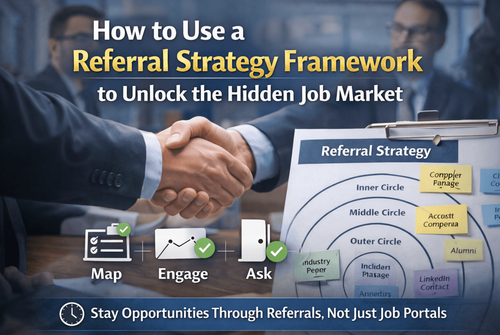

How to Use a Referral Strategy Framework to Unlock the Hidden Job Market
Most professionals believe that landing the next job depends primarily on submitting applications through job portals. They spend hours refining their CV, applying to dozens of roles, and waiting for responses that often never arrive. The frustration is real, but the underlying problem is not effort. It is strategy.
A significant portion of career opportunities never reach job portals. Many roles are filled through internal recommendations, trusted introductions, and informal conversations before they are publicly advertised. This means professionals who rely only on job applications are competing in the most crowded channel while ignoring the most powerful one.
The Referral Strategy Framework offers a structured approach to accessing these hidden opportunities. Instead of hoping for lucky introductions, it provides a systematic method for mapping relationships, building rapport, and making confident referral requests. Designed for busy professionals, the framework converts networking into a disciplined process that consistently produces career momentum.
Who Is This Blog For?
- Professionals actively searching for new career opportunities
- Mid-career professionals exploring leadership or transition roles
- Consultants and freelancers building client pipelines
- Career changers entering new industries
- Professionals who want to strengthen their long-term professional network
Why This Topic Matters Today?
In modern hiring markets, many roles are filled before they ever appear on job boards. According to the guide, a large percentage of job opportunities are filled through referrals, recommendations, and internal introductions rather than public postings.
Despite this reality, most professionals still focus their job search on portals and applications.
This mismatch creates several problems:
- Qualified candidates remain invisible to hiring managers
- Job searches become long and discouraging
- Professionals compete with hundreds of applicants for each posting
- Opportunities within personal networks remain untapped
Referral strategies solve this problem by shifting the focus from portals to people. Instead of waiting for job openings, professionals build relationships that lead to opportunities organically.
Core Concept or Framework Explained
The Referral Strategy Framework is built around a five-phase system designed to transform professional relationships into career opportunities.
Rather than relying on random networking efforts, the framework treats referrals as the result of deliberate actions.
The five phases are:
Map
Prioritise
Engage
Ask
Nurture
Each phase builds on the previous one. Professionals who skip early stages often fail because they jump directly to asking for help before building trust.
By following all five phases, referral conversations feel natural rather than transactional.
How This Blog and Guidebook Help You?
Applying the referral strategy framework helps professionals:
- Discover opportunities that never reach job boards
- Strengthen relationships with colleagues and industry contacts
- Build a consistent pipeline of referrals and introductions
- Approach networking conversations with clarity and confidence
- Create long-term professional goodwill within their network
Instead of treating networking as an uncomfortable activity, professionals learn to manage it as a structured career growth system.
Step-by-Step Breakdown
Step 1: Map Your Professional Network
Before asking anyone for referrals, professionals need to understand the full scope of their existing network.
Most people underestimate how many useful connections they already have.
The framework recommends mapping contacts across three circles.
Inner Circle
This includes people who know your work closely and would advocate for you immediately.
Examples include:
- Current managers
- Former supervisors
- Close colleagues
- Mentors or coaches
- Trusted industry friends
Middle Circle
These are professionals who know you but may not interact with you regularly.
Examples include:
- Former coworkers
- Alumni connections
- Industry peers
- Project collaborators
Outer Circle
This includes professional contacts who may not know you well but share industry or organisational links.
Examples include:
- LinkedIn connections
- Conference contacts
- Alumni from your university
- Professionals you have met briefly
Interestingly, weak connections in the outer circle often generate the most job leads because they operate in networks different from your own.
Step 2: Prioritise the Right Contacts
After mapping your network, the next step is deciding where to focus your energy.
The framework recommends evaluating contacts across two dimensions:
Relationship Strength
How well the person knows you and your work.
Opportunity Relevance
How closely the person is connected to the companies, industries, or roles you want to enter.
Contacts who score high on both dimensions become top priorities.
Professionals should typically focus on a shortlist of around 10–20 key contacts who are most likely to open the right doors.
Step 3: Engage Before You Ask
This stage is where many professionals fail.
Instead of building relationships first, they immediately ask for referrals.
The framework emphasises building genuine rapport before making any request.
Engagement strategies include:
- Commenting thoughtfully on LinkedIn posts
- Congratulating contacts on professional milestones
- Sharing relevant articles or insights
- Sending personalised messages referencing their work
Think of relationship-building as making deposits into a relationship bank account. Only after several positive interactions should a professional make a referral request.
Step 4: Ask for Referrals Clearly and Confidently
Many professionals hesitate at this stage because they fear appearing desperate or transactional.
However, the key to effective referral requests is clarity.
A strong referral request includes five components:
Context
Explain your career direction or the opportunity you are exploring.
Specificity
Clearly mention the type of role, company, or introduction you are seeking.
Low Friction
Make the request easy for the person to act on.
Graceful Exit
Allow the person to decline comfortably if they are unable to help.
Gratitude
Acknowledge their time and willingness to assist.
For example, instead of saying “Let me know if you hear of anything,” a professional might say:
“I’m currently exploring product management roles in B2B SaaS companies. Do you happen to know anyone at Company X or Y who might be open to a short conversation?”
Clear requests make it easier for contacts to help.
Step 5: Nurture Relationships Over Time
Referral strategies succeed when relationships continue beyond a single conversation.
After receiving help or introductions, professionals should always close the loop.
This means updating contacts on outcomes and thanking them sincerely.
A simple nurturing cadence can include:
- Sending a thank-you message within 24 hours
- Sharing a useful resource after one week
- Updating them on progress after one month
- Checking in every quarter
Consistent communication ensures that relationships remain active and supportive.
Common Mistakes or Pitfalls to Avoid
Reaching Out Only When You Need Something
Professionals who contact their network only during job searches often weaken relationships.
Maintaining regular contact prevents this issue.
Being Vague About What You Need
Vague requests create confusion and reduce the likelihood of helpful responses.
Always specify the role, company, or connection you are seeking.
Sending Generic Messages
Copy-paste outreach messages signal a lack of genuine interest.
Personalisation dramatically improves response rates.
Failing to Close the Loop
Many professionals forget to update contacts after receiving help.
Sharing outcomes shows respect and strengthens relationships.
Neglecting Network Tracking
Without tracking conversations and introductions, professionals often forget follow-ups.
Maintaining a simple referral tracker keeps the process organised.
How Should You Use This Guidebook Effectively?
To get the most value from the referral strategy framework, professionals should follow a structured routine.
Week 1
Map your network and identify at least 30 contacts across the three circles.
Week 2
Prioritise the top 20 contacts based on relationship strength and opportunity relevance.
Week 3
Begin engagement by reconnecting with key contacts through personalised messages.
Week 4
Make your first referral requests and track all conversations.
Ongoing
Continue nurturing relationships through regular check-ins and updates.
Consistency is far more important than intensity.
Key Takeaways
- Many career opportunities are discovered through referrals rather than job portals
- A structured referral strategy helps professionals access hidden opportunities
- Mapping your network reveals valuable connections you may have overlooked
- Prioritising contacts ensures your effort focuses on the most relevant relationships
- Building rapport before asking for help strengthens professional trust
- Specific and clear referral requests increase the likelihood of introductions
- Long-term relationship nurturing creates ongoing career opportunities
Your Next Step: Accelerate Your Career with PlanetSpark
Creating an impact-driven resume is not just about landing your next job—it’s about owning your professional story and presenting it with clarity, confidence, and credibility. When your resume clearly communicates value, results, and impact, opportunities follow naturally.
At PlanetSpark, we are committed to empowering working professionals with practical, outcome-focused resources that drive real career growth. From resume building and workplace communication to leadership presence and professional writing, our programs are designed to help you succeed in today’s fast-evolving job market.
Visit https://www.planetspark.in/resources to explore:
- Career and resume-building guides
- Workplace communication and professional writing resources
- Skill-development tools curated for working professionals
Want a deeper, hands-on experience?
You can also book a free trial session to learn more about PlanetSpark’s Working Professional Courses, designed to accelerate your career through personalised coaching, real-world practice, and expert guidance.
Your career deserves more than generic advice.
It deserves clarity, confidence, and measurable impact.
Personalized Communication Roadmaps
Record a video to get a AI generated personalized communication reports