
Remote Work Setup Checklist for Working Professionals
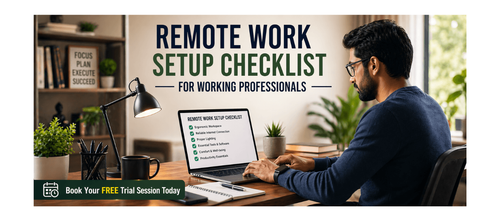

Remote Work Setup Checklist: A Practical Guide to Build a Productive, Professional Workspace That Drives Real Results
If you’ve ever started your workday from your dining table, struggled with unstable internet during an important call, or felt like your day never truly “ends”—you’re not alone.
Most working professionals don’t fail at remote work because of lack of effort. They fail because they don’t have a system.
Remote work isn’t just about working from home—it’s about working effectively from home. And without a structured setup, even the most capable professionals experience distractions, burnout, and reduced performance.
That’s exactly why the Remote Work Setup Checklist exists. It’s designed for professionals who want to build a high-performance remote work environment that supports focus, credibility, and long-term productivity—not just survival.
This guide gives you a complete, step-by-step system to design your workspace, optimise your tools, improve communication, and protect your energy.
Who Is This Blog For?
- Working professionals transitioning to remote or hybrid roles
- Managers and consultants working across distributed teams
- Early to mid-career professionals struggling with productivity at home
- Freelancers and remote-first employees building their workspace
- Anyone who feels busy all day but not truly productive
Why This Topic Matters Today?
Remote work is no longer optional—it is the default for many professionals.
As highlighted on page 2, most people enter remote work without a structured setup, leading to:
- Missed deadlines due to distractions
- Blurred boundaries between work and personal life
- Reduced professional visibility
- Constant dependency on unstable tools or systems
The gap between “working from home” and “working effectively from home” is significant.
A well-designed setup doesn’t just improve productivity—it protects your career growth, professional reputation, and mental wellbeing.
Core Concept or Framework Explained
The guide introduces a four-phase system (pages 3–6) to build a complete remote work environment:
- Physical Workspace: Your environment and ergonomics
- Technology & Infrastructure: Tools and connectivity
- Communication & Visibility: How you stay seen and credible
- Boundaries & Wellbeing: How you sustain performance
Each phase addresses a different failure point in remote work—and together, they create a sustainable system.
How This Blog and Guidebook Help You?
By applying this system, you can:
- Eliminate distractions and improve focus
- Build a professional, client-ready setup
- Ensure reliable and interruption-free work
- Improve visibility and communication with your team
- Prevent burnout and maintain long-term productivity
Most importantly, you shift from reactive remote work to intentional performance.
Step-by-Step Breakdown
Phase 1: Build Your Physical Workspace
Your environment directly impacts your productivity.
As explained on page 3, your workspace should include:
- A dedicated work zone (not your bed or sofa)
- Proper ergonomic setup (screen at eye level, chair support)
- Good lighting and clean background for video calls
- Noise management strategies
A key insight: even a small, consistent space creates a powerful mental boundary for focus.
Phase 2: Set Up Your Technology & Infrastructure
Your tools are your office in remote work.
According to page 4, you need:
- Reliable internet (with backup options)
- Essential hardware (monitor, webcam, headset)
- Security systems (VPN, password manager, backups)
- Collaboration tools (Zoom, Slack, project management apps)
The goal is not expensive tools—it’s reliable systems.
Phase 3: Master Communication & Visibility
In remote work, communication equals presence.
As highlighted on page 5:
- Set clear working hours
- Define response time expectations
- Use camera-on discipline for trust
- Share proactive updates regularly
A powerful shift: don’t wait to be asked—make your work visible before questions arise.
Phase 4: Protect Your Focus, Boundaries & Wellbeing
Remote work fails when boundaries collapse.
The daily system on page 6 includes:
- Morning start ritual
- Deep work blocks
- Mid-day reset
- End-of-day shutdown ritual
The shutdown ritual—reviewing tasks, setting next priorities, and closing work—prevents burnout and mental overload.
Real-World Application: 7-Day Setup Plan
The action plan on page 7 provides a simple implementation roadmap:
- Day 1: Set up workspace
- Day 2: Fix internet and connectivity
- Day 3: Secure data and tools
- Day 4: Define communication systems
- Day 5: Audit tools
- Day 6: Schedule deep work
- Day 7: Implement shutdown ritual
This phased approach ensures quick and sustainable improvement.
Common Mistakes or Pitfalls to Avoid
The guide highlights key remote work mistakes:
- Working from bed or unstructured spaces
- Setting up tools reactively instead of proactively
- Being invisible due to poor communication
- Skipping boundaries and working continuously
- Ignoring ergonomics and long-term health
Each of these reduces productivity and professional credibility.
How Should You Use This Guidebook Effectively?
To maximise results:
- First scan all phases to identify gaps
- Start with physical workspace improvements
- Gradually upgrade tools and systems
- Build communication habits consistently
- Implement daily rituals for sustainability
Time investment:
- Initial setup: 2–4 hours
- Ongoing optimisation: 15–20 minutes weekly
Consistency matters more than perfection.
Key Takeaways
- Remote work success depends on systems, not effort
- A dedicated workspace improves focus instantly
- Reliable tools prevent professional disruption
- Communication determines visibility and credibility
- Boundaries protect long-term performance
- Small, structured changes create massive impact
Your Next Step: Accelerate Your Career with PlanetSpark
Creating an impact-driven resume is not just about landing your next job—it’s about owning your professional story and presenting it with clarity, confidence, and credibility. When your resume clearly communicates value, results, and impact, opportunities follow naturally.
At PlanetSpark, we are committed to empowering working professionals with practical, outcome-focused resources that drive real career growth. From resume building and workplace communication to leadership presence and professional writing, our programs are designed to help you succeed in today’s fast-evolving job market.
Visit https://www.planetspark.in/resources to explore:
- Career and resume-building guides
- Workplace communication and professional writing resources
- Skill-development tools curated for working professionals
Want a deeper, hands-on experience?
You can also book a free trial session to learn more about PlanetSpark’s Working Professional Courses, designed to accelerate your career through personalised coaching, real-world practice, and expert guidance.
Your career deserves more than generic advice.
It deserves clarity, confidence, and measurable impact.
Start building that advantage today—with PlanetSpark.
Personalized Communication Roadmaps
Record a video to get a AI generated personalized communication reports