
Research Publication CV Guide for Academic Career Growth
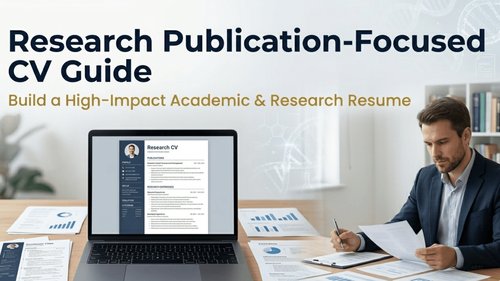

Research Publication-Focused CV Guide: Build a High-Impact Academic and Research Resume That Gets Noticed
If you’ve ever tried building a research-focused CV from scratch, you know how overwhelming it can be. Structuring publications, deciding section order, showcasing impact, and tailoring your profile for different opportunities often turns into hours of confusion and second-guessing.
Whether you are applying for a faculty role, a postdoctoral fellowship, a research grant, or transitioning into industry R&D, your CV needs to do more than list achievements. It must clearly communicate credibility, impact, and relevance.
This is exactly where the Research Publication-Focused CV Template pack becomes a powerful solution. Designed by career strategists, it removes guesswork and helps you present your research profile with clarity, structure, and confidence.
Who Is This Blog For?
- Academic researchers applying for faculty or lecturer roles
- PhD graduates seeking postdoctoral opportunities
- Professionals submitting research grant or funding applications
- Researchers transitioning into industry or consulting roles
- Early-career professionals building their first research CV
- Interdisciplinary researchers struggling to present a cohesive profile
Why This Topic Matters Today?
In today’s competitive academic and research landscape, your CV is not just a document—it is your professional identity. Hiring committees, grant panels, and recruiters evaluate not only what you have done, but how effectively you communicate it.
Many professionals struggle with:
- Presenting publications in a structured and credible format
- Highlighting research impact rather than just activity
- Aligning their CV with specific roles like academia, grants, or industry
- Balancing technical depth with readability
The result is a CV that looks incomplete or unfocused, even if the candidate is highly qualified.
This template pack addresses these challenges by offering 10 distinct CV formats tailored to real-world scenarios—from academic roles to consulting and international opportunities.
Core Concept or Framework Explained
The core idea behind this guidebook is simple but powerful: a research CV must be context-specific, impact-driven, and structurally clear.
Instead of using one generic CV for every opportunity, the framework encourages professionals to:
- Choose a CV structure aligned with their career goal
- Highlight the most relevant sections based on the role
- Present research contributions in measurable and credible formats
- Use guided placeholders to ensure no critical detail is missed
For example, a faculty CV emphasises teaching experience, publications, and service contributions, while a grant CV focuses on funding history, research impact, and measurable outputs.
Similarly, an industry transition CV reframes academic experience into business outcomes such as efficiency improvements, product impact, or cross-functional collaboration.
This approach ensures your CV is not just comprehensive—but strategically aligned.
How This Blog and Guidebook Help You?
This blog and the accompanying template pack help you:
- Save hours of formatting and structuring effort
- Present your research in a recruiter-friendly format
- Align your CV with specific career goals and opportunities
- Showcase publications, grants, and impact effectively
- Build a professional, polished CV ready for submission
Most importantly, it helps you move from a generic profile to a targeted, high-impact professional narrative.
Step-by-Step Breakdown
Step 1: Choose the Right CV Template for Your Goal
The template pack includes 10 specialised CV formats, each designed for a specific use case:
- Academic Faculty CV for teaching and research roles
- Postdoctoral Fellowship CV for advanced research positions
- Research Grant CV for funding applications
- Industry R&D CV for corporate transitions
- Early-Career CV for beginners with limited publications
- Interdisciplinary CV for cross-domain researchers
- Science Communication CV for public-facing roles
- Consulting CV for advisory professionals
- Conference Speaker CV for thought leadership profiles
- International Mobility CV for global opportunities
Choosing the right template ensures your strengths are positioned correctly from the start.
Step 2: Craft a Strong Research or Professional Summary
Every template begins with a concise summary that defines your expertise and value.
For example:
- A research profile highlights methodologies, focus areas, and contributions
- An industry profile focuses on outcomes and real-world applications
This section sets the tone and immediately communicates relevance to the reader.
Step 3: Structure Your Education and Research Experience
Your academic background should be presented clearly, including:
- Degrees, institutions, and years
- Thesis or dissertation titles
- Supervisors where relevant
Research experience should focus on:
- Key contributions
- Techniques or methodologies used
- Measurable outcomes where possible
This ensures your experience is both detailed and easy to evaluate.
Step 4: Present Publications with Credibility
Publications are central to a research CV, but they must be structured correctly.
The templates guide you to organise them into:
- Peer-reviewed journal articles
- Book chapters
- Conference proceedings
Each entry includes:
- Authors
- Title
- Journal or conference name
- Year and additional details like DOI or citations
This format enhances credibility and readability.
Step 5: Highlight Impact, Not Just Activity
One of the most powerful aspects of the templates is their focus on impact metrics.
For example, in a grant CV, you highlight:
- Total publications and citations
- H-index and i10-index
- Patents and technology transfers
- Policy influence or real-world applications
This shifts your CV from descriptive to evidence-driven.
Step 6: Tailor Sections Based on Your Career Path
Each template includes specialised sections depending on the use case:
- Teaching experience for academic roles
- Technical skills and tools for postdoctoral positions
- Core competencies for industry roles
- Consulting engagements for advisory profiles
- Media reach and speaking engagements for thought leaders
This ensures your CV speaks directly to what decision-makers care about.
Step 7: Finalise, Format, and Submit Professionally
The guidebook provides clear instructions to:
- Replace placeholders with your information
- Adjust section order based on strengths
- Convert to Word or Google Docs if needed
- Save as a polished PDF before submission
This final step ensures your CV is submission-ready and professionally presented.
Common Mistakes or Pitfalls to Avoid
Even strong candidates often weaken their CVs due to avoidable mistakes:
- Using a generic CV for all applications instead of tailoring
- Listing publications without proper formatting or structure
- Focusing on responsibilities instead of outcomes and impact
- Ignoring key sections like grants, collaborations, or teaching
- Overloading the CV with irrelevant details
The templates help eliminate these issues by guiding you through a structured and role-specific approach.
How Should You Use This Guidebook Effectively?
To get the best results from this template pack:
- Start by identifying your immediate goal, such as a faculty role or grant application
- Select the most relevant template from the directory
- Allocate 2–3 focused hours to fill in accurate and detailed information
- Customise section order to highlight your strongest credentials
- Review for clarity, consistency, and alignment with your target role
This structured workflow ensures you don’t just complete your CV—but optimise it for success.
Key Takeaways
- A research CV must be tailored to specific career goals, not generic
- Structured presentation of publications enhances credibility
- Impact metrics such as citations and funding strengthen your profile
- Different roles require different CV formats and emphasis
- Templates save time while improving clarity and professionalism
- A well-crafted CV directly influences opportunities in academia and industry
Your Next Step: Accelerate Your Career with PlanetSpark
Creating an impact-driven resume is not just about landing your next job—it’s about owning your professional story and presenting it with clarity, confidence, and credibility. When your resume clearly communicates value, results, and impact, opportunities follow naturally.
At PlanetSpark, we are committed to empowering working professionals with practical, outcome-focused resources that drive real career growth. From resume building and workplace communication to leadership presence and professional writing, our programs are designed to help you succeed in today’s fast-evolving job market.
Visit https://www.planetspark.in/resources to explore:
- Career and resume-building guides
- Workplace communication and professional writing resources
- Skill-development tools curated for working professionals
Want a deeper, hands-on experience?
You can also book a free trial session to learn more about PlanetSpark’s Working Professional Courses, designed to accelerate your career through personalised coaching, real-world practice, and expert guidance.
Your career deserves more than generic advice.
It deserves clarity, confidence, and measurable impact.
Personalized Communication Roadmaps
Record a video to get a AI generated personalized communication reports