
Resume Achievement Verification Guide for Career Growth
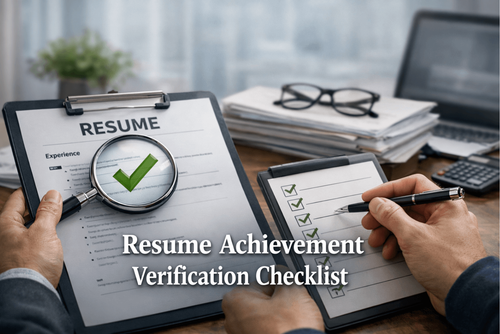

How to Write Verified Resume Achievements That Get Interviews
Most professionals assume their resume fails because they lack the right skills, experience, or qualifications. In reality, the problem is often much simpler: the resume fails to prove impact.
Recruiters review hundreds of applications for a single role. When every candidate lists similar responsibilities such as managing projects, handling clients, or overseeing operations, resumes start to look identical. Without clear evidence of results, even highly capable professionals blend into the background.
This is where an evidence backed, achievement-driven resume changes everything.
Instead of listing tasks anyone in the same role could claim, a verified achievement resume demonstrates measurable impact, clear ownership, and real business outcomes. It answers the recruiter’s most important question instantly: What difference did this person actually make?
This guide explains how working professionals can systematically transform vague job descriptions into powerful, verified achievements that stand up to recruiter scrutiny and dramatically increase interview opportunities.
Who Is This Blog For?
This blog and the accompanying guidebook are designed for professionals who want their resume to communicate real impact and measurable results.
- Early-career professionals with 0–10 years of experience trying to stand out in competitive hiring markets
- Mid-career professionals aiming for promotions, leadership roles, or career acceleration
- Job seekers struggling to secure interviews despite strong experience
- Career switchers repositioning their past experience for a new role or industry
- Consultants, analysts, and specialists building a results-driven personal brand
- Professionals who know they should quantify achievements but don’t know how to do it effectively
Why This Topic Matters Today?
Hiring practices have evolved significantly in the last decade. Recruiters rely heavily on speed, automation, and evidence when evaluating candidates.
Most resumes today fail because they focus on duties rather than impact. Statements like “Managed social media accounts” or “Handled client onboarding” reveal very little about a candidate’s actual contribution.
When hiring managers scan resumes, they are looking for clear signals of performance:
- Measurable business results
- Individual contribution and ownership
- Evidence of problem solving
- Demonstrated improvements in efficiency, growth, or outcomes
Without these elements, even strong professionals appear average on paper.
A resume built on verified achievements changes the dynamic entirely. Instead of blending in, it shows concrete value and positions the candidate as someone who drives measurable results.
Core Concept or Framework Explained
At the heart of an evidence-based resume is a structured verification process. Every achievement bullet must pass a rigorous quality check before it appears on the final resume.
This approach transforms resumes from simple task lists into defensible records of professional impact. The core framework consists of five verification checks that every resume bullet must pass.
Action Check
Every achievement should begin with a strong, specific past-tense action verb. Words such as negotiated, engineered, reduced, launched, secured, or delivered immediately signal ownership and initiative.
Weak phrases such as responsible for or helped with dilute the impact and create ambiguity.
Quantification Check
A strong resume bullet includes at least one number that shows scale or magnitude. These numbers might represent revenue, percentages, time savings, volume handled, team size, or performance improvements. Numbers make achievements tangible and credible.
Attribution Check
The recruiter should clearly understand the candidate’s individual contribution. When work was completed in a team environment, the bullet should specify the role played within that team. This ensures that credit is accurately represented.
Business Impact Check
Achievements must connect to outcomes that matter to the organisation. This may include revenue growth, efficiency gains, improved customer outcomes, reduced costs, or faster delivery timelines. Context converts an activity into a business result.
Honesty and Defensibility Check
Every number and claim on the resume must be something the candidate can confidently explain in an interview. Evidence such as reports, dashboards, performance reviews, or emails should support the claim.
When a bullet passes all five checks, it becomes a credible achievement statement that strengthens the entire resume.
How This Blog and Guidebook Help You?
This guide provides a practical system that helps professionals convert their experience into compelling evidence of performance.
By following the process outlined in the guidebook, readers can:
- Identify overlooked achievements across past roles
- Build a personal evidence bank for future applications
- Transform vague responsibilities into quantified accomplishments
- Write clear, concise, and powerful achievement statements
- Create resume bullets that recruiters recognise immediately
The outcome is a resume that communicates value quickly, confidently, and credibly.
Step-by-Step Breakdown
Step 1: Build Your Evidence Bank Before Writing
One of the biggest resume mistakes professionals make is attempting to write achievement statements from memory.
Achievement writing is not purely creative. It is investigative. Before drafting a single bullet point, professionals should collect the evidence that proves their contributions.
Useful sources include:
- Performance reviews and feedback reports
- Project completion emails and milestone updates
- KPI dashboards and performance analytics
- Client feedback or testimonials
- Reports and presentations delivered during projects
These documents often contain exact numbers and results that professionals forget over time.
Mining past communications is particularly useful. Searching email archives for words like launched, delivered, increased, or reduced frequently reveals measurable outcomes that can be used in resume statements.
Step 2: Surface Hidden Achievements Through Reflection
Many professionals underestimate their impact simply because they have never analysed their work systematically. Structured reflection helps uncover accomplishments that would otherwise remain invisible.
Questions that unlock achievements include:
- What measurable results did my work produce?
- What would not have happened if I had not contributed?
- When did I exceed expectations or outperform targets?
- What problems did I solve that others could not?
- What improvements did I introduce that remained in place?
Exploring these questions across categories such as results, leadership, projects, and process improvements often reveals a surprising number of achievements.
These raw notes later become the foundation for strong resume bullets.
Step 3: Apply the Achievement Verification Framework
After gathering evidence and identifying potential achievements, each bullet must be tested against the verification framework.
For example, consider this weak bullet:
Managed social media accounts for the brand.
This statement fails multiple checks because it lacks quantification, ownership clarity, and business impact. A verified version would look very different.
Grew Instagram following from 2,400 to 18,000 within nine months by launching a weekly video series, increasing inbound enquiries by 34 percent.
This revised bullet includes a strong action verb, measurable numbers, clear actions, and visible impact. The difference is dramatic.
Step 4: Quantify Achievements Even Without Exact Numbers
Professionals often hesitate to quantify achievements because they believe they do not have precise metrics available.
In reality, most achievements can be quantified using a structured estimation process.
The verified estimation method follows four steps.
- Identify a known baseline or starting point
- Define the specific change introduced
- Estimate the improvement conservatively
- Express the result in the most meaningful unit
For example, instead of avoiding numbers entirely, a candidate might say:
Reduced processing time by approximately 40 percent.
Saved the team roughly six hours per week through workflow automation.
Using words such as approximately or estimated signals transparency and intellectual honesty.
Step 5: Rewrite Duty-Based Statements into Achievement Bullets
Transforming existing resume bullets is one of the most powerful steps in this process.
Most resumes begin with duty-based descriptions such as:
Managed client onboarding processes.
Using the achievement rewriting formula, the statement becomes:
Implemented a streamlined onboarding workflow that reduced client activation time by 30 percent and improved onboarding satisfaction scores.
The formula typically follows this structure:
Strong verb + specific action + quantified result + business impact.
Repeating this process across all roles dramatically increases the strength of the resume.
Step 6: Validate Every Bullet with the Master Checklist
Before finalising a resume, each bullet should be tested against a comprehensive checklist.
Common Mistakes or Pitfalls to Avoid
Even experienced professionals make predictable mistakes when writing resume achievements.
Recognising these pitfalls helps prevent weak statements.
Claiming full credit for team results
Candidates sometimes claim organisational achievements as personal accomplishments. Recruiters quickly recognise this.
A stronger approach clarifies individual contribution within the team effort.
Using vague language
Statements like significantly improved performance or greatly enhanced engagement lack credibility without numbers.
Specific metrics always strengthen the claim.
Inflating numbers
Rounding numbers aggressively or exaggerating results creates credibility risks during interviews.
Conservative estimates are more trustworthy.
Skipping the business impact
Achievements should always answer why the result mattered. Efficiency gains, revenue growth, or customer benefits provide essential context.
Copying job description language
Many candidates unintentionally replicate job posting wording. A resume should reflect actual results, not theoretical responsibilities.
How Should You Use This Guidebook Effectively?
To get the maximum benefit from the guidebook, follow a structured workflow.
- Read the guide once to understand the overall process
- Collect evidence and documentation from past roles
- Complete the reflection prompts to identify achievements
- Rewrite existing resume bullets using the verification framework
- Run each bullet through the master checklist before finalising
Setting aside focused time for this process, even a single weekend, can significantly transform the strength of a resume. Once complete, the evidence bank created during this exercise becomes a reusable resource for future job applications, performance reviews, and professional profiles.
Key Takeaways
- Resumes should highlight achievements, not just responsibilities
- Evidence and documentation strengthen credibility
- Every resume bullet should pass the five verification checks
- Quantification makes accomplishments tangible and persuasive
- Conservative estimation allows honest metrics even without exact numbers
- Strong verbs, clear ownership, and business impact create powerful statements
- A verified achievement resume significantly improves interview chances
Your Next Step: Accelerate Your Career with PlanetSpark
Creating an impact-driven resume is not just about landing your next job—it’s about owning your professional story and presenting it with clarity, confidence, and credibility. When your resume clearly communicates value, results, and impact, opportunities follow naturally.
At PlanetSpark, we are committed to empowering working professionals with practical, outcome-focused resources that drive real career growth. From resume building and workplace communication to leadership presence and professional writing, our programs are designed to help you succeed in today’s fast-evolving job market.
Visit https://www.planetspark.in/resources to explore:
- Career and resume-building guides
- Workplace communication and professional writing resources
- Skill-development tools curated for working professionals
Want a deeper, hands-on experience?
You can also book a free trial session to learn more about PlanetSpark’s Working Professional Courses, designed to accelerate your career through personalised coaching, real-world practice, and expert guidance.
Your career deserves more than generic advice.
It deserves clarity, confidence, and measurable impact.
Start building that advantage today—with PlanetSpark.
Personalized Communication Roadmaps
Record a video to get a AI generated personalized communication reports