
Revenue Growth Resume Guide for Career-Focused Professionals
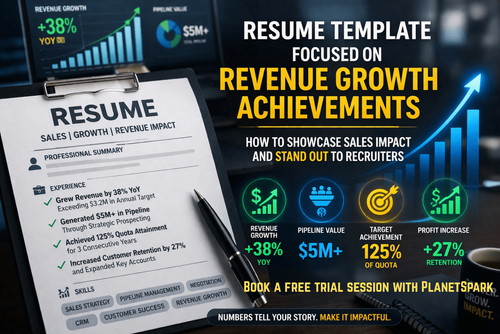

Resume Template Focused on Revenue Growth Achievements: How to Showcase Sales Impact and Stand Out to Recruiters
You’ve hit targets. Closed deals. Built pipelines. Driven revenue.
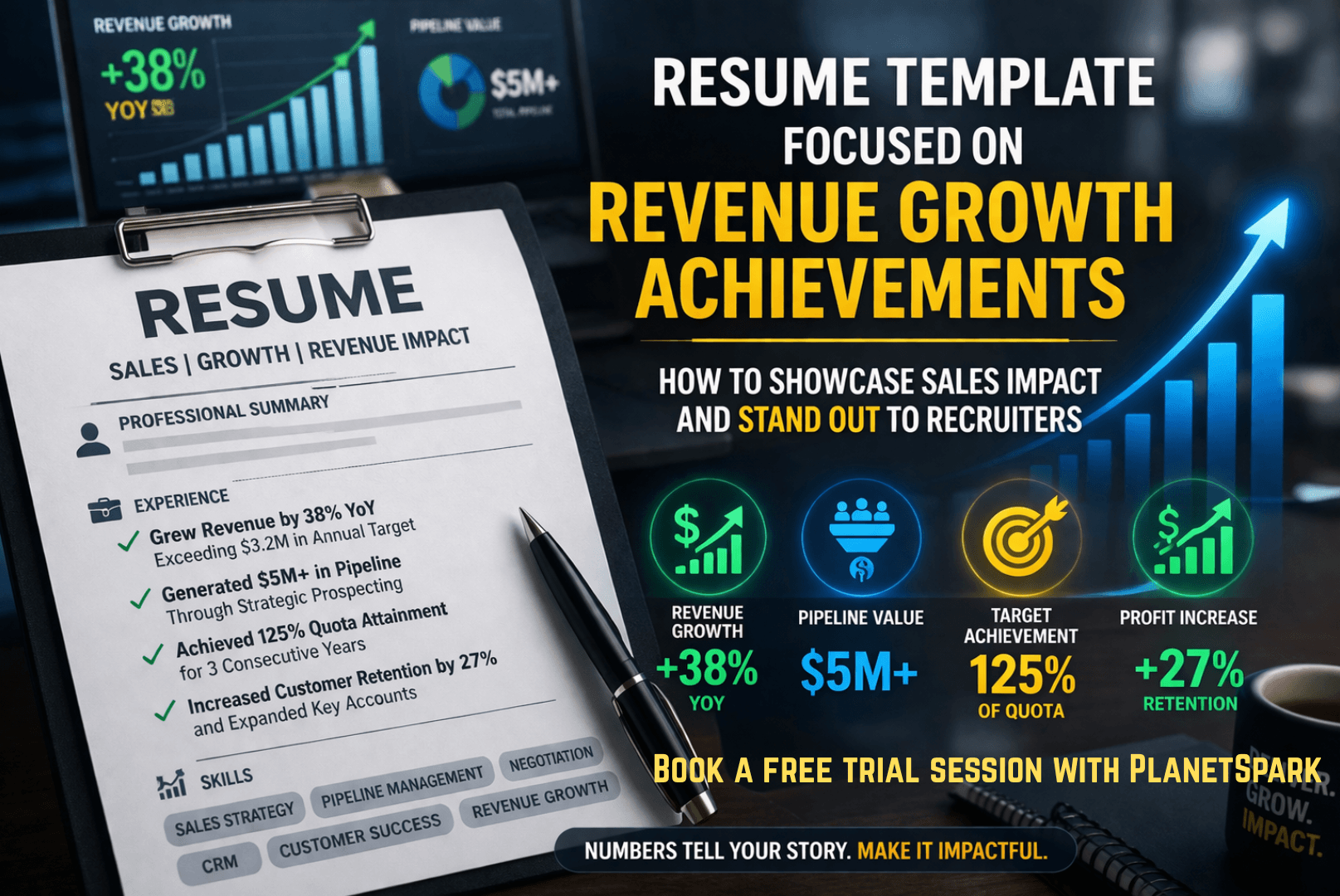
Book your free trial session today with Planetspark.
Download for more details or PDF file.
But your resume still sounds like a job description.
This is one of the biggest reasons high-performing sales and growth professionals get overlooked. Recruiters are not interested in what you were responsible for—they care about what you delivered.
If your resume doesn’t clearly show revenue impact within the first few seconds, it fails—no matter how strong your experience is.
This guide, built from a structured template pack, shows you how to transform your resume into a revenue-driven document that highlights measurable growth, commercial impact, and business outcomes in a way that recruiters and ATS systems immediately recognise.
Who Is This Blog For?
- Sales professionals in B2B, B2C, SaaS, or enterprise environments
- Business development and account management professionals
- Growth marketers and revenue-focused digital professionals
- Sales managers and leaders responsible for team revenue
- Freelancers and consultants driving client-side revenue growth
- Career switchers transitioning into revenue-generating roles
Why This Topic Matters Today?
In competitive hiring markets, especially in sales and growth roles, your resume is judged on one primary question:
How did this person impact revenue?
Recruiters scan for:
- Revenue growth percentages
- Quota attainment
- Pipeline generation
- Deal size and value
- Retention and expansion metrics
As highlighted in the resource, traditional resumes fail because they focus on responsibilities instead of measurable results.
For example:
“Managed sales territory” means very little
But
“Grew territory revenue by 38% YoY” immediately signals value
Additionally, ATS systems actively scan for revenue-specific keywords such as ARR, quota attainment, pipeline value, and NRR. Without these, even strong candidates can be filtered out.
In today’s market, clarity, numbers, and business impact are non-negotiable.
Core Concept or Framework Explained
The foundation of a strong revenue-focused resume is:
Metric → Action → Outcome
Metric
Start with numbers—percentage growth, revenue generated, pipeline size.
Action
What you did—strategy, execution, sales motion.
Outcome
The business result—growth, retention, expansion, or efficiency.
Example transformation:
Instead of “Responsible for closing deals”
Use:
“Closed $2M in new business revenue within 12 months by expanding mid-market accounts”
This structure ensures your resume communicates impact instantly.
The visual on page 1 reinforces this principle by highlighting metrics like revenue growth, pipeline value, target achievement, and profit increase—showing that numbers are central to your story.
Every section of your resume—from summary to experience—should follow this outcome-first approach.
How This Blog and Guidebook Help You?
This guide converts structured templates into actionable strategies you can implement immediately.
By applying these frameworks, you will:
- Turn your resume into a revenue-focused document
- Highlight measurable business impact clearly
- Improve ATS visibility with the right keywords
- Align your experience with recruiter expectations
- Increase interview calls for sales and growth roles
Instead of listing work, you will demonstrate results.
Step-by-Step Breakdown
Step 1: Choose the Right Revenue Scenario
The template pack includes 10 scenario-driven templates such as:
- Quota-crushing individual contributor
- Revenue team builder (manager/leader)
- SaaS ARR growth specialist
- Enterprise deal closer
- Growth marketing professional
- Career switcher into sales
- Freelance revenue consultant
- Early-career sales achiever
- Revenue recovery specialist
- P&L owner or general manager
Choosing the right scenario ensures your resume reflects your exact career context.
Step 2: Lead Every Bullet with Metrics
This is the most important rule.
Weak example:
“Closed deals with clients”
Strong example:
“Closed $1.2M in new business revenue, achieving 125% of quota”
As the guide emphasises, numbers should appear early in every bullet—not buried at the end.
Step 3: Focus on Achievements, Not Responsibilities
Avoid phrases like:
- Responsible for
- Managed
- Worked on
Instead, focus on outcomes:
- Grew revenue
- Generated pipeline
- Exceeded quota
- Improved retention
Your resume should read like a results report, not a job description.
Step 4: Highlight Key Revenue Metrics
Depending on your role, include metrics such as:
Sales Roles
- Revenue generated
- Quota attainment
- Deal size
SaaS Roles
- ARR and MRR
- Net revenue retention
- Churn reduction
Marketing Roles
- Pipeline generated
- ROI on campaigns
- Customer acquisition cost
Leadership Roles
- Team revenue growth
- P&L ownership
- Market expansion
Using the right metrics makes your resume highly relevant.
Step 5: Structure Your Professional Summary Around Revenue
Your summary should include:
- Years of experience
- Industry or domain
- Key revenue achievement
Example:
“Sales professional with 5+ years of experience driving $3M+ annual revenue and consistently exceeding quota by 120%”
This immediately positions you as a revenue contributor.
Step 6: Showcase Pipeline and Growth Contributions
Revenue is not just about closing deals.
Highlight:
- Pipeline generation
- Conversion rates
- Sales cycle improvements
- Expansion and upsell contributions
This shows a complete understanding of the revenue lifecycle.
Step 7: Use Industry-Specific Keywords
ATS systems rely on exact keyword matches.
Examples:
- ARR, MRR
- Quota attainment
- Pipeline velocity
- NRR, churn rate
- Sales forecasting
Align your resume with the job description to improve visibility.
Step 8: Tailor for Your Career Stage
1. Individual Contributor
Focus on quota achievement and deal impact.
2. Manager or Leader
Highlight team performance and scaling results.
3. Consultant or Freelancer
Show client-side revenue outcomes across engagements.
4. Early-Career Professional
Emphasise pipeline generation, meetings booked, and early metrics.
5. Career Switcher
Translate previous experience into revenue impact.
Step 9: Maintain ATS-Friendly Formatting
Ensure your resume:
- Uses clear headings
- Avoids complex layouts
- Uses standard fonts and formatting
- Is exported as a clean PDF
This ensures compatibility with ATS systems.
Step 10: Customise for Every Application
Templates provide structure—but customisation drives results.
For each job:
- Match keywords to job description
- Highlight relevant metrics
- Adjust examples to align with role requirements
This increases both ATS success and recruiter engagement.
Common Mistakes or Pitfalls to Avoid
- Listing responsibilities instead of achievements
- Burying metrics deep within bullet points
- Using the same resume for every application
- Ignoring revenue-specific keywords
- Failing to quantify impact
- Writing vague or generic summaries
These mistakes make even strong candidates appear average.
How Should You Use This Guidebook Effectively?
Follow this workflow:
- Identify your revenue scenario
- Select the appropriate template
- Replace placeholders with real metrics
- Ensure every bullet includes quantified impact
- Align keywords with job description
- Review for clarity and precision
Recommended approach:
- Spend 2–3 hours building your first version
- Tailor for each application
- Update regularly as you achieve new results
Think of your resume as a revenue performance report—not just a career summary.
Key Takeaways
- Revenue-focused resumes must highlight measurable business impact
- Numbers should lead every bullet point
- Recruiters prioritise revenue growth, not responsibilities
- ATS systems require specific revenue-related keywords
- Templates provide structure, but personalisation drives success
- Clear positioning significantly increases interview chances
- Your resume should demonstrate how you drive top-line growth
Your Next Step: Accelerate Your Career with PlanetSpark
Creating an impact-driven resume is not just about landing your next job—it’s about owning your professional story and presenting it with clarity, confidence, and credibility. When your resume clearly communicates value, results, and impact, opportunities follow naturally.
At PlanetSpark, we are committed to empowering working professionals with practical, outcome-focused resources that drive real career growth. From resume building and workplace communication to leadership presence and professional writing, our programs are designed to help you succeed in today’s fast-evolving job market.
Visit https://www.planetspark.in/resources to explore:
- Career and resume-building guides
- Workplace communication and professional writing resources
- Skill-development tools curated for working professionals
Want a deeper, hands-on experience?
You can also book a free trial session to learn more about PlanetSpark’s Working Professional Courses, designed to accelerate your career through personalised coaching, real-world practice, and expert guidance.
Your career deserves more than generic advice.
It deserves clarity, confidence, and measurable impact.
Personalized Communication Roadmaps
Record a video to get a AI generated personalized communication reports