
Scenario Planning Guide to Manage Career Risks Effectively
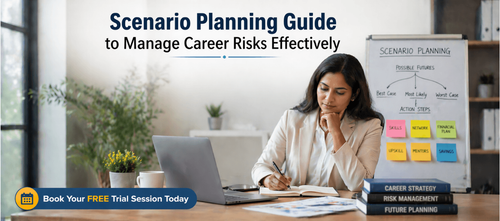

Career Risk Planning Made Practical: A Step-by-Step Guide to Making Confident Career Moves Without Guesswork
Every professional reaches a point where staying in the same role feels limiting—but moving forward feels uncertain. You might be considering a role change, a shift in industry, or stepping into leadership. On the surface, these decisions look exciting. But beneath that excitement lies a complex web of risks—financial stability, skill gaps, reputation, and long-term career trajectory.
The challenge is not a lack of ambition. It’s a lack of structured thinking. Many professionals rely on instinct, scattered advice, or surface-level research when making high-stakes career decisions. Some delay action for months or even years, waiting for “perfect clarity” that never arrives. Others take bold steps without preparation and find themselves struggling to recover from avoidable setbacks.
This creates a frustrating cycle—overthinking leads to inaction, while impulsive decisions lead to regret. In both cases, the real issue is the absence of a clear, strategic framework to evaluate risk and plan ahead.
What if you could approach your career decisions the same way top companies approach business strategy? Instead of guessing outcomes, you map them. Instead of fearing risks, you define and prepare for them. Instead of reacting to problems, you anticipate and manage them.
That’s exactly what career risk scenario planning enables you to do. It provides a structured, practical approach to break down uncertainty, assess potential outcomes, and create a clear action plan before you make your move. Whether you're planning a transition or evaluating an opportunity, this method ensures you're not just hopeful—but prepared.
Download these resources and apply them alongside your daily work for improved clarity, productivity, and professional growth. You can also book a free trial to gain expert guidance and enhance your communication, problem-solving, and decision-making skills. The materials are designed in a clear, structured format to help professionals learn efficiently and implement insights with confidence.
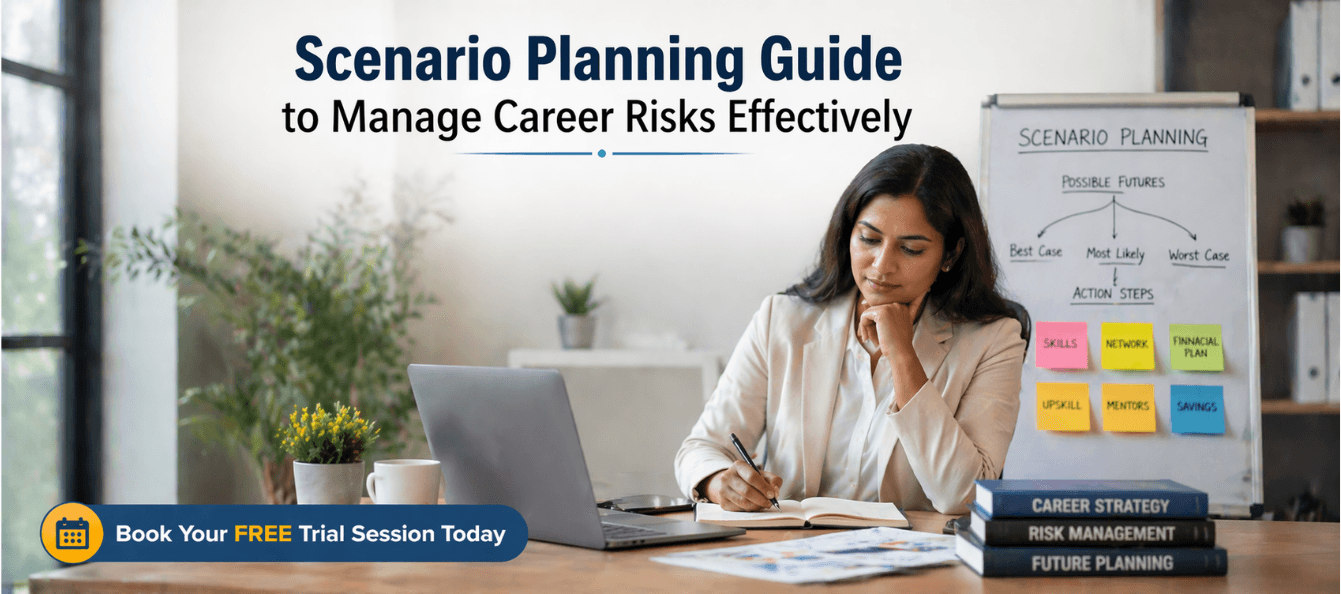
Who Is This Blog For?
- Working professionals planning a career transition or promotion
- Career switchers exploring new industries or roles
- Mid-career professionals seeking clarity before making bold moves
- Consultants and freelancers evaluating business risks
- Managers and leaders aiming for strategic career decisions
Why This Topic Matters Today?
Career decisions today are more complex than ever. The job market is evolving rapidly, industries are being disrupted, and traditional career paths are no longer linear. This means that every decision carries multiple layers of risk.
Many professionals fall into one of two traps:
- Staying stuck due to fear of uncertainty
- Taking impulsive decisions without proper planning
Neither approach leads to sustainable growth. What truly differentiates high-performing professionals is their ability to think strategically about uncertainty.
Career risk planning helps you:
- Replace guesswork with structured thinking
- Balance ambition with preparation
- Make informed decisions based on data and self-awareness
In a world where career moves define long-term success, structured risk planning is no longer optional—it is essential.
Core Concept or Framework Explained
The Career Risk Scenario Planning framework is built on structured decision-making principles borrowed from strategic business planning. It transforms vague fears into actionable insights through a step-by-step approach.
Clarity Before Action
Every effective decision starts with clarity. Instead of vague intentions like “I want a change,” the framework pushes you to define a specific, time-bound career move.
Risk Tolerance Awareness
Not all professionals can take the same level of risk. Your financial situation, skills, mental resilience, and support system all influence what risks are realistic for you.
Structured Risk Identification
Rather than fearing the unknown, you systematically identify risks across five categories:
- Financial
- Reputational
- Skill-based
- Relational
- Market-driven
Data-Driven Risk Prioritisation
Each risk is evaluated using likelihood and impact scores, helping you focus on what truly matters instead of overthinking low-probability scenarios.
Scenario Planning
Instead of predicting one outcome, you prepare for three:
- Best case
- Realistic case
- Worst case
This reduces anxiety and increases preparedness.
Mitigation Planning
The framework ensures you don’t stop at identifying risks—you actively prepare solutions in advance.
How This Blog and Guidebook Help You?
This blog translates the worksheet into a practical, easy-to-follow guide that helps you take action immediately.
You will gain:
- A structured approach to making high-stakes career decisions
- Tools to evaluate risks realistically
- Clarity on your personal risk tolerance
- A system to prepare for multiple outcomes
- A proactive plan to handle uncertainty
The outcome is simple: you move from confusion and hesitation to clarity and confident execution.
Step-by-Step Breakdown
Define Your Career Move Clearly
Before assessing risk, you must define your decision precisely.
Instead of vague statements, create a clear sentence that includes:
- Your current role
- Your intended role or move
- Timeline for the transition
- Core motivation behind the decision
Clarity at this stage determines the effectiveness of everything that follows.
Assess Your Risk Tolerance Baseline
Your ability to handle risk depends on four key factors:
- Financial runway such as savings and income stability
- Career capital including skills and network
- Psychological resilience or ability to recover from setbacks
- Personal support system like mentors or family
Scoring yourself across these areas helps you understand how much preparation you need before making a move.
Identify All Potential Risks
Most professionals operate with vague fears. This step forces you to list every possible risk across categories:
- Financial risks like income loss
- Reputational risks such as failed transitions
- Skill gaps that may slow progress
- Relationship risks affecting professional connections
- Market risks driven by industry conditions
The goal is completeness, not perfection.
Score and Prioritise Risks
Each identified risk is evaluated using two dimensions:
- Likelihood of occurrence
- Impact if it occurs
Multiplying these gives a Risk Priority Number.
This allows you to:
- Focus on high-priority risks
- Avoid overthinking low-impact scenarios
- Allocate your time and energy effectively
Plan for Three Scenarios
Instead of assuming a single outcome, prepare for:
- Best case where everything goes right
- Realistic case with moderate challenges
- Worst case where things don’t go as planned
For each scenario, define:
- What happens
- What triggers it
- How you will respond
This approach transforms uncertainty into a manageable plan.
Build a Mitigation Playbook
Every high-priority risk should have a clear action plan.
Your mitigation strategy should include:
- Prevention actions to reduce likelihood
- Early warning signals to detect issues
- Immediate response actions
- Recovery plans to regain stability
This ensures you are prepared before problems arise.
Avoid Common Planning Mistakes
Awareness of common errors strengthens your decision-making.
Typical mistakes include:
- Planning only for the average outcome
- Using vague strategies instead of specific actions
- Working in isolation without feedback
- Treating risk as static instead of evolving
- Ignoring the risk of not making a move
- Overestimating how long recovery takes
Correcting these improves both confidence and outcomes.
Execute a 30-Day Action Plan
The first 30 days after your decision are critical.
Your focus should be on:
- Activating mitigation strategies immediately
- Engaging your professional network
- Closing skill gaps
- Monitoring early warning signals
- Reviewing and adjusting your plan
This phase determines whether your preparation translates into success.
Common Mistakes or Pitfalls to Avoid
Even experienced professionals make avoidable mistakes when planning career risks.
Key pitfalls include:
- Making decisions without clear definitions
- Ignoring personal risk tolerance
- Leaving risks unstructured and vague
- Focusing only on worst-case scenarios
- Skipping mitigation planning
- Failing to revisit and update plans
The better approach is to combine clarity, structure, and continuous review.
How Should You Use This Guidebook Effectively?
To maximise the value of this framework, follow a structured workflow:
- Read the entire framework once before starting
- Work through each section step by step
- Write down your responses honestly and in detail
- Revisit the plan before major decisions
- Share your insights with a mentor or peer for feedback
Time investment:
- 45–60 minutes for initial completion
- 30-minute review every 60 days
Consistency and reflection are key to making this tool effective.
Key Takeaways
- Career decisions require structured thinking, not guesswork
- Clarity in defining your move is the foundation of risk planning
- Your personal risk tolerance determines your strategy
- Identifying and categorising risks reduces anxiety
- Prioritisation helps focus on what truly matters
- Scenario planning prepares you for uncertainty
- Mitigation planning turns risks into manageable challenges
- The first 30 days post-decision are critical for success
- Regular reviews keep your strategy relevant and effective
Your Next Step: Accelerate Your Career with PlanetSpark
Creating an impact-driven resume is not just about landing your next job—it’s about owning your professional story and presenting it with clarity, confidence, and credibility. When your resume clearly communicates value, results, and impact, opportunities follow naturally.
At PlanetSpark, we are committed to empowering working professionals with practical, outcome-focused resources that drive real career growth. From resume building and workplace communication to leadership presence and professional writing, our programs are designed to help you succeed in today’s fast-evolving job market.
Visit https://www.planetspark.in/resources to explore:
- Career and resume-building guides
- Workplace communication and professional writing resources
- Skill-development tools curated for working professionals
Want a deeper, hands-on experience?
You can also book a free trial session to learn more about PlanetSpark’s Working Professional Courses, designed to accelerate your career through personalised coaching, real-world practice, and expert guidance.
Your career deserves more than generic advice.
It deserves clarity, confidence, and measurable impact.
Start building that advantage today—with PlanetSpark.
Personalized Communication Roadmaps
Record a video to get a AI generated personalized communication reports