
Should You List Hobbies on Your Resume? A Practical 2026 Guide
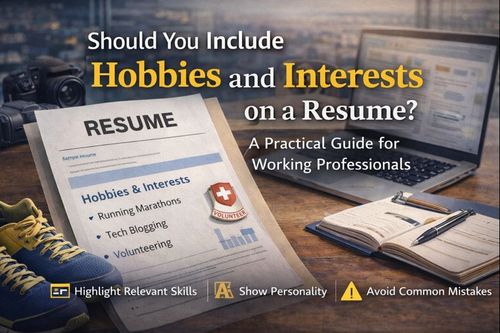

Should You Include Hobbies and Interests on a Resume? A Practical Guide for Working Professionals
You spend hours refining your resume,
carefully choosing every word to showcase your experience, achievements, and skills. Then you reach an optional section that sparks debate, doubt, and second-guessing: hobbies and interests. Should you include them, or do they make your resume look unfocused and unprofessional?
For years, conventional advice suggested skipping hobbies altogether. Yet today’s hiring landscape looks very different. Employers are no longer evaluating candidates on technical skills alone. Cultural fit, communication ability, leadership potential, and authentic personality cues now influence hiring decisions more than ever.
This guide cuts through conflicting opinions with a practical, evidence-based approach. Instead of asking whether hobbies belong on a resume in general, it helps you decide when they add value, how to present them strategically, and when leaving them out is the smarter move.
If you want your resume to stand out for the right reasons while staying professional, relevant, and impact-driven, this guide shows you exactly how to approach the hobbies and interests section with confidence.
Who Is This Blog and Guidebook For?
This blog and the accompanying guidebook are designed for working professionals who want clarity, not generic advice. It is especially useful for:
- Early-career professionals who need to demonstrate skills beyond limited work experience
- Career switchers looking to highlight transferable skills through meaningful activities
- Consultants and professionals positioning a distinctive personal brand
- Job seekers applying to roles where culture fit and collaboration matter
- Professionals unsure whether hobbies strengthen or weaken their resume
If you have ever wondered whether your interests help tell your professional story or simply take up space, this resource is built for you.
Why This Topic Matters Today?
The question of including hobbies on a resume matters more now than it did a decade ago. Hiring practices have evolved, and resumes are no longer evaluated only as lists of job titles and responsibilities.
Research across more than 2,000 companies reveals a nuanced reality. A majority of recruiters do read hobbies sections when they are included, but only a smaller percentage consider them highly influential during initial screening. However, for roles that require creativity, collaboration, and cultural alignment, the influence of hobbies nearly doubles.
At the same time, there is risk involved. A poorly written or irrelevant hobbies section can hurt your chances. Recruiters report that resumes with generic or controversial interests are more likely to be screened out than helped.
The takeaway is clear. Strategic inclusion creates advantage. Generic listing wastes space. In a competitive job market, every section of your resume must earn its place.
Core Concept or Framework Explained
At the heart of this guide is a simple but powerful idea: hobbies are not filler. When used correctly, they function as evidence of skills, values, and behaviors that are difficult to demonstrate through job titles alone.
The guidebook introduces a decision-based approach rather than a one-size-fits-all rule. It focuses on three core principles:
Relevance over tradition
Hobbies should only appear when they support your professional narrative. Their value depends on role requirements, industry norms, and career stage.
Specificity over generality
Vague interests do not differentiate you. Specific achievements, sustained commitment, and measurable outcomes do.
Strategy over emotion
Personal attachment to an activity is not enough. The decision to include a hobby must be grounded in how it strengthens your candidacy.
This framework ensures that hobbies are treated as strategic assets rather than personal indulgences.
How This Blog and Guidebook Help You?
This blog and guidebook help you move from confusion to clarity by offering:
- A clear framework to decide whether hobbies belong on your resume
- Industry-specific guidance to avoid cultural missteps
- Career-stage strategies that reflect real hiring expectations
- Practical templates to transform hobbies into professional proof points
- Common mistakes to avoid that could quietly damage your application
Instead of guessing what recruiters might think, you gain a structured way to evaluate and present your interests with confidence.
Step-by-Step Breakdown
Assessing When Hobbies Add Value
Hobbies add value when they demonstrate qualities your resume may not fully capture elsewhere. These include:
- Soft skills such as discipline, leadership, teamwork, or creativity
- Cultural alignment with a company’s values or mission
- Differentiation from candidates with similar qualifications
- Transferable skills for career changers
- Substance for early-career professionals with limited experience
On the other hand, hobbies should be skipped when experience already speaks strongly for itself, when industry norms are highly conservative, or when interests have no clear connection to the role.
The 4-Question Decision Framework
The guidebook introduces a practical assessment to help you decide objectively. If you can answer yes to three or more of the following questions, including hobbies is usually a strong choice.
Does this hobby demonstrate a skill the job requires?
For example, marathon training can signal discipline and perseverance, while coding side projects demonstrate technical depth.
Does it reveal cultural alignment with the company?
Community volunteering may resonate with mission-driven organizations, while sustainability initiatives align with environmentally focused companies.
Does it differentiate you memorably from other candidates?
Unique accomplishments such as published writing, competitive athletics, or recognized creative work stand out.
Do you have limited professional experience to showcase?
For recent graduates and career changers, hobbies can serve as credible proof of capability.
Industry-Specific Standards
Different industries view resume personalization differently, and understanding these norms helps you calibrate your approach.
Creative and media roles often welcome hobbies that reveal personality, creativity, and cultural awareness.
Technology and startup environments generally respond positively to well-rounded candidates, especially when hobbies include side projects or technical exploration.
Finance and consulting roles require caution. Only exceptional, leadership-oriented hobbies tend to add value.
Legal and accounting fields prioritize credentials and experience, making hobbies largely unnecessary unless highly relevant.
Career Stage Guidance
Your experience level plays a major role in deciding whether hobbies belong on your resume.
For professionals with zero to two years of experience, hobbies can demonstrate leadership, reliability, and skill development not yet proven at work.
Those with three to seven years of experience should include hobbies only when they directly support the professional narrative or show exceptional achievement.
Professionals with eight to fifteen years of experience should generally skip hobbies unless they significantly enhance executive presence or thought leadership.
What Makes a Hobby Resume-Worthy?
Not all hobbies are created equal. Resume-worthy hobbies share clear characteristics.
Strong choices demonstrate measurable achievement, sustained commitment, leadership, or direct relevance to the role.
Weak choices are generic, passive, controversial, or disconnected from your professional story.
A simple test helps clarify the difference. If you cannot speak confidently for two to three minutes about what you learned or achieved through a hobby, it is likely too generic to include.
Strategic Examples That Work
Effective hobby descriptions connect activities to professional capabilities.
Completing multiple marathons over several years demonstrates discipline, resilience, and goal management under pressure.
Maintaining a technical blog with thousands of readers showcases expertise, communication skills, and initiative.
Leading a community initiative with measurable impact proves leadership, planning, and accountability.
These examples work because they are specific, outcome-driven, and professionally relevant.
The Skill-Bridge Strategy for Career Changers
For career changers, hobbies can become powerful bridges. The strategy involves identifying target role skills, mapping hobby evidence to those skills, and explicitly connecting the two in your descriptions.
This approach transforms personal interests into credible proof of readiness for a new professional path.
Common Mistakes or Pitfalls to Avoid
One of the most common mistakes is listing generic hobbies such as reading, traveling, or music without context. These add no value and waste space.
Another pitfall is including controversial or polarizing topics that may trigger unconscious bias, regardless of intent.
Passive consumption activities such as watching films or following sports also weaken resumes unless reframed as active engagement or analysis.
The solution is always the same. Be specific, neutral, and focused on skills and outcomes.
The Achievement Upgrade Formula
To strengthen any hobby description, the guidebook recommends a three-part structure.
Start with the activity and context, including duration or level of commitment.
Follow with achievements and metrics wherever possible.
Conclude with a clear connection to a professional skill relevant to the target role.
This formula turns simple interests into compelling evidence.
How Should You Use This Guidebook Effectively?
The guidebook is designed for flexible use. You can read it end to end for a complete understanding or jump directly to the decision framework and templates if time is limited.
A practical workflow includes assessing your situation, selecting hobbies strategically, crafting descriptions using the upgrade formula, and validating choices through the quality checklist.
The entire process can be completed in under two hours, making it ideal for time-pressed professionals.
Key Takeaways
- Hobbies belong on a resume only when they demonstrate relevant skills, alignment, or achievement
- Context matters, including industry norms, career stage, and available space
- Specificity creates memorability and credibility
- Quality always beats quantity when selecting interests
- Every listed hobby should support interview conversations and professional impact
Your resume tells a professional story. Hobbies should appear only when they make that story stronger.
Your Next Step: Accelerate Your Career with PlanetSpark
Creating an impact-driven resume is not just about landing your next job—it’s about owning your professional story and presenting it with clarity, confidence, and credibility. When your resume clearly communicates value, results, and impact, opportunities follow naturally.
At PlanetSpark, we are committed to empowering working professionals with practical, outcome-focused resources that drive real career growth. From resume building and workplace communication to leadership presence and professional writing, our programs are designed to help you succeed in today’s fast-evolving job market.
Visit https://www.planetspark.in/resources to explore:
- Career and resume-building guides
- Workplace communication and professional writing resources
- Skill-development tools curated for working professionals
Want a deeper, hands-on experience?
You can also book a free trial session to learn more about PlanetSpark’s Working Professional Courses, designed to accelerate your career through personalised coaching, real-world practice, and expert guidance.
Your career deserves more than generic advice.
It deserves clarity, confidence, and measurable impact.
Start building that advantage today—with PlanetSpark.