
Showcase Learning & Growth in Interviews: Guide for Professionals
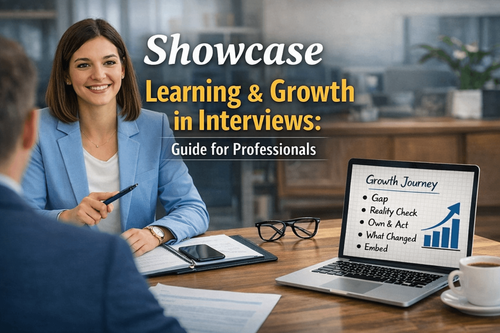

Professionals Must Know How to Demonstrate Learning and Growth in Interviews: A Practical Guide to Show Your Career Evolution
Most professionals walk into interviews prepared
to talk about what they have done. They list projects, responsibilities, and achievements. Yet many still walk out without an offer.
The reason is simple: experience alone no longer guarantees opportunity. Employers want evidence of something deeper — the ability to learn, adapt, and grow in rapidly changing environments.
Hiring managers today are not only evaluating what you know. They are evaluating how quickly you can evolve when faced with new challenges. This quality, known as learning agility, has become one of the strongest predictors of long-term career success.
Unfortunately, many professionals genuinely grow throughout their careers but struggle to communicate that growth clearly in interviews. They say things like “I’m a quick learner” or “I’m open to feedback,” but without real examples, these claims rarely stand out.
This guide transforms that problem into a practical solution. It explains how to identify powerful growth stories from your career, structure them effectively, and deliver them with confidence so interviewers see clear evidence of your professional evolution.
Who Is This Blog For?
This blog and guidebook are designed for professionals who want to present their career journey with clarity and credibility in interviews.
It is particularly valuable for:
- Early and mid-career professionals with 0–15 years of experience preparing for interviews
- Career changers repositioning their skills for new industries or roles
- Consultants and specialists who want to communicate their growth trajectory clearly
- Managers preparing for leadership-level interviews
- Job seekers who struggle to demonstrate learning and adaptability during interviews
Why This Topic Matters Today?
The professional world is changing faster than ever. New tools, technologies, and business models emerge constantly, making technical skills more short-lived than in the past.
Hiring managers understand this reality. Instead of hiring only for current expertise, they look for people who can grow quickly when the environment changes.
Research highlighted in the guidebook identifies learning agility as one of the strongest predictors of career success. Learning agility refers to the ability to learn from experience and apply that learning in unfamiliar or challenging situations.
Interviewers often use questions such as:
- Tell me about a time you had to learn something quickly
- Describe a mistake you made and what you learned
- How have you adapted when circumstances changed
These questions are not random. They help employers evaluate three critical qualities:
- Self-awareness about strengths and weaknesses
- Resilience when facing challenges or setbacks
- Curiosity and initiative in developing new skills
Candidates who can demonstrate these qualities through clear, structured stories consistently make stronger impressions.
Core Concept or Framework Explained
The central framework introduced in the guidebook is the GROWE method. It provides a structured way to explain learning and growth in interviews so that your stories are clear, credible, and memorable.
The GROWE framework consists of five steps.
Gap
Identify the capability, knowledge, or experience you lacked at the time. This shows honesty and self-awareness.
Reality Check
Explain how you realized the gap existed. Often this moment involves feedback, a challenge, or a situation where your limitations became clear.
Own and Act
Describe the responsibility you took and the actions you implemented to address the gap.
What Changed
Show measurable results or improvements that occurred because of your actions.
Embed
Explain how the lesson has influenced your behavior since then. This step proves that your learning created lasting change.
Most candidates stop after describing an action or outcome. The Embed step is what transforms a simple story into evidence of long-term professional growth.
How This Blog and Guidebook Help You
The insights from this guide and blog help professionals strengthen their interview performance in several practical ways.
You will learn how to:
- Identify powerful learning experiences from your career history
- Convert real experiences into structured growth stories
- Demonstrate learning agility through specific examples
- Answer difficult behavioral questions with clarity and confidence
- Present your growth trajectory in a compelling and credible way
The result is an interview narrative that shows employers not only what you have done but also how you continuously evolve.
Step-by-Step Breakdown
Step 1: Build Your Growth Story Inventory
Before you can tell strong stories in interviews, you need to identify the experiences that demonstrate growth.
Many professionals underestimate how much they have evolved because growth rarely feels dramatic in the moment. Instead, it often appears as difficult projects, unexpected challenges, or moments of constructive feedback.
To prepare effectively, create a Growth Story Inventory containing six to ten experiences that illustrate learning and adaptation.
Useful categories include:
- Moments of failure or setbacks that forced you to rethink your approach
- Skill gaps you had to close quickly to meet a challenge
- Role transitions that required learning new responsibilities
- Feedback that significantly changed how you worked
Give each story a simple nickname such as “The Difficult Client” or “The Product Launch.” This helps you recall the story quickly during interviews.
Step 2: Structure Each Story Using the GROWE Framework
Once you identify your stories, structure them using the five-step GROWE approach.
Start by explaining the gap in your knowledge or experience. Next, describe the moment when you recognized the issue. Then explain the action you took to address it.
After that, highlight what changed as a result of your effort. This could include measurable outcomes, improved performance, or successful project completion.
Finally, describe how this learning continues to influence your behavior today.
This structured approach helps interviewers follow your narrative and understand the significance of the experience.
Step 3: Map Stories to Common Interview Questions
Interview questions about growth often appear in different forms. Preparing a variety of stories ensures you can respond effectively regardless of how the question is phrased.
Common question categories include:
- Learning under pressure
- Failure and recovery
- Feedback and coachability
- Adaptation to change
- Self-initiated skill development
- Helping others grow or develop
Mapping your stories to these categories allows you to quickly choose the most relevant example during the interview.
Step 4: Deliver Stories With Confidence and Clarity
Preparation alone is not enough. The way you deliver your story also determines how persuasive it is.
The guidebook highlights three principles that make growth stories more effective.
Lead with the learning
Begin with a brief insight before telling the story. This signals reflection and helps the interviewer understand the point immediately.
Be radically specific
Replace vague claims with concrete details. Specific numbers, actions, and outcomes increase credibility.
Close with a forward bridge
End your answer by explaining how the learning influences your current behaviour. This demonstrates lasting growth rather than a one-time experience.
Step 5: Follow the 90-Second Rule
Interview answers should be concise yet meaningful.
An effective growth story typically lasts around 60 to 90 seconds when spoken. Shorter answers may lack depth, while longer responses risk losing the interviewer’s attention.
When practicing, remove unnecessary background information. Every sentence should either explain the challenge, describe an action, or highlight a lesson learned.
Step 6: Demonstrate a Growth Mindset Throughout the Interview
Your growth mindset is not demonstrated only through stories. It also appears in how you interact during the conversation.
Small signals can reinforce your learning orientation:
- Ask thoughtful learning questions about the role or team
- Acknowledge when you do not know something and explain how you would learn it
- Mention mentors or colleagues who influenced your development
- Talk about skills or knowledge you are currently building
These behaviors create a strong impression of curiosity, humility, and continuous improvement.
Step 7: Reinforce Your Growth Story After the Interview
Many candidates overlook the follow-up email as an opportunity to strengthen their narrative.
A thoughtful follow-up message can reinforce your learning mindset.
Effective follow-ups typically include:
- A genuine thank you to the interviewer
- A reference to a specific moment or insight from the conversation
- A brief idea, article, or reflection related to the discussion
- A statement about what you are excited to learn in the role
This approach keeps the conversation alive and highlights your intellectual curiosity.
Common Mistakes or Pitfalls to Avoid
Even well-prepared professionals make mistakes when trying to demonstrate growth in interviews.
Common pitfalls include:
- Claiming qualities like adaptability or curiosity without providing real examples
- Sharing only success stories while avoiding discussions of failure
- Ending stories without explaining how the learning continues today
- Describing growth without explaining how the learning actually occurred
- Blaming external factors rather than taking ownership of challenges
Avoiding these mistakes helps your answers sound authentic, reflective, and credible.
How Should You Use This Guidebook Effectively?
To get the best results from this resource, follow a structured preparation approach.
Start by reading the guide once to understand the concepts and frameworks.
Then complete the exercises and worksheets provided throughout the guide. Building your Growth Story Inventory is especially important.
Allocate time to practice your answers aloud and refine them until they feel natural rather than memorized.
A focused preparation schedule may include:
- Building your story inventory over one day
- Applying the GROWE framework to your strongest examples
- Mapping stories to interview question categories
- Practicing answers aloud and timing them
- Recording yourself to evaluate clarity and authenticity
Within a few hours of focused effort, you can transform how confidently and effectively you communicate your professional growth.
Key Takeaways
- Employers evaluate learning agility as strongly as technical skills
- Growth must be demonstrated through real stories, not vague claims
- Build a Growth Story Inventory with multiple experiences
- Use the GROWE framework to structure learning narratives
- Deliver answers with specificity, clarity, and confidence
- End every story with a forward bridge that shows ongoing growth
- Reinforce your learning mindset throughout the entire interview process
Your Next Step: Accelerate Your Career with PlanetSpark
Creating an impact-driven resume is not just about landing your next job—it’s about owning your professional story and presenting it with clarity, confidence, and credibility. When your resume clearly communicates value, results, and impact, opportunities follow naturally.
At PlanetSpark, we are committed to empowering working professionals with practical, outcome-focused resources that drive real career growth. From resume building and workplace communication to leadership presence and professional writing, our programs are designed to help you succeed in today’s fast-evolving job market.
Visit https://www.planetspark.in/resources to explore:
- Career and resume-building guides
- Workplace communication and professional writing resources
- Skill-development tools curated for working professionals
Want a deeper, hands-on experience?
You can also book a free trial session to learn more about PlanetSpark’s Working Professional Courses, designed to accelerate your career through personalized coaching, real-world practice, and expert guidance.
Your career deserves more than generic advice.
It deserves clarity, confidence, and measurable impact.
Start building that advantage today—with PlanetSpark.
Personalized Communication Roadmaps
Record a video to get a AI generated personalized communication reports