
Skill Mapping Guide for Professionals Planning Career Growth
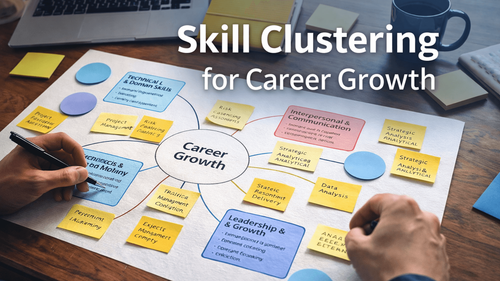

Skill Clustering Mind Map: A Practical Framework to Organise Your Skills, Build a Career Strategy, and Stand Out Professionally
Most professionals can list what they do—but struggle to explain what they truly bring. You might say you manage projects, analyze data, or handle clients. But when it comes to positioning yourself for a promotion, a career switch, or a new opportunity, that list often falls short.
The problem is not a lack of skills—it’s a lack of structure.
This is where the Skill Clustering Mind Map changes everything. Instead of viewing your abilities as scattered tasks, it helps you organise them into meaningful clusters that tell a compelling career story. This blog breaks down a powerful framework from the Skill Clustering Mind-Map Sheet and shows you how to turn your skills into a strategic advantage.
Who Is This Blog For?
- Career switchers trying to reposition their experience for a new role
- Early to mid-career professionals (0–15 years) seeking clarity on their strengths
- Managers and consultants who want to articulate their value more effectively
- Professionals preparing for interviews, promotions, or performance reviews
- Anyone feeling stuck because they “have skills” but lack direction
Why This Topic Matters Today?
In today’s competitive job market, simply having skills is not enough. Employers are not just evaluating what you can do—they are assessing how clearly you understand and communicate your value.
The traditional approach—listing skills on a resume or LinkedIn—creates a fragmented picture. As highlighted in the resource, most professionals operate with an unorganised mental inventory of abilities. This leads to:
- Weak personal branding
- Difficulty in career transitions
- Missed opportunities due to poor articulation
- Lack of clarity on growth areas
Skill clustering solves this by turning scattered competencies into structured capability zones. Instead of a job description, you create a career strategy.
Core Concept or Framework Explained
At the heart of this approach is the Five Cluster Zones Framework, a structured way to group your skills into meaningful categories that align with how employers evaluate talent.
These five zones are:
- Technical and Domain Skills
These are your hard skills—tools, systems, and subject expertise such as Python, financial modelling, or UX research.
- Interpersonal and Communication
This includes how you work with people—collaboration, stakeholder management, feedback delivery, and active listening.
- Strategic and Analytical
These skills define how you think—problem solving, data interpretation, decision-making, and pattern recognition.
- Execution and Delivery
This is about getting things done—project ownership, prioritisation, accountability, and delivery quality.
- Leadership and Growth
These reflect your ability to develop yourself and others—mentoring, team building, and change management.
A critical insight from the framework is that skills can belong to multiple zones. For example, “data storytelling” sits at the intersection of technical and communication skills. These overlaps are your differentiators.
How This Blog and Guidebook Help You?
By applying this framework, you move from confusion to clarity. Specifically, you will:
- Identify your strongest capability zones
- Discover hidden skills you previously overlooked
- Recognise gaps that matter for your career goals
- Build a compelling professional narrative
- Create a structured plan for skill development
The outcome is not just better self-awareness—it’s better positioning in the job market.
Step-by-Step Breakdown
Brain Dump First — Organise Later
Start by listing everything you can do. This step is about volume, not perfection.
Most professionals underestimate their skills because they focus only on formal or titled abilities. However, skills also include:
- Handling ambiguity under pressure
- Synthesising complex information
- Informally onboarding team members
- Making judgement-based decisions
Use prompts like:
- What do colleagues ask you for help with?
- What tasks feel easy to you but hard for others?
- What tools or systems do you understand deeply?
Aim to list at least 20 skills without filtering.
Group Skills Using the Five Cluster Zones
Once your list is ready, assign each skill to one or more of the five zones.
For example:
- “Market analysis” fits into Strategic and Analytical
- “Client presentations” belong to Interpersonal and Communication
- “Sprint planning” aligns with Execution and Delivery
This grouping helps you see patterns instead of isolated abilities.
Build Your Personal Mind Map
Now convert your clusters into a visual structure.
According to the diagram on page 5 of the resource, the process includes:
- Writing your name at the centre
- Drawing five branches for each cluster zone
- Placing skills under relevant branches
- Adding sub-branches for context such as tools or proficiency
- Marking strengths and growth areas using different colours
This visualisation makes invisible patterns visible and easier to interpret.
Evaluate Your Cluster Strength
Not all clusters are equal. You need to assess where you stand.
Based on the evaluation model in the worksheet:
- 5 or more skills in a zone = Strong Zone
- 3–4 skills = Developing Zone
- 1–2 skills = Gap Zone
- 0 skills = Blind Spot
This step transforms your mind map from a visual tool into a strategic decision-making framework.
Build Your Skill Narrative
Your mind map is internal. Your narrative is external.
Use the Cluster Narrative Formula:
- Lead with your primary cluster (your strongest zone)
- Add 1–2 supporting clusters (your versatility)
- Highlight one growth area (your direction)
For example, as shown in the real-world case of Priya on page 8:
She positioned herself as a “customer-obsessed strategist” combining strategic thinking, execution, and growing technical capabilities—allowing her to transition into product management successfully.
Create a 30-Day Action Plan
Turn insight into action with a structured timeline:
- Days 1–3: Complete your mind map
- Days 4–7: Write your narrative
- Days 8–14: Update LinkedIn and resume
- Days 15–21: Address one key skill gap
- Days 22–30: Test your narrative in real conversations
This ensures your effort leads to tangible outcomes.
Common Mistakes or Pitfalls to Avoid
Only Listing Hard Skills
Ignoring interpersonal and leadership skills limits your perceived value. These are often the differentiators at senior levels.
Confusing Tasks with Skills
“Writing reports” is a task. “Synthesising complex data into insights” is a skill. Focus on transferable competencies.
Treating All Zones Equally
Not every zone matters equally for your career goals. Prioritise the ones aligned with your target role.
Not Updating Your Map
Your skills evolve. A static map becomes outdated and misleading. Review it every 6 months.
How Should You Use This Guidebook Effectively?
To get the most value:
- Allocate 15–20 minutes for the initial exercise
- Use pen and paper or digital tools like Miro or Google Slides
- Focus on completion, not perfection
- Revisit your map every 6–12 months
- Use it actively in resumes, LinkedIn, and interviews
Think of this as a recurring career audit, not a one-time activity.
Key Takeaways
- Your skills already exist—they just need organisation
- Skill clusters tell a stronger story than isolated lists
- Overlapping skills across zones are your competitive advantage
- Gap zones are strategic opportunities, not weaknesses
- Clear communication of skills is as important as the skills themselves
- Your skill map should evolve with your career
- Action is what converts insight into real career progress
Your Next Step: Accelerate Your Career with PlanetSpark
Creating an impact-driven resume is not just about landing your next job—it’s about owning your professional story and presenting it with clarity, confidence, and credibility. When your resume clearly communicates value, results, and impact, opportunities follow naturally.
At PlanetSpark, we are committed to empowering working professionals with practical, outcome-focused resources that drive real career growth. From resume building and workplace communication to leadership presence and professional writing, our programs are designed to help you succeed in today’s fast-evolving job market.
Visit https://www.planetspark.in/resources to explore:
- Career and resume-building guides
- Workplace communication and professional writing resources
- Skill-development tools curated for working professionals
Want a deeper, hands-on experience?
You can also book a free trial session to learn more about PlanetSpark’s Working Professional Courses, designed to accelerate your career through personalised coaching, real-world practice, and expert guidance.
Your career deserves more than generic advice.
It deserves clarity, confidence, and measurable impact.
Personalized Communication Roadmaps
Record a video to get a AI generated personalized communication reports