
Skills Gap Analysis- A Practical Upskilling Guide for 2026

How to Close Your Skills Gap and Accelerate Your Career: A 90-Day Development Plan
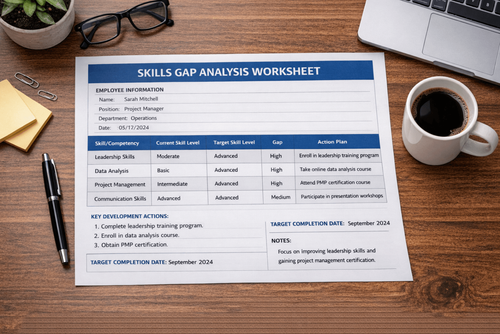
Career growth today isn’t linear. Whether you’re transitioning into a new field, aiming for a promotion, or refining your skill set, knowing where you stand versus where you want to be is critical. Too many professionals waste time and effort by guessing what they need to improve or hoping they’ll eventually learn the right skills on the job. The *Skills Gap Analysis Worksheet* provides a focused, actionable way to bridge this gap and turn career stagnation into forward momentum.
By following this guide, you can clearly define your current skills, identify exactly what your target role requires, and build a systematic plan to close the gaps in 90 days.
Who Is This Blog For?
* Career changers looking to pivot into a new industry
* Managers or professionals aiming for a promotion
* Consultants refining their skill set
* Professionals seeking targeted career growth
* Anyone feeling stuck or unsure of the next steps in their career journey
Why This Topic Matters Today?
In the fast-moving job market, many professionals feel stuck or underqualified for their desired roles. The lack of clear direction leads to frustration, random learning, and missed opportunities. By conducting a thorough skills gap analysis, you can remove the guesswork and replace it with a targeted, structured plan. Knowing what skills are missing and prioritizing them can make all the difference in landing your next role or promotion.
Core Concept or Framework Explained
This worksheet breaks down the process of closing your skills gap into five key steps:
1. Define Your Target Destination – Clearly outline where you want to go, whether it’s a job title, project, or new career path.
2. Map Required Skills – Identify the specific skills required for your target role, distinguishing between hard skills and soft skills.
3. Audit Your Current Skills – Honestly rate your current proficiency and highlight areas of strength and weakness.
4. Calculate and Visualize Your Gaps – Determine where your skills fall short and categorize them by priority.
5. Build Your 90-Day Skills Development Plan – Create a focused, actionable plan to close your critical skills gaps in 90 days.
How This Blog and Guidebook Help You?
Following this process allows you to:
* Create a concrete, actionable plan for your career growth
* Identify exactly where you need to focus your efforts
* Avoid wasting time on unnecessary learning or unproductive career moves
* Develop a clear narrative for yourself and future employers on your growth and readiness for the next step
Step-by-Step Breakdown
Step 1: Define Your Target Destination
To start, be specific about where you want to be in your career.
* Write down your target role, company, or outcome.
* Identify reference points—real job descriptions or LinkedIn profiles that reflect your goal.
* Set a timeline for reaching this destination.
Step 2: Map the Required Skills for Your Target Role
Once you’ve locked in your target, it’s time to map out the skills required.
* Hard Skills: Technical, measurable skills required for the job.
* Soft Skills: Interpersonal and behavioral skills, such as leadership or communication.
* Aim for 15–25 skills based on job postings and professional frameworks.
Step 3: Audit Your Current Skills
Take an honest look at where you currently stand. Rate your proficiency in each skill, from "Unaware" (Level 1) to "Expert" (Level 4).
* Reflect on real-life examples of when you’ve used each skill.
* If unsure, ask a colleague or mentor to help with your self-assessment.
Step 4: Calculate and Visualize Your Gaps
For each skill, compare what’s required for your target role and where you stand now.
* Prioritize critical gaps, such as those affecting your ability to get the job.
* Categorize your skills into three groups:
* Critical Gaps: High-priority areas that need immediate attention.
* Development Areas: Skills that need improvement but aren’t deal-breakers.
* Strengths to Leverage: Skills you already excel in and should emphasize in your job applications.
Step 5: Build Your 90-Day Skills Development Plan
Now that you know where you need to improve, create a focused, 90-day action plan.
* Focus: Pick 2–3 critical gaps to work on in the next 90 days.
* Method: Choose the right learning mode (e.g., online courses, on-the-job training, mentorship).
* Commit: Block time for practice sessions and learning.
* Measure: Define a concrete success metric, such as completing a project or receiving positive feedback.
Common Mistakes or Pitfalls to Avoid
* Mistake: Overloading your plan with too many skills to work on at once.
* Fix: Focus on 2–3 critical skills per quarter to ensure real progress.
* Mistake: Relying solely on courses without applying the skills in real-world projects.
* Fix: Build application into your learning process—practice in real work situations.
* Mistake: Rating yourself too highly or too low in self-assessments.
* Fix: Be honest and conservative in your ratings. Ask for feedback from others if unsure.
How Should You Use This Guidebook Effectively?
To get the most out of this guidebook, follow these best practices:
* Complete the initial worksheet in one focused session.
* Review and update your skills analysis every 90 days to track progress.
* Use your 90-day skills development plan to focus on actionable outcomes rather than vague learning goals.
* If you have a mentor or coach, leverage their expertise to accelerate your learning.
Key Takeaways
* Clarity precedes progress: A named skill gap is a gap that can be closed.
* Prioritize ruthlessly: Focus on 2–3 high-priority skills every quarter.
* Self-rating is key: Anchor every rating to real examples of your work.
* Application beats consumption: Learn by doing, not just by reading or watching courses.
* Quarterly reviews compound progress: Small, consistent updates over 12–18 months can lead to dramatic improvements.
FIXED PLANETSPARK OUTRO (DO NOT MODIFY)
Your Next Step: Accelerate Your Career with PlanetSpark
Creating an impact-driven resume is not just about landing your next job—it’s about owning your professional story and presenting it with clarity, confidence, and credibility. When your resume clearly communicates value, results, and impact, opportunities follow naturally.
At PlanetSpark, we are committed to empowering working professionals with practical, outcome-focused resources that drive real career growth. From resume building and workplace communication to leadership presence and professional writing, our programs are designed to help you succeed in today’s fast-evolving job market.
Visit (https://www.planetspark.in/resources) to explore:
* Career and resume-building guides
* Workplace communication and professional writing resources
* Skill-development tools curated for working professionals
Want a deeper, hands-on experience?
You can also book a free trial session to learn more about PlanetSpark’s Working Professional Courses, designed to accelerate your career through personalised coaching, real-world practice, and expert guidance.
Your career deserves more than generic advice.
It deserves clarity, confidence, and measurable impact.