
Smart Purchase Decision Framework to Avoid Financial Regret
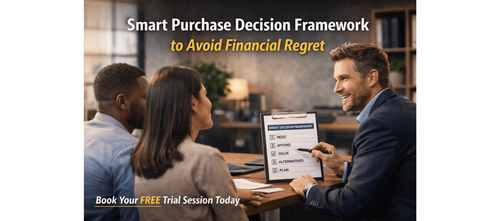

Never Regret a Big Purchase Again: A Proven Framework for Smarter Financial Decisions.
You’ve been there before. You spend hours researching a product—reading reviews, comparing options, watching videos—and finally make the purchase. But within days, a quiet doubt creeps in: “Did I really make the right decision?”
This feeling, often called buyer’s remorse, is surprisingly common among working professionals. And it doesn’t just affect your bank balance—it impacts your confidence in making future financial decisions.
The truth is, big purchases are rarely just financial decisions. They are influenced by emotions, social pressure, urgency, and sometimes even identity. Whether it’s a laptop, a car, a course, or home furniture, these decisions shape your financial trajectory and daily satisfaction.
That’s exactly why the resource “How to Evaluate Big Purchases Without Regret” exists. It provides a structured, repeatable system that helps you make confident, well-thought-out decisions—without overthinking or second-guessing later.
Download these resources and apply them alongside your daily work for improved clarity, productivity, and professional growth. You can also book a free trial to gain expert guidance and enhance your communication, problem-solving, and decision-making skills. The materials are designed in a clear, structured format to help professionals learn efficiently and implement insights with confidence.
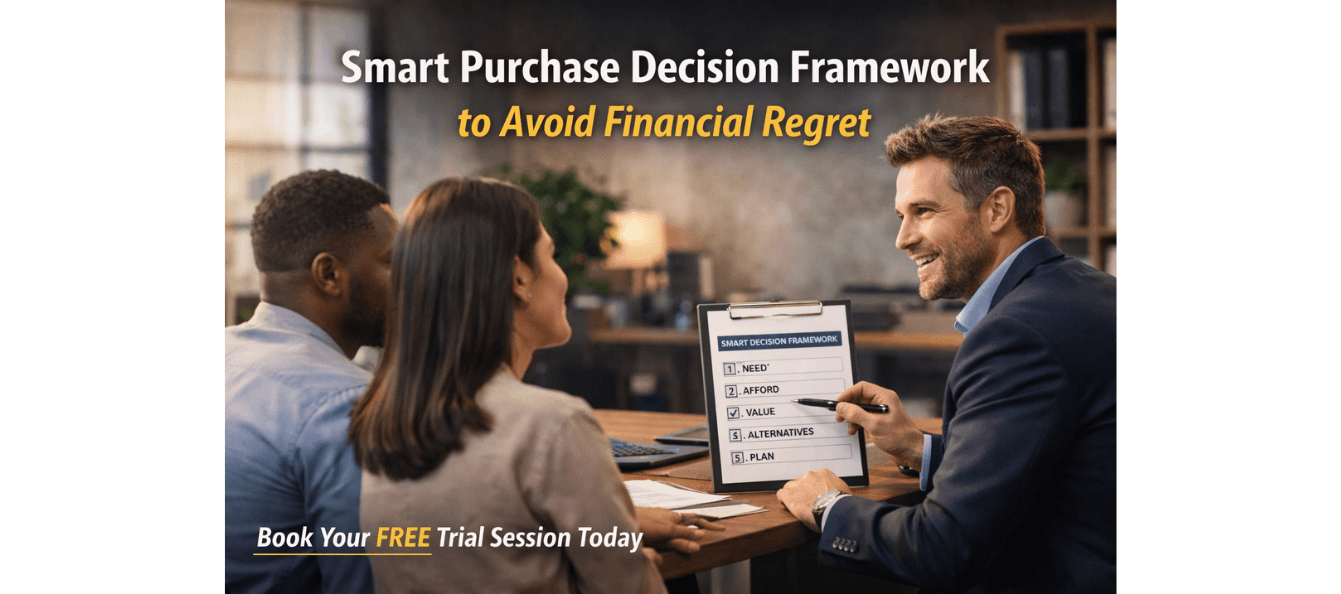
Who Is This Blog For?
- Working professionals managing their own finances
- Individuals planning high-value purchases like gadgets, vehicles, or courses
- Career switchers investing in skill development
- Managers making purchase decisions for work or personal use
- Anyone who has experienced buyer’s remorse in the past
- Professionals who want to spend smarter and more intentionally
Why This Topic Matters Today?
In today’s consumer-driven environment, purchasing decisions are heavily influenced by urgency and perception.
Professionals often face:
- Limited-time offers that create artificial pressure
- Lifestyle inflation as income increases
- Social comparison influencing buying behaviour
- Over-research leading to confusion and decision fatigue
- Emotional decision-making disguised as rational choice
The result is not just overspending—but “financial noise.” Small regrets accumulate over time, reducing clarity and confidence in money decisions.
Without a structured approach, even smart professionals make inconsistent and emotionally driven purchases.
Core Concept or Framework Explained
At the heart of this guide is the PAUSE Framework—a five-phase decision-making system designed to bring clarity and structure to major purchases.
The framework includes:
- Purpose Check to identify the real reason behind the purchase
- Affordability Audit to evaluate financial impact and trade-offs
- Urgency Test to distinguish real need from artificial pressure
- Substitution Scan to explore better or more efficient alternatives
- Exit Plan to reduce risk through reversibility and resale options
Each phase acts as a filter. A purchase only moves forward when it passes all five stages, ensuring decisions are based on clarity—not impulse.
How This Blog and Guidebook Help You?
This blog simplifies the guide into actionable insights you can apply immediately.
It helps you:
- Make confident financial decisions without overthinking
- Avoid costly mistakes driven by emotion or urgency
- Understand the true cost of purchases beyond price tags
- Build a repeatable decision-making system
- Reduce regret and improve long-term financial clarity
Most importantly, it helps you shift from reactive spending to intentional decision-making.
Step-by-Step Breakdown
Purpose Check: Why Do You Really Want This?
Start by identifying the real reason behind the purchase.
Use the three-layer “Why” test:
- What problem does this solve?
- Why does that problem matter?
- Why is that important to you long-term?
Example:
Buying a premium desk may seem like a comfort decision, but deeper analysis may reveal it improves health, productivity, and career performance.
Green signals:
- Solves a recurring problem
- Aligns with long-term goals
- Need has existed for weeks or months
Red flags:
- Triggered by sales or peer influence
- Cannot clearly explain the need
- Feels urgent without real reason
Affordability Audit: Can You Truly Afford It?
Affordability is not just about having money—it’s about priorities.
Evaluate:
- Total cost including maintenance and hidden expenses
- Opportunity cost of using that money elsewhere
- Funding source such as savings, income, or credit
Apply the 1 percent rule:
- If a purchase exceeds 1 percent of your annual income, treat it as a major decision
Also be cautious with EMIs:
- Monthly payments may feel small, but total cost is often much higher
Urgency Test: Do You Need It Now?
Many purchases feel urgent—but aren’t.
Differentiate:
Real urgency:
- Work-related necessity
- Health-related need
- Time-sensitive opportunity
Manufactured urgency:
- Limited-time sales
- Peer pressure
- Marketing tactics
Use the 48-hour rule:
- Wait at least 48 hours before making a decision
- Avoid research and discussion during this period
- Re-evaluate your interest after the wait
If the desire remains strong, it is likely genuine.
Substitution Scan: Is There a Better Alternative?
Before committing, explore other ways to solve the same problem.
Consider:
- Renting instead of buying
- Certified refurbished products
- Lower-tier models with similar utility
- Borrowing or sharing resources
Often, a 70–90 percent solution exists at 50–60 percent of the cost.
The goal is not to find the cheapest option—but the most efficient one.
Exit Plan: What If It Doesn’t Work Out?
Every smart purchase includes an exit strategy.
Evaluate:
- Return policies and conditions
- Resale value after 1–2 years
- Warranty and service availability
- Depreciation rate
When you know a purchase is reversible, the decision becomes less stressful and more rational.
Common Mistakes or Pitfalls to Avoid
- Anchoring decisions based on high-priced options
- Confusing wants with genuine needs
- Ignoring total cost of ownership
- Spending excessive time researching without deciding
- Making purchases in emotionally charged environments
- Overlooking resale value
- Assuming EMI equals affordability
Avoiding these mistakes significantly improves decision quality.
How Should You Use This Guidebook Effectively?
Use the guide in a flexible, practical way:
- For quick decisions, refer to the checklist and framework
- For deeper clarity, read the full guide once
- For active decisions, use the worksheet in real time
Suggested workflow:
- Apply the PAUSE framework for every major purchase
- Use the checklist before finalising decisions
- Reflect using the provided questions for deeper clarity
Time investment:
- 10 minutes for quick filtering
- 30 minutes for full evaluation
- 1–2 hours for complex decisions
Consistency is more important than perfection.
Key Takeaways
- Big purchases are emotional as well as financial decisions
- A structured framework reduces regret and improves clarity
- The PAUSE framework ensures balanced, logical decisions
- The 48-hour rule prevents impulsive spending
- Total cost matters more than sticker price
- Alternatives often provide better value
- Exit planning reduces risk and anxiety
- Reflection improves long-term decision-making ability
Your Next Step: Accelerate Your Career with PlanetSpark
Creating an impact-driven resume is not just about landing your next job—it’s about owning your professional story and presenting it with clarity, confidence, and credibility. When your resume clearly communicates value, results, and impact, opportunities follow naturally.
At PlanetSpark, we are committed to empowering working professionals with practical, outcome-focused resources that drive real career growth. From resume building and workplace communication to leadership presence and professional writing, our programs are designed to help you succeed in today’s fast-evolving job market.
Visit https://www.planetspark.in/resources to explore:
- Career and resume-building guides
- Workplace communication and professional writing resources
- Skill-development tools curated for working professionals
Want a deeper, hands-on experience?
You can also book a free trial session to learn more about PlanetSpark’s Working Professional Courses, designed to accelerate your career through personalised coaching, real-world practice, and expert guidance.
Your career deserves more than generic advice.
It deserves clarity, confidence, and measurable impact.
Start building that advantage today—with PlanetSpark.
Personalized Communication Roadmaps
Record a video to get a AI generated personalized communication reports