
Stakeholder Influence Mapping Guide for Professionals

Stakeholder Influence Mapping: The Ultimate Career Skill to Drive Projects, Gain Buy-In, and Accelerate Growth
You’ve done the work. The strategy
is solid, the execution is strong, and the results should speak for themselves. Yet somehow, your project stalls, decisions get delayed, or worse—your work gets quietly deprioritised.
If this sounds familiar, the issue is not your capability. It is visibility, alignment, and influence. In today’s workplace, success is rarely determined by effort alone. It is shaped by the people who control decisions, resources, and momentum.
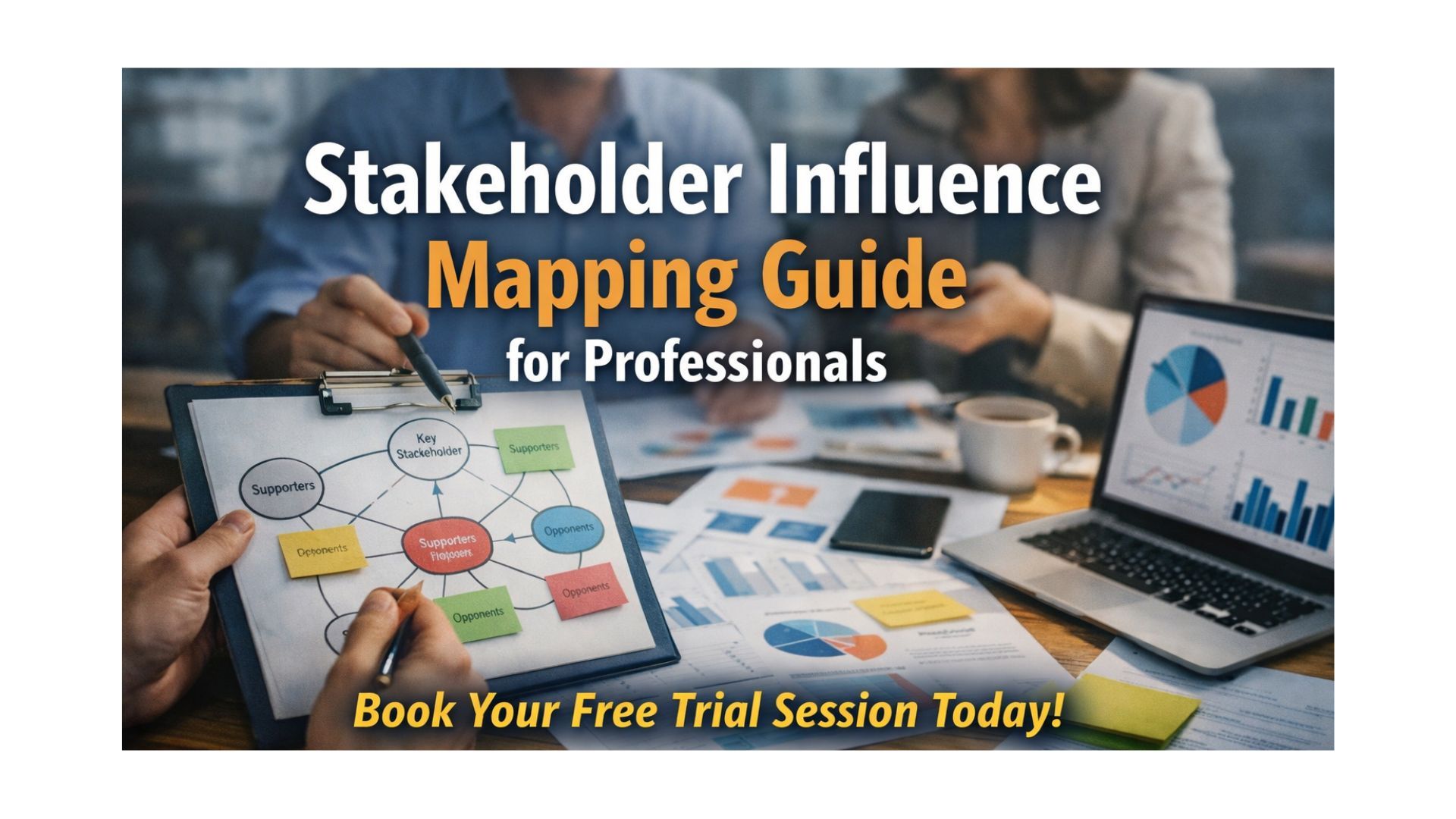
This is where stakeholder influence mapping becomes a career-defining advantage. Instead of leaving outcomes to chance, it gives you a structured way to identify who matters, understand what drives them, and influence outcomes strategically. This blog transforms a proven stakeholder mapping framework into a practical, step-by-step guide for working professionals who want results, not just effort.
Who Is This Blog For?
- Working professionals managing projects, cross-functional initiatives, or team deliverables
- First-time managers learning to navigate organisational dynamics
- Mid-career professionals aiming to influence senior stakeholders
- Consultants and client-facing professionals handling complex stakeholder environments
- Anyone whose work depends on approvals, alignment, or collaboration
Why This Topic Matters Today?
Modern workplaces are more complex than ever. Projects span departments, decisions involve multiple stakeholders, and influence often outweighs authority.
One of the biggest professional blind spots is assuming that good work naturally gets recognised. In reality, many high-quality initiatives fail not because of poor execution, but because the right stakeholders were not engaged at the right time.
Professionals often spend the majority of their energy on deliverables, while neglecting the people who shape outcomes. The result is predictable: delays, resistance, missed opportunities, and stalled career growth.
Stakeholder influence mapping addresses this gap directly. It ensures that your work is not only strong but also supported, endorsed, and accelerated by the right people.
Core Concept or Framework Explained
At its core, stakeholder influence mapping is about shifting from reactive communication to strategic influence. It is a structured process that helps you identify, prioritise, analyse, and engage stakeholders effectively.
The framework operates in five key stages:
- Identify all stakeholders connected to your goal
- Plot them based on power and interest
- Analyse their stance, motivation, and relationship quality
- Design tailored influence strategies
- Sustain engagement through consistent communication
This is not about manipulation. It is about alignment. The goal is to understand what stakeholders care about and position your work in a way that aligns with their priorities.
Three core influence levers drive this framework:
- Information: Sharing relevant data and insights
- Relationships: Building trust and rapport
- Alignment: Connecting your goals with stakeholder motivations
When used together, these levers transform how decisions are made around your work.
How This Blog and Guidebook Help You?
This guide equips you with a repeatable system to:
- Identify hidden stakeholders you might otherwise miss
- Prioritise your time and energy effectively
- Understand stakeholder motivations and resistance
- Influence decisions without conflict or friction
- Build long-term professional credibility and trust
The outcome is simple but powerful: your work gets noticed, supported, and approved faster.
Step-by-Step Breakdown
Step 1: How Do You Identify Every Stakeholder in Your Orbit?
The first step is building a complete list of stakeholders. Most professionals underestimate this step by focusing only on their manager or immediate team.
A strong stakeholder map includes anyone who can impact your goal or be impacted by it. This includes:
- Decision-makers who approve or reject outcomes
- Influencers who shape opinions without formal authority
- Implementers who execute the work
- Gatekeepers who control access to resources
- End-users who experience the final output
- Potential blockers who may resist
Think beyond internal teams. External stakeholders such as clients, vendors, or regulators often play critical roles.
Ask yourself:
- Who benefits if this project succeeds?
- Who is affected if it fails?
- Who has the power to stop it?
Completeness at this stage is more important than accuracy. You can refine later.
Step 2: How Do You Prioritise Stakeholders Using Power and Interest?
Not all stakeholders require equal attention. Trying to engage everyone equally leads to wasted effort and burnout.
The Power-Interest Grid helps you categorise stakeholders into four groups:
- Manage Closely: High power, high interest
- Keep Satisfied: High power, low interest
- Keep Informed: Low power, high interest
- Monitor: Low power, low interest
This classification determines how you allocate time and communication.
For example:
- High-power stakeholders require proactive engagement
- Low-power but high-interest stakeholders can become strong advocates
- Ignoring high-power stakeholders can quickly turn them into blockers
Remember, stakeholder positions can change. Regular updates to this map are essential.
Step 3: How Do You Analyse Stance, Motivation, and Relationship Gaps?
Once prioritised, the next step is deeper analysis. This is where real strategic insight begins.
Evaluate each key stakeholder across three dimensions:
Stance
- Active blocker
- Passive resister
- Neutral
- Passive supporter
- Active champion
Motivation
- Career growth or recognition
- Team workload and stability
- Financial or efficiency outcomes
- Customer impact
- Alignment with leadership
Relationship Quality
- Strong
- Moderate
- Weak
- Damaged
This analysis reveals influence gaps. For example, a high-power stakeholder with a weak relationship requires trust-building before persuasion.
Understanding these nuances ensures your approach is targeted and effective.
Step 4: How Do You Design an Effective Influence Strategy?
This is where planning turns into action. Each stakeholder requires a tailored approach based on their profile.
An effective influence strategy follows four principles:
- Understand: Learn their concerns and motivations deeply
- Align: Connect your goal to their priorities
- Engage: Choose the right communication method and timing
- Iterate: Adjust based on feedback and response
Different stakeholders respond to different approaches:
- Resistant stakeholders need private, listening-first conversations
- Data-driven leaders respond to evidence and structured insights
- Relationship-driven individuals prefer informal interactions
- Champions should be empowered with talking points and visibility
The key is specificity. Vague intentions do not influence outcomes. Clear, scheduled actions do.
Step 5: How Do You Build a Communication Rhythm That Sustains Influence?
Influence is not a one-time effort. It requires consistency over time.
A communication rhythm ensures stakeholders remain engaged and aligned. This includes:
- Regular check-ins with high-priority stakeholders
- Periodic updates for broader groups
- Timely engagement before key decisions
- Continuous tracking of stakeholder stance changes
A structured cadence prevents surprises and builds trust. Stakeholders who feel informed are less likely to resist or intervene unexpectedly.
Common Mistakes or Pitfalls to Avoid
Even experienced professionals make predictable mistakes in stakeholder management:
- Treating stakeholder mapping as a one-time activity instead of an ongoing process
- Assuming seniority equals influence while ignoring informal power structures
- Using the same communication style for all stakeholders
- Avoiding difficult conversations with blockers
- Ignoring low-power but high-interest stakeholders who could become advocates
- Working in isolation without validating assumptions
Each of these mistakes reduces your effectiveness. Correcting them can significantly improve outcomes.
How Should You Use This Guidebook Effectively?
To get maximum value from this framework, follow a structured approach:
- Start with a real project or goal you are currently working on
- Complete stakeholder identification without filtering
- Use the power-interest grid to prioritise
- Analyse your top stakeholders in detail
- Create specific influence actions with timelines
- Allocate 2–3 focused hours to complete the process
- Revisit and update your map at key milestones
Consistency is more important than perfection. Even a basic map can dramatically improve your effectiveness.
Key Takeaways
- Influence, not just execution, determines professional success
- Identify all stakeholders before taking action
- Prioritise using power and interest to focus your energy
- Analyse stakeholder motivations and relationships deeply
- Customise your communication and influence strategy
- Engage blockers early with curiosity, not avoidance
- Maintain a consistent communication rhythm
- Revisit and refine your stakeholder map regularly
Your Next Step: Accelerate Your Career with PlanetSpark
Creating an impact-driven resume is not just about landing your next job—it’s about owning your professional story and presenting it with clarity, confidence, and credibility. When your resume clearly communicates value, results, and impact, opportunities follow naturally.
At PlanetSpark, we are committed to empowering working professionals with practical, outcome-focused resources that drive real career growth. From resume building and workplace communication to leadership presence and professional writing, our programs are designed to help you succeed in today’s fast-evolving job market.
Visit https://www.planetspark.in/resources to explore:
- Career and resume-building guides
- Workplace communication and professional writing resources
- Skill-development tools curated for working professionals
Want a deeper, hands-on experience?
You can also book a free trial session to learn more about PlanetSpark’s Working Professional Courses, designed to accelerate your career through personalised coaching, real-world practice, and expert guidance.
Your career deserves more than generic advice.
It deserves clarity, confidence, and measurable impact.
Start building that advantage today—with PlanetSpark.
Personalized Communication Roadmaps
Record a video to get a AI generated personalized communication reports