
Startup vs Corporate: Career Fit Guide for Professionals 2026
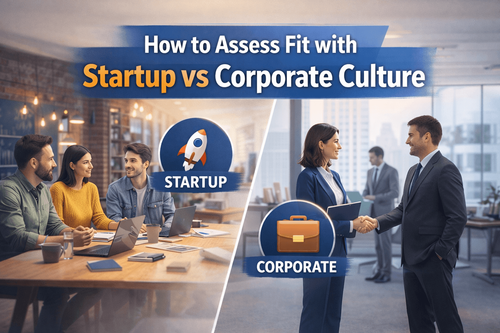

Startup vs Corporate Career Decision: A Practical Framework to Assess Your Culture Fit with Confidence
You have an offer in hand.
Or maybe you are actively interviewing. One opportunity is with a fast-growing startup promising ownership, equity, and rapid learning. The other is with a well-established corporate offering stability, brand value, and structured growth.
On the surface, it looks like a compensation comparison. In reality, it is a culture alignment decision that can shape your daily energy, long-term growth, and professional identity for years.
Many working professionals make this choice based on salary, brand perception, or peer pressure. Months later, they realise the environment drains them instead of amplifying their strengths.
This blog, based on the practical guide Startup vs Corporate: How to Assess Your Fit, gives you a structured, repeatable decision-making framework. Instead of guessing which environment suits you, you will learn how to evaluate your values, decode culture signals, assess specific organisations, and make a deliberate, career-accelerating choice.
Who Is This Blog(and Guidebook For?
This resource is designed for:
- Working professionals with 0–15 years of experience evaluating their next move
- Career changers comparing startup and corporate pathways
- Managers and individual contributors considering a high-stakes offer
- Professionals confused by conflicting advice from peers and mentors
- High performers who feel misaligned in their current environment
If you have ever wondered whether you are underperforming because of skill gaps or because of cultural misfit, this framework is for you.
Why This Topic Matters Today
The startup ecosystem has matured. Corporates are transforming digitally. Career paths are no longer linear, and professionals move between environments more fluidly than ever before.
But culture fit remains one of the top predictors of:
- Job satisfaction
- Performance consistency
- Long-term retention
- Career velocity
A structured thinker placed in a chaotic, ambiguous startup environment may spend more energy managing uncertainty than creating value. A creative risk-taker buried under multi-layered corporate approvals may disengage quickly.
The wrong environment does not mean you lack talent. It often means your strengths are being taxed instead of amplified.
In a competitive job market, choosing the right environment is no longer optional. It is strategic.
Core Concept or Framework Explained
The guide is built around a five-step decision architecture that moves from self-awareness to external evaluation:
- Know your values first
- Read the organisation’s culture signals
- Assess personality-culture fit
- Evaluate the specific organisation using four lenses
- Run a structured red flag and green flag audit
At the heart of this approach is a simple principle: optimise for environment alignment, not just role appeal or compensation.
Startups and corporates are not merely small versus large companies. They differ fundamentally across:
- Decision speed
- Risk tolerance
- Role clarity
- Learning structure
- Compensation models
- Impact visibility
- Job security
- Innovation freedom
Neither is superior. Each rewards a different psychological and professional profile.
How This Blog and Guidebook Help You
By applying these frameworks, you will:
- Gain clarity on what truly energises and drains you at work
- Stop romanticising one environment over another
- Learn to decode real culture signals before you join
- Evaluate organisations systematically rather than emotionally
- Reduce the risk of a costly misaligned career move
Instead of asking Which one looks better on my CV, you will start asking Which environment brings out my best work right now?
That shift alone changes everything.
Step-by-Step Breakdown
Step 1: Know Your Values First
The most common mistake professionals make is starting with salary or title instead of self-awareness.
Before you evaluate any opportunity, answer three questions.List Your Non-Negotiables
What must exist in your work environment for you to feel engaged?
Examples include:
- Autonomy over how you execute work
- Financial stability and predictable income
- Clear role scope and defined responsibilities
- Fast feedback loops
- Structured mentorship
If these conditions are absent, you disengage or burn out. These are your anchors.
Identify Your Energisers
Recall a time when you felt genuinely excited about your work.Ask yourself:
- Were you building something from scratch or improving an existing system?
- Were decisions happening quickly or carefully?
- Was ownership high or tightly managed?
Your energisers reveal the environment where you naturally flourish
.Acknowledge Your Drains
Be honest about what consistently drains you:
- Endless meetings with no outcomes
- Constant fire-fighting and ambiguity
- Rigid multi-layer approval chains
- Lack of ownership
Mapping drains is as important as identifying energisers.
Rank Your Career Stage Needs.Your priorities evolve.
- Early career professionals often prioritise rapid learning
- Mid-career professionals may value visible impact
- Senior professionals may seek institutional influence
Be clear about what you need now, not what impressed you three years ago.
The Values Self-Assessment Signal-If four or more of your essential values lean strongly toward either speed, autonomy, and ambiguity, or toward stability, structure, and mentorship, that is a directional indicator worth paying attention to.
Step 2: Read the Organisation’s Culture Signals
Culture is observable long before you join. You simply need to know where to look.
Use the Culture Signal Decoder across four channels.
Job Description Language
Startup signals often include:
- Scrappy
- Zero-to-one
- High ownership
- Fast-paced
- Wear many hats
Corporate signals often include:
- Stakeholder management
- Governance
- Compliance
- Strategic alignment
- Cross-functional collaboration
These words are previews of daily reality.
LinkedIn Behaviour
Observe how leaders and employees communicate publicly.
- Are they celebrating product launches, pivots, and hustle?
- Or are they sharing industry thought leadership, governance wins, and structured initiatives?
What gets amplified internally is often visible externally.
Glassdoor and Review Patterns
Do not obsess over one review. Look for themes across recent feedback.
- High turnover without explanation is a signal
- Consistent praise for mentorship is a signal
- Defensive responses from management are a signal
Patterns rarely lie.
Interview Process Design
A startup moving from first call to offer in a week signals decision speed and autonomy.
A corporate with four to six rounds signals consensus culture and rigour.
The process is the preview.
Step 3: Use the Personality-Culture Fit Matrix
Certain personality tendencies align structurally with certain environments.
Answer five diagnostic questions honestly:
- How do you react to vague briefs and ambiguity?
- What is your instinct after a public failure?
- Do you follow process or find immediate workarounds?
- What kind of recognition motivates you most?
- Does equity upside excite you more than predictable salary growth?
Your lean may be:
- Startup
- Corporate
- Hybrid
There are no right answers. Only accurate ones.
Step 4: Evaluate the Specific Organisation
Categories matter less than specifics.
A 12-person seed-stage startup is different from a 120-person Series B company. A digital-first corporate business unit differs from a traditional hierarchical conglomerate.
Apply the Four-Lens Organisation Evaluation Framework.
Lens 1: Leadership Quality
- Track record
- Communication style
- Handling of public setbacks
- Employee feedback
Strong leadership elevates average environments.
Lens 2: Financial Health
For startups:
- Last funding round
- Runway
- Burn rate
For corporates:
- Growth versus cost-cutting mode
- Business unit trajectory
Financial health shapes your daily stability.
Lens 3: Team Composition
- Experience and calibre of peers
- Tenure of team members
- Quality of direct manager
High-quality peers accelerate growth exponentially.
Lens 4: Trajectory
Is the organisation growing or stagnating?
Growth creates opportunity. Stagnation often creates politics.
Step 5: Conduct the Red Flag and Green Flag Audit
Before signing any offer, run a structured audit.
Universal Red Flags
- Interviewers cannot define success clearly
- High unexplained turnover
- Contradictory information from different interviewers
- Pressure to decide quickly
- Leadership deflects culture questions
Universal Green Flags
- Honest discussion of challenges
- Access to current team members
- Clear growth path beyond year one
- Consistent organisational narrative
- You feel energised after interviews
Environment-Specific Red Flags
Startup examples:
- No clear runway
- Founder cannot delegate
- Vague equity structure
- Multiple pivots without learning narrative
Corporate examples:
- Excessive hierarchy for decisions
- Innovation stuck in pilot for years
- Tenure valued over impact
- No excitement about future direction
Red flags are not automatic dealbreakers. They are mandatory conversations.
Common Mistakes or Pitfalls to Avoid
Optimising for Compensation Alone
Salary matters. But chronic culture misalignment erodes long-term growth faster than a lower package ever will.
Romanticising the Alternative
Corporate professionals romanticise startup freedom. Startup professionals romanticise corporate stability. Evaluate reality, not fantasy.
Skipping Research
Spend as much time evaluating culture as negotiating pay.
Treating the Decision as Permanent
Career capital transfers across environments. This is a chapter, not a life sentence.
Ignoring the Manager Variable
Your direct manager is often the single biggest predictor of job satisfaction. Evaluate them independently.
How Should You Use This Guidebook Effectively?
Follow this structured approach over the next 72 hours:
- Complete the values self-assessment in 30 focused minutes
- Apply the culture signal decoder to one live opportunity
- Run the personality diagnostic honestly
- Schedule one informal conversation with a current employee
- Use the Culture Fit Score Card before accepting any offer
The Culture Fit Score Card includes 10 dimensions rated from 1 to 5. A score above 40 suggests strong alignment. A score below 25 signals serious misalignment requiring reconsideration.
Do not skip steps under time pressure. The sequence matters:
- Values clarity
- Culture signals
- Personality fit
- Organisation evaluation
- Structured audit
Research-backed intuition becomes powerful only after deliberate analysis.
Key Takeaways / Summary
- Culture fit directly influences performance and satisfaction
- Start with values clarity before evaluating the market
- Culture signals are observable through language, behaviour, and process
- Evaluate the specific organisation, not just the category
- Red flags demand investigation, not panic
- Your manager matters as much as the company
- Treat each move as a strategic chapter, not a permanent verdict
The best career move is not the most impressive one. It is the one aligned with who you are and what you need right now.
Your Next Step: Accelerate Your Career with PlanetSpark
Creating an impact-driven resume is not just about landing your next job—it’s about owning your professional story and presenting it with clarity, confidence, and credibility. When your resume clearly communicates value, results, and impact, opportunities follow naturally.
At PlanetSpark, we are committed to empowering working professionals with practical, outcome-focused resources that drive real career growth. From resume building and workplace communication to leadership presence and professional writing, our programs are designed to help you succeed in today’s fast-evolving job market.
Visit https://www.planetspark.in/resources to explore:
- Career and resume-building guides
- Workplace communication and professional writing resources
- Skill-development tools curated for working professionals
Want a deeper, hands-on experience?
You can also book a free trial session to learn more about PlanetSpark’s Working Professional Courses, designed to accelerate your career through personalised coaching, real-world practice, and expert guidance.
Your career deserves more than generic advice.
It deserves clarity, confidence, and measurable impact.
Start building that advantage today—with PlanetSpark.