
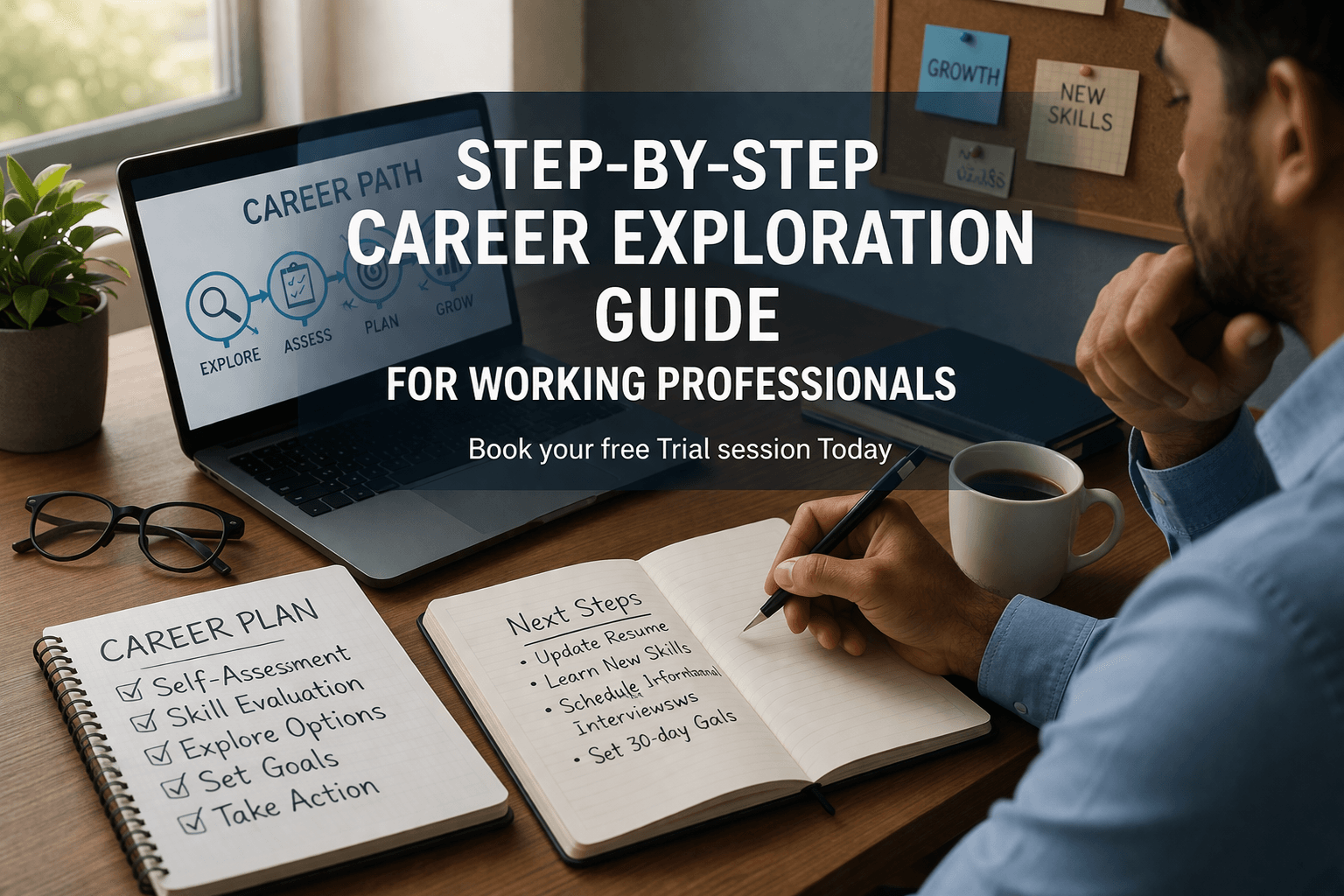
Step-by-Step Career Exploration Guide for Working Professionals


A Strategic Approach to Career Decision-Making: A Step-by-Step Framework to Evaluate Opportunities with Clarity and Confidence
A structured approach doesn’t eliminate uncertainty, but it gives you a reliable way to navigate it. Instead of asking “Which option feels right right now?”, you begin asking better questions: Which role aligns with my long-term vision? Which environment supports my strengths? Which trade-offs am I willing to accept?
By breaking decisions into clear criteria—such as learning opportunities, work-life balance, financial growth, company culture, and future mobility—you shift from reactive thinking to intentional evaluation. This not only reduces anxiety but also builds confidence in your choices, because you can clearly see why one option stands out over another.
Another key advantage is consistency. Career decisions are not one-time events; they occur repeatedly across your professional journey. Having a repeatable framework ensures that each decision builds on the last, rather than being influenced by temporary emotions or external pressure.
Over time, this structured thinking sharpens self-awareness. You begin to notice patterns in what energizes you, what drains you, and what truly drives your sense of fulfillment. That insight becomes more valuable than any single decision—it becomes a compass for your entire career.
Ultimately, clarity doesn’t come from having all the answers upfront. It comes from asking the right questions in the right way. A structured framework doesn’t just help you choose between options—it helps you understand yourself better, and that’s what leads to more meaningful, aligned career decisions.
Book your free trial session today with Planetspark.
Download for more details or PDF file.
Who Is This Blog For?
This blog and the accompanying guidebook
are designed for:
- Working professionals with 0–15 years of experience navigating career decisions
- Career changers exploring new industries or roles
- Mid-career professionals evaluating promotions or leadership opportunities
- Consultants and managers at a crossroads in their professional journey
- Individuals struggling with decision paralysis or second-guessing
Why This Topic Matters Today?
Career decisions today are more complex than ever. Professionals are no longer choosing between similar roles—they’re comparing entirely different paths: stability vs growth, corporate vs startup, remote vs office, passion vs pay.
The worksheet highlights that most professionals struggle not because they lack options, but because they have too many variables and no structured way to evaluate them
Without a clear framework:
- Decisions become emotional rather than strategic
- Important criteria get overlooked
- Short-term gains override long-term alignment
- Professionals experience regret even after making “logical” choices
A structured approach eliminates noise and ensures decisions are intentional, data-backed, and aligned with your future.
Core Concept or Framework Explained
At the heart of this guide is a structured 7-step career decision-making framework designed to combine logic, clarity, and intuition.
Instead of relying on guesswork, the framework helps you:
- Define your decision clearly
- Build a personalised evaluation system
- Assign importance to what truly matters
- Compare options using weighted scoring
- Filter out unacceptable choices
- Combine data with intuition
- Validate assumptions before deciding
As explained in the worksheet introduction (page 2), this is not a test—it’s a thinking tool that helps you organise what you already know and use it effectively
How This Blog and Guidebook Help You?
This blog and the worksheet together help you:
- Break down complex career decisions into structured steps
- Eliminate confusion and overthinking
- Identify what truly matters to you—not what “should” matter
- Make decisions with confidence and clarity
- Reduce regret by aligning choices with values
- Build a repeatable framework for future decisions
The outcome is not just a better decision—but a more confident decision-maker.
Step-by-Step Breakdown
Step 1: Define What You Are Actually Deciding
The most common mistake is starting comparisons without clarity.
Before evaluating options, define:
- What exactly are you deciding?
- What are the two (or more) specific options?
- What is your decision timeline?
- Who are the stakeholders involved?
For example, instead of asking “Should I change jobs?”, define:
“I am deciding between Job A at Company X and Job B at Company Y.”
As highlighted on page 3, vague decisions lead to vague clarity. Precision at this stage saves hours of confusion later
Step 2: Build Your Personal Criteria Framework
Not all factors matter equally—and not all matter equally to you.
The worksheet outlines key evaluation criteria:- Compensation and benefits
- Growth and learning opportunities
- Culture and people
- Purpose and mission alignment
- Logistics and lifestyle
- Stability and risk
You can also add custom criteria like mentorship or brand value.
This step ensures your decision is based on what you value—not generic benchmarks.
Step 3: Assign Weights to Your Criteria
Every factor does not carry the same importance.
You must distribute 100 points across your criteria based on priority.
For example:
- Growth: 30
- Compensation: 20
- Culture: 20
- Others: remaining points
This step prevents bias and ensures honesty in decision-making. As noted on page 5, weighting forces you to confront your real priorities—not socially acceptable ones
Step 4: Use the Side-by-Side Comparison Matrix
This is the most analytical part of the framework.
For each option:
- Score each criterion from 1 to 10
- Multiply by its weight
- Calculate total scores
The worksheet (page 6) explains how weighted scoring converts subjective impressions into structured insights
The highest score indicates the best alignment—not necessarily the final decision.
Step 5: Apply the Non-Negotiables Filter
Even high-scoring options can fail if they violate core needs.
Non-negotiables could include:
- Minimum salary
- Work-life balance
- Remote flexibility
- Manager quality
If an option fails even one non-negotiable, it is eliminated—regardless of its score.
This step ensures you don’t compromise on what truly matters.
Step 6: Combine Data with Intuition
Numbers alone are not enough.
The worksheet introduces powerful reflection questions:
- Future Self Test: Where will you be in 3 years?
- Regret Test: What will you regret not choosing?
- Energy Test: What feels exciting vs draining?
- Trusted Friend Test: What reflects your true self?
As noted on page 8, intuition is not irrational—it’s pattern recognition based on experience :
Step 7: Identify Information Gaps Before Deciding
Many decisions fail due to assumptions.
Before finalising:
- Identify what you know vs assume
- Separate researchable vs unknowable gaps
- Validate critical information
Common gaps include:
- Actual team culture
- Promotion timelines
- Real work-life balance
Closing these gaps ensures informed decisions—not risky guesses.
Common Mistakes or Pitfalls to Avoid
- Comparing offers instead of long-term career paths
- Overvaluing salary despite lower importance in your framework
- Seeking too many opinions and getting overwhelmed
- Waiting for perfect information and delaying decisions
- Ignoring personal values while prioritising external validation
The worksheet (page 11) highlights that these are cognitive biases—not personal failures—and can be corrected with structured thinking
How Should You Use This Guidebook Effectively?
Follow this practical workflow:
- Read the full guide once to understand the framework
- Complete each step using a real decision you’re facing
- Allocate 2–3 focused hours for full implementation
- Use the 30-minute sprint version when time is limited
- Revisit the framework for future career decisions
The worksheet is reusable and becomes more powerful with practice.
Key Takeaways
- Always define your decision clearly before comparing options
- Build a criteria framework based on your personal values
- Assign weights to reflect what truly matters
- Use structured scoring to reduce bias
- Apply non-negotiables to avoid poor-fit decisions
- Combine logic with intuition for better outcomes
- Identify and close information gaps before deciding
- Document your decision to reduce future doubt
--- Your Next Step: Accelerate Your Career with PlanetSpark
Creating an impact-driven resume is not just about landing your next job—it’s about owning your professional story and presenting it with clarity, confidence, and credibility. When your resume clearly communicates value, results, and impact, opportunities follow naturally.
At PlanetSpark, we are committed to empowering working professionals with practical, outcome-focused resources that drive real career growth. From resume building and workplace communication to leadership presence and professional writing, our programs are designed to help you succeed in today’s fast-evolving job market.
Visit https://www.planetspark.in/resources to explore:
- Career and resume-building guides
- Workplace communication and professional writing resources
- Skill-development tools curated for working professionals
Want a deeper, hands-on experience?
You can also book a free trial session to learn more about PlanetSpark’s Working Professional Courses, designed to accelerate your career through personalised coaching, real-world practice, and expert guidance.
Your career deserves more than generic advice.
It deserves clarity, confidence, and measurable impact.
Start building that advantage today—with PlanetSpark.
---
Personalized Communication Roadmaps
Record a video to get a AI generated personalized communication reports