
Step-by-Step Financial Literacy Guide for Working Professionals
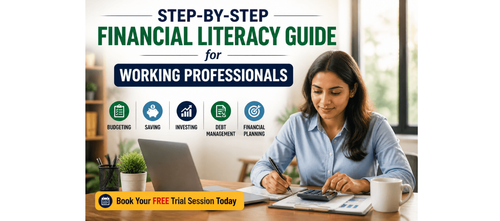

Build Financial Literacy With a Structured Learning Plan: A Practical Guide for Working Professionals
In today’s fast-evolving professional landscape, financial decisions are no longer limited to personal budgeting—they directly influence your career growth, confidence, and long-term stability. Yet, most professionals step into the workforce without ever being taught how money actually works. Concepts like investing, taxation, financial planning, and interpreting financial statements are often learned through trial and error rather than structured education.
This lack of clarity leads to reactive decision-making. Professionals rely on assumptions, follow trends without understanding them, or delay important financial actions due to confusion. Over time, these small gaps compound into missed opportunities, financial stress, and limited career leverage.
The reality is simple: financial literacy is not just a life skill—it is a critical career skill. Whether you are negotiating a salary, managing a budget, advising clients, or planning your future, your understanding of money shapes your outcomes.
This is where structured learning creates a powerful shift. Instead of scattered knowledge, it provides a clear, step-by-step pathway to build financial confidence, make informed decisions, and take control of your financial future.
Download these resources and apply them alongside your daily work for improved clarity, productivity, and professional growth. You can also book a free trial to gain expert guidance and enhance your communication, problem-solving, and decision-making skills. The materials are designed in a clear, structured format to help professionals learn efficiently and implement insights with confidence.
Who Is This Blog For?
- Working professionals who want to take control of their financial decisions
- Managers and leaders who need financial confidence in business discussions
- Career switchers aiming to build financial stability in new roles
- Freelancers and consultants managing income, taxes, and investments
- Early and mid-career professionals seeking long-term wealth creation
Why This Topic Matters Today?
In today’s economy, financial complexity is increasing while structured financial education remains limited. Professionals are expected to make decisions about savings, investments, loans, insurance, and taxes without a clear framework.
This creates several challenges:
- Decision-making based on guesswork rather than understanding
- Over-reliance on peer advice or social media tips
- Delayed financial planning due to confusion or fear
- Limited confidence in professional financial discussions
Financial literacy directly impacts:
- Career growth and negotiation power
- Investment outcomes and wealth creation
- Ability to handle economic uncertainty
- Professional credibility in leadership roles
Without a structured approach, even capable professionals struggle to build consistent financial clarity.
Core Concept or Framework Explained
The guide is built around a powerful three-stage learning framework:
Awareness, Application, and Mastery
This framework simplifies financial learning into a progressive journey rather than an overwhelming task.
Awareness
This stage focuses on building foundational understanding. You identify knowledge gaps, learn essential financial vocabulary, and understand your current financial position.
Application
At this stage, knowledge turns into action. You follow a structured learning path, apply concepts to real-life decisions, and build consistent habits.
Mastery
This stage focuses on refining your financial skills. You learn to read financial statements, build investment portfolios, and make strategic financial decisions with confidence.
The key idea is progression. Each stage builds on the previous one, creating a stable and sustainable learning system.
How This Blog and Guidebook Help You?
This guide provides a complete system for improving financial literacy in a practical and structured way.
You gain:
- A clear roadmap to learn finance step by step
- Tools to identify and fix knowledge gaps
- Real-world application strategies for better decision-making
- Systems to build consistent financial habits
- Confidence in both personal and professional financial situations
The outcome is not just knowledge—but measurable improvement in how you manage, discuss, and grow your finances.
Step-by-Step Breakdown
Step 1: Audit Your Financial Knowledge Gaps
Start by identifying where you currently stand.
Assess your understanding in:
- Personal finance basics such as budgeting and debt
- Investing fundamentals like mutual funds and compounding
- Taxation and compliance
- Business finance concepts such as P and L statements
Any weak area becomes your priority focus.
Step 2: Build Your Financial Vocabulary
Financial confidence begins with language.
Learn key terms such as:
- Net worth and cash flow
- Equity and debt instruments
- ROI and working capital
A simple habit is to learn three terms per week and use them in real conversations.
Step 3: Understand Your Financial Baseline
Track your current financial situation.
Key components include:
- Income and expenses
- Savings and investments
- Debt and liabilities
- Net worth
Use frameworks like the 50 30 20 rule to structure your finances effectively.
Step 4: Choose a Structured Learning Path
Avoid consuming random financial content.
Instead:
- Pick one resource per topic
- Follow it from start to finish
- Focus on depth rather than variety
This reduces confusion and improves retention.
Step 5: Use Curated Learning Resources
Follow a level-based approach:
- Foundation stage for basics
- Building stage for investing knowledge
- Investing stage for portfolio creation
- Advanced stage for financial analysis
Each level builds progressively on the previous one.
Step 6: Follow the 30-Minute Daily Learning System
Consistency matters more than intensity.
A simple weekly structure:
- Monday: Read financial content
- Tuesday: Watch or listen to learning material
- Wednesday: Apply concepts
- Thursday: Reflect on learning
- Friday: Review progress
Thirty minutes daily can transform your financial understanding within a year.
Step 7: Apply Learning to Real Decisions
Every concept must lead to action.
Examples:
- Use compound interest to plan investments
- Adjust your portfolio based on risk profiling
- Apply tax deductions in real scenarios
Follow the learn and apply within 14 days rule.
Step 8: Build a Financial Habit Stack
Integrate finance into daily life:
- Read financial news during your morning routine
- Listen to podcasts during your commute
- Review finances weekly and monthly
Small, consistent habits create long-term impact.
Step 9: Learn to Read Financial Statements
Understand three key statements:
- Income statement to analyse profitability
- Balance sheet to assess financial stability
- Cash flow statement to track actual cash movement
This skill enhances both career and investment decisions.
Step 10: Build and Manage an Investment Portfolio
Create a structured portfolio:
- Emergency funds and safe investments as a foundation
- Core equity funds for long-term growth
- Diversified investments for balanced risk
Focus on consistency and discipline rather than chasing high returns.
Common Mistakes or Pitfalls to Avoid
Many professionals struggle due to avoidable mistakes:
- Consuming information without applying it
- Jumping to advanced topics without basics
- Waiting to invest until income increases
- Over-diversifying investments
- Ignoring tax planning
- Relying on unverified financial advice
A better approach is to:
- Follow a structured sequence
- Apply concepts quickly
- Focus on clarity over complexity
How Should You Use This Guidebook Effectively?
To maximise results:
- Start with a complete knowledge audit
- Follow the Awareness to Application to Mastery path
- Dedicate 30 minutes daily to learning
- Apply every concept within two weeks
- Use worksheets and reflection tools consistently
Suggested workflow:
- Weekly learning and application cycle
- Monthly financial review
- Quarterly self-assessment
Consistency is the key driver of progress.
Key Takeaways
- Financial literacy is a critical career skill, not just a life skill
- Structured learning creates clarity and reduces confusion
- Awareness, Application, and Mastery form a powerful framework
- Daily 30-minute learning builds long-term competence
- Applying knowledge quickly accelerates understanding
- Financial habits matter more than one-time actions
- Avoiding common mistakes improves outcomes significantly
- Consistency and reflection drive continuous improvement
Your Next Step: Accelerate Your Career with PlanetSpark
Creating an impact-driven resume is not just about landing your next job—it’s about owning your professional story and presenting it with clarity, confidence, and credibility. When your resume clearly communicates value, results, and impact, opportunities follow naturally.
At PlanetSpark, we are committed to empowering working professionals with practical, outcome-focused resources that drive real career growth. From resume building and workplace communication to leadership presence and professional writing, our programs are designed to help you succeed in today’s fast-evolving job market.
Visit https://www.planetspark.in/resources to explore:
- Career and resume-building guides
- Workplace communication and professional writing resources
- Skill-development tools curated for working professionals
Want a deeper, hands-on experience?
You can also book a free trial session to learn more about PlanetSpark’s Working Professional Courses, designed to accelerate your career through personalised coaching, real-world practice, and expert guidance.
Your career deserves more than generic advice.
It deserves clarity, confidence, and measurable impact.
Start building that advantage today—with PlanetSpark.
Personalized Communication Roadmaps
Record a video to get a AI generated personalized communication reports