
Step-by-Step Guide for Identifying High-Impact Tasks to Focus On
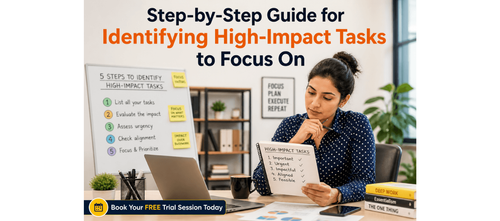

Identifying High-Impact Tasks Guide: How to Prioritise Work That Drives Real Career Growth
Most professionals don’t struggle with a lack of work—they struggle with doing the wrong work.
Your calendar is full. Your to-do list keeps growing. You respond to emails, attend meetings, complete reports, and stay “busy” all day. But at the end of the week, there’s a lingering question: what actually moved forward?
This disconnect between effort and impact is one of the biggest career growth blockers today. Being busy is no longer enough. What matters is whether your work contributes to meaningful outcomes—business results, career progression, or strategic goals.
That’s exactly where the High-Impact Task Identification Guide becomes essential. It helps you move beyond reactive work patterns and build a system for identifying, prioritising, and executing tasks that truly matter.
Download these resources and apply them alongside your daily work for improved clarity, productivity, and professional growth. You can also book a free trial to gain expert guidance and enhance your communication, problem-solving, and decision-making skills. The materials are designed in a clear, structured format to help professionals learn efficiently and implement insights with confidence.
Who Is This Blog For?
- Early to mid-career professionals looking to improve productivity and visibility
- Managers handling competing priorities and decision-making responsibilities
- Consultants balancing multiple clients and deliverables
- Career switchers aiming to demonstrate impact quickly
- Professionals overwhelmed by workload but unsure what to prioritise
- Individuals seeking structured frameworks for better time and energy management
Why This Topic Matters Today?
Modern work culture often rewards visible activity over meaningful outcomes. Professionals are expected to stay responsive, attend frequent meetings, and manage constant communication. This creates an illusion of productivity.
The guide identifies four common traps that dominate today’s work environment:
- The Urgent Spiral: reacting to immediate demands instead of focusing on what matters
- The Effort Illusion: equating long hours with high value
- The Priority Fog: treating all tasks as equally important
- The Completion Bias: choosing easy tasks for quick wins instead of meaningful ones
These patterns result in professionals spending the majority of their time on low-impact work. Over time, this leads to stagnation, burnout, and missed growth opportunities.
In a competitive job market, the ability to identify and focus on high-impact work is not optional—it is a core professional skill.
Core Concept
At the heart of this guide is a simple but powerful idea: not all tasks are equal.
A high-impact task is defined using three key dimensions:
- Outcome Proximity: Does the task directly contribute to a meaningful result such as a business metric, client outcome, or career milestone?
- Leverage Multiplier: Does the task unlock or accelerate other work?
- Irreplaceability: Is this a task that only you can perform based on your expertise or role?
Tasks that score high across these dimensions deserve priority. Tasks that don’t should be questioned, delegated, or eliminated.
The guide builds on this foundation using structured frameworks like the Impact-Effort Matrix, Goal Alignment Test, Pareto Principle, and MIT method. Together, they create a repeatable system for decision-making.
For example, instead of asking “What should I do next?”, you begin asking “What creates the most value right now?”
How This Blog and Guidebook Help You?
This guide is designed to create immediate and measurable improvements in how you work.
It helps you:
- Gain clarity on what truly matters in your role
- Reduce time spent on low-value activities
- Make faster, more confident prioritisation decisions
- Align daily work with long-term career goals
- Improve output without increasing working hours
- Build a structured productivity system that compounds over time
The result is not just better productivity—but better career outcomes. You become someone who consistently delivers value, not just effort.
Step-by-Step Breakdown
Step 1: Audit Your Current Task Landscape
The first step is awareness. Most professionals underestimate how much time they spend on low-impact tasks.
The guide recommends a 3-day task audit:
- Track every task that takes more than 15 minutes
- Record tasks without filtering or judging
- Categorise them at the end using an Impact-Effort framework
This exercise reveals patterns such as time leaks, unnecessary work, and misaligned priorities.
Reflection questions help deepen insights:
- Which tasks could only I have done?
- Which tasks directly contributed to outcomes?
- Which tasks could have been avoided?
Step 2: Use the Impact-Effort Matrix
This is the primary prioritisation tool.
Each task is evaluated based on:
- Impact: the value it creates
- Effort: the time and energy required
Tasks are then grouped into four categories:
- High impact, low effort
- High impact, high effort
- Low impact, low effort
- Low impact, high effort
The goal is to focus on high-impact tasks and minimise time spent in low-impact zones.
A key practice is spending five minutes each morning mapping your top tasks into this matrix before starting your day.
Step 3: Apply the Goal Alignment Test
Not all impactful tasks are aligned with the right goals.
This step ensures your work contributes to what truly matters:
- Define your top three professional goals
- Score each task based on its connection to those goals
- Prioritise tasks that score high on both impact and alignment
This prevents misdirected effort and ensures your work supports meaningful outcomes.
Step 4: Apply the Pareto Principle
The 80/20 rule states that a small percentage of tasks create the majority of results.
The guide helps you identify:
- Key activities that drive most of your output
- High-value relationships and responsibilities
- Tasks that can be reduced or eliminated
Once identified, these high-impact tasks should be protected with dedicated time blocks.
Step 5: Implement the MIT Method
The Most Important Tasks method focuses your day.
Each day, you:
- Identify three high-impact tasks
- Set them the night before
- Complete them before engaging in reactive work
This approach reduces decision fatigue and ensures your best energy is used on meaningful work.
Step 6: Use the Delegation Diagnostic
Effective prioritisation is not just about doing the right tasks—it’s about removing the wrong ones.
Every task should pass through four filters:
- Can it be automated?
- Can it be delegated?
- Can it be eliminated?
- Does it require your expertise?
Only tasks that pass these filters should remain on your list.
Step 7: Use Action Tools and Worksheets
The guide includes practical tools such as:
- Daily high-impact checklist
- Weekly prioritisation worksheet
- Reflection questions
- Personal action plan template
These tools help convert knowledge into consistent action.
Common Mistakes
Even with the right frameworks, professionals often fall into common traps:
Confusing urgency with importance
Immediate requests feel important but may not align with goals
Over-optimising task lists
Spending more time organising than executing
Setting too many priorities
Dilutes focus and reduces effectiveness
Not protecting high-impact time
Allowing meetings and interruptions to take over
Skipping weekly reviews
Leads to drift and misalignment
Avoiding these mistakes requires discipline and consistent application of the guide’s frameworks.
How Should You Use This Guidebook Effectively?
To maximise value, follow a structured approach:
- Initial read: 30 to 45 minutes to understand frameworks
- First application: complete the 3-day task audit
- Daily use: apply the Impact-Effort Matrix and MIT method
- Weekly routine: use the prioritisation worksheet and reflection questions
- Monthly review: reassess goals and alignment
This guide is not meant for one-time reading. It is a repeatable system that improves with consistent use.
The key is not perfection—it is consistency.
Key Takeaways
- Productivity is not about doing more, but doing what matters
- High-impact tasks are defined by outcome, leverage, and irreplaceability
- The Impact-Effort Matrix simplifies daily prioritisation
- The MIT method ensures focus on what truly matters each day
- The Pareto Principle helps identify your highest-value work
- Delegation and elimination are essential for freeing time
- Weekly reflection drives continuous improvement
- Consistent application leads to long-term career growth
Your Next Step: Accelerate Your Career with PlanetSpark
Creating an impact-driven resume is not just about landing your next job—it’s about owning your professional story and presenting it with clarity, confidence, and credibility. When your resume clearly communicates value, results, and impact, opportunities follow naturally.
At PlanetSpark, we are committed to empowering working professionals with practical, outcome-focused resources that drive real career growth. From resume building and workplace communication to leadership presence and professional writing, our programs are designed to help you succeed in today’s fast-evolving job market.
Visit https://www.planetspark.in/resources to explore:
- Career and resume-building guides
- Workplace communication and professional writing resources
- Skill-development tools curated for working professionals
Want a deeper, hands-on experience?
You can also book a free trial session to learn more about PlanetSpark’s Working Professional Courses, designed to accelerate your career through personalised coaching, real-world practice, and expert guidance.
Your career deserves more than generic advice.
It deserves clarity, confidence, and measurable impact.
Personalized Communication Roadmaps
Record a video to get a AI generated personalized communication reports