
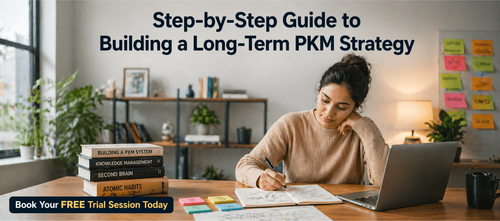
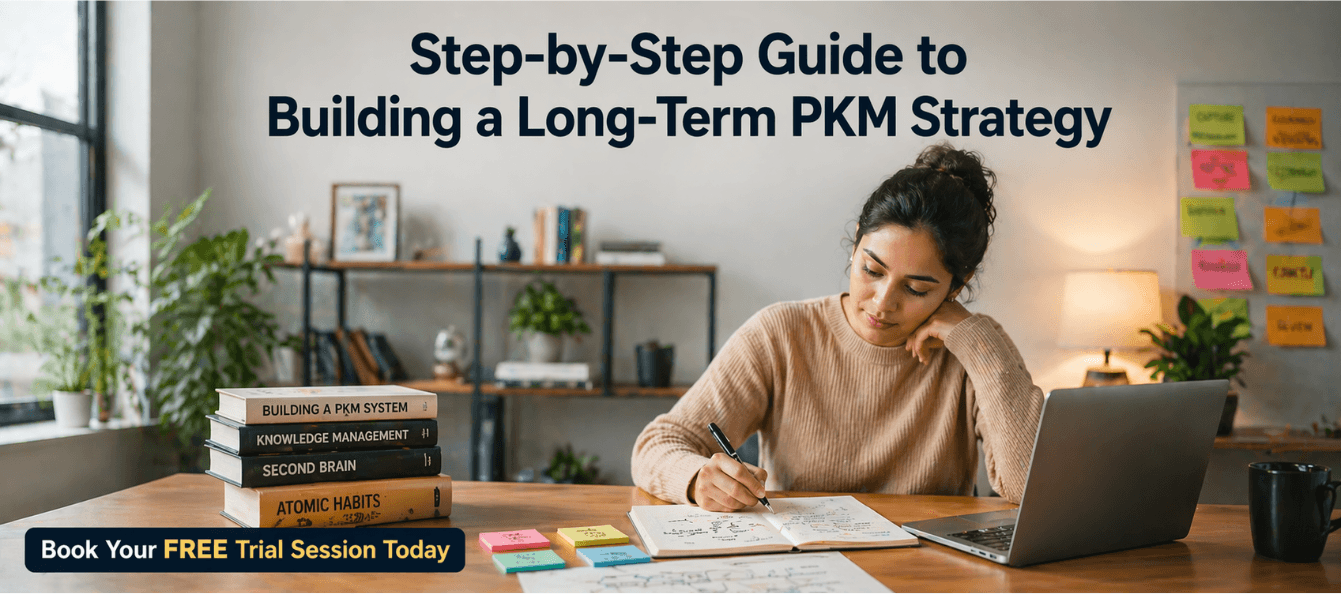
Step-by-Step Guide to Building a Long-Term PKM Strategy

Building Long-Term Personal Knowledge Strategy for Sustainable Career Growth
You are constantly learning—reading articles, attending meetings, taking courses, and gaining experience on the job. But have you ever stopped to ask: where does all this knowledge go?
For most professionals, the answer is unclear. Insights remain scattered across notebooks, apps, emails, and memory. Valuable lessons are forgotten, repeated mistakes occur, and hard-earned knowledge rarely compounds into long-term expertise.
The problem is not learning—it is the absence of a long-term knowledge strategy. Without a structured approach, even the most dedicated professionals struggle to turn learning into consistent career growth.
This is exactly where a Long-Term Personal Knowledge Strategy becomes essential. It helps you move from random learning to intentional knowledge building—so your insights accumulate, your thinking sharpens, and your professional value increases over time.
Download these resources and apply them alongside your daily work for improved clarity, productivity, and professional growth. You can also book a free trial to gain expert guidance and enhance your communication, problem-solving, and decision-making skills. The materials are designed in a clear, structured format to help professionals learn efficiently and implement insights with confidence.
Who Is This Blog For?
- Working professionals looking to build long-term expertise
- Career switchers entering new industries or roles
- Managers aiming to improve decision-making and strategic thinking
- Consultants handling complex, knowledge-intensive work
- Early to mid-career professionals focused on continuous growth
Why This Topic Matters Today?
In today’s fast-evolving job market, knowledge is one of the few assets that compounds over time—if managed correctly.
However, most professionals face common challenges:
- Learning without a clear direction or long-term goal
- Forgetting key insights due to lack of structured capture
- Struggling to connect ideas across different domains
- Failing to apply knowledge consistently in real work scenarios
This creates a fragmented learning experience where effort does not translate into results.
A long-term knowledge strategy addresses this gap by ensuring:
- Learning is intentional and goal-driven
- Knowledge is captured, organised, and revisited
- Insights are applied consistently
- Expertise builds progressively over time
Without such a strategy, growth becomes reactive rather than strategic.
Core Concept or Framework Explained
A Long-Term Personal Knowledge Strategy is built around four core pillars:
Clarity of Learning Goals
Defining what you want to learn and why it matters to your career
Systematic Knowledge Capture
Documenting insights in a structured and consistent manner
Structured Organisation
Creating a system that allows easy retrieval and connection of ideas
Consistent Application and Review
Using knowledge in real scenarios and refining it over time
These pillars work together to ensure that knowledge is not just collected—but actively used and improved.
How This Blog and Guidebook Help You?
This blog and the strategy guide provide a practical roadmap to build a sustainable knowledge system.
You gain:
- A clear framework for long-term knowledge development
- Tools to align learning with career goals
- Methods to improve retention and recall
- A system to apply knowledge effectively in your work
The result is a professional who learns with purpose, thinks more clearly, and delivers better outcomes consistently.
Step-by-Step Breakdown
Step 1: Define Your Knowledge Vision — What Do You Want to Master?
A strong knowledge strategy starts with clarity.
Instead of random learning, define:
- Key domains relevant to your career
- Skills you want to develop
- Outcomes you want to achieve
This ensures your learning is aligned with long-term goals.
Step 2: Identify Knowledge Sources — Where Will You Learn From?
Not all information sources are equally valuable.
Focus on:
- High-quality books, courses, and experts
- Industry-specific insights and trends
- Real-world experiences and projects
Curating your sources improves the quality of your learning.
Step 3: Build a Capture System — How Will You Retain Insights?
Without capture, knowledge fades quickly.
Create a system to:
- Document key ideas immediately
- Record lessons from experiences
- Capture both successes and failures
Consistency in capture is more important than complexity.
Step 4: Organise Your Knowledge — How Will You Structure It?
Organisation determines usability.
Best practices include:
- Categorising knowledge by themes or projects
- Using clear naming conventions
- Maintaining a clean and simple structure
A well-organised system supports faster thinking and better decisions.
Step 5: Connect Ideas — How Do You Build Deeper Understanding?
True expertise comes from connecting ideas.
Focus on:
- Linking related concepts
- Identifying patterns across experiences
- Combining knowledge from different domains
This creates a network of insights rather than isolated notes.
Step 6: Apply Knowledge — How Do You Turn Learning into Action?
Application is the most critical step.
Ensure that you:
- Use insights in real work scenarios
- Test ideas through action
- Reflect on outcomes
This transforms knowledge into capability.
Step 7: Review and Reflect — How Do You Improve Over Time?
Regular review ensures continuous growth.
Key actions:
- Revisit notes periodically
- Identify what worked and what didn’t
- Refine your understanding
Reflection turns experience into wisdom.
Step 8: Build Knowledge Assets — How Do You Create Long-Term Value?
Over time, your knowledge should evolve into assets.
Examples include:
- Frameworks and templates
- Decision-making models
- Documented case studies
These assets increase your professional leverage.
Step 9: Share Knowledge — How Do You Multiply Impact?
Sharing knowledge enhances both learning and visibility.
Ways to share include:
- Internal team discussions
- Mentoring and coaching
- Writing and presenting insights
This builds credibility and strengthens your network.
Step 10: Evolve Your Strategy — How Do You Stay Relevant?
Your knowledge strategy must adapt over time.
Regularly:
- Update your learning goals
- Explore new domains
- Remove outdated information
This ensures your knowledge remains aligned with changing career demands.
Common Mistakes or Pitfalls to Avoid
Many professionals struggle with knowledge strategy due to:
- Learning without clear goals
- Capturing too much information without filtering
- Overcomplicating systems and tools
- Failing to apply knowledge consistently
- Skipping regular review and reflection
A better approach is to:
- Keep systems simple and focused
- Prioritise actionable knowledge
- Build consistent habits over time
How Should You Use This Guidebook Effectively?
To implement a long-term knowledge strategy:
- Start by defining your learning goals
- Build a simple capture and organisation system
- Apply one insight at a time
- Schedule regular review sessions
Recommended workflow:
- Daily: Capture key insights
- Weekly: Organise and review notes
- Monthly: Reflect and refine
- Quarterly: Update your strategy
Consistency is the key to long-term success.
Key Takeaways
- Knowledge becomes valuable only when managed effectively
- A long-term strategy ensures consistent growth and expertise
- Clear goals align learning with career outcomes
- Structured capture and organisation improve retention and usability
- Application and reflection drive real impact
- Sharing knowledge builds credibility and influence
- Continuous evolution keeps your knowledge relevant
Your Next Step: Accelerate Your Career with PlanetSpark
Creating an impact-driven resume is not just about landing your next job—it’s about owning your professional story and presenting it with clarity, confidence, and credibility. When your resume clearly communicates value, results, and impact, opportunities follow naturally.
At PlanetSpark, we are committed to empowering working professionals with practical, outcome-focused resources that drive real career growth. From resume building and workplace communication to leadership presence and professional writing, our programs are designed to help you succeed in today’s fast-evolving job market.
Visit https://www.planetspark.in/resources to explore:
- Career and resume-building guides
- Workplace communication and professional writing resources
- Skill-development tools curated for working professionals
Want a deeper, hands-on experience?
You can also book a free trial session to learn more about PlanetSpark’s Working Professional Courses, designed to accelerate your career through personalised coaching, real-world practice, and expert guidance.
Your career deserves more than generic advice.
It deserves clarity, confidence, and measurable impact.
Start building that advantage today—with PlanetSpark.
Personalized Communication Roadmaps
Record a video to get a AI generated personalized communication reports