
Step-by-Step Guide to Crack Walk-In Interviews in 2026
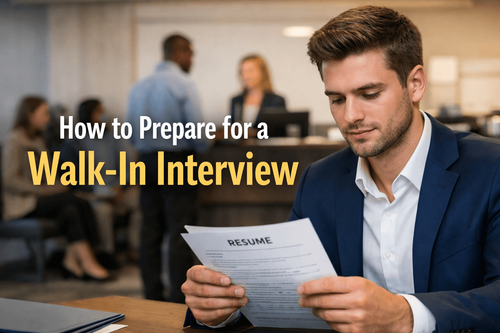

Strategic Guide to Prepare for a Walk-In Interview and Standing Out Instantly
Walk-in interviews operate at a different
speed. Unlike scheduled interviews, they demand instant readiness, sharp first impressions, and structured communication under pressure. You may have only a few minutes to prove your value among dozens—or even hundreds—of candidates competing for the same opportunity.
Many professionals underestimate walk-in interviews because they seem informal or urgent. In reality, they require even stronger preparation. When recruiters meet multiple candidates back-to-back, clarity, confidence, and differentiation become decisive.
This guide breaks down how working professionals can prepare strategically for walk-in interviews, manage pressure effectively, and convert spontaneous opportunities into confirmed job offers.
Who Is This Blog For?
This blog and accompanying guidebook are designed for:
- Fresh graduates attending campus or open hiring drives
- Working professionals exploring immediate job opportunities
- Candidates applying in high-volume hiring sectors such as sales, operations, BPO, or retail
- Professionals switching industries and testing market demand
- Job seekers who want to maximise every in-person hiring opportunity
Why This Topic Matters Today?
In fast-moving job markets, many organisations use walk-in interviews to accelerate hiring. These interviews reduce screening time and allow recruiters to evaluate communication skills, personality, and readiness in real time.
However, because the process is fast-paced:
- Recruiters make decisions quickly
- First impressions carry more weight
- Communication clarity becomes critical
- Preparation gaps become visible instantly
Unlike scheduled interviews where candidates have days to prepare mentally, walk-ins test your ability to think clearly, present confidently, and respond effectively under time constraints.
Core Concept or Framework Explained
Successful walk-in interview preparation revolves around three pillars:
1. Immediate Readiness
2. Structured Self-Presentation
3. Professional Impression Management
The framework below ensures you are not just prepared—but strategically prepared.
The R.I.S.E. Preparation Model:
- Research: Understand the company, role, and industry before arriving
- Identity: Clarify your professional story and key achievements
- Strategy: Prepare structured responses to common questions
- Execution: Deliver with confidence, clarity, and professionalism
This model transforms a walk-in interview from a reactive situation into a controlled opportunity.
How This Blog and Guidebook Help You?
Together, this blog and guidebook help you:
- Prepare efficiently even with short notice
- Organise essential documents professionally
- Structure concise yet powerful self-introductions
- Anticipate high-frequency walk-in interview questions
- Manage nerves and high-pressure environments
- Make a memorable first impression
The goal is simple: convert unpredictability into preparation.
Step-by-Step Breakdown
Step 1: Conduct Rapid Company Research
Even if the interview is scheduled on short notice, invest at least 30–45 minutes in research.
Focus on:
- Company background and industry
- Products or services offered
- Recent developments or expansion
- Role expectations from the job description
This preparation allows you to tailor responses instead of giving generic answers. Recruiters notice informed candidates immediately.
Step 2: Prepare a Concise Professional Introduction
In walk-in interviews, your introduction often determines the tone of the conversation.
Structure your answer as follows:
- Your current role or qualification
- Years of experience (if applicable)
- Core strengths aligned to the job
- One measurable achievement
- Career direction
Keep it under 60–90 seconds. Clarity and structure create impact.
Step 3: Organise Your Documents Professionally
Carry multiple printed copies of:
- Updated resume
- Passport-size photographs
- Identification documents
- Educational certificates
- Experience letters (if applicable)
Arrange them in a clean folder. Document organisation signals seriousness and professionalism.
Step 4: Prepare for High-Frequency Questions
Walk-in interviews often focus on:
- Tell me about yourself
- Why do you want this role?
- What are your strengths?
- Why should we hire you?
- Are you available to join immediately?
Prepare structured, confident responses using measurable examples where possible.
Even in entry-level roles, including metrics such as performance improvements, project impact, or academic achievements strengthens credibility.
Step 5: Dress Strategically for the Role
Professional attire should align with industry expectations.
General guidelines:
- Clean, formal clothing
- Minimal accessories
- Polished footwear
- Groomed appearance
Even if the company culture is casual, your first interaction should reflect professionalism.
Step 6: Manage Waiting Time Effectively
Walk-in interviews often involve waiting periods. Use this time to:
- Review your resume
- Practice key responses mentally
- Observe company environment
- Stay calm and composed
Avoid excessive phone usage. Professional body language matters even before the interview begins.
Step 7: Demonstrate Energy and Adaptability
Recruiters conducting walk-in interviews value:
- Quick thinking
- Clear communication
- Positive attitude
- Immediate availability
Maintain eye contact, answer concisely, and project enthusiasm without exaggeration.
Common Mistakes or Pitfalls to Avoid
The guidebook highlights several errors candidates frequently make:
- Arriving without researching the company
- Wearing overly casual clothing
- Giving long, unstructured answers
- Speaking negatively about previous employers
- Showing impatience during waiting periods
- Appearing disorganised with documents
- Failing to ask at least one thoughtful question
Even small missteps become amplified in fast-paced hiring environments.
How Should You Use This Guidebook Effectively?
For maximum benefit:
- Review the full guide once to understand the preparation model
- Create a standard interview folder ready for future walk-ins
- Draft and practice a 60-second introduction
- Prepare 5–7 adaptable achievement stories
- Conduct mock practice before attending
- Reflect after each walk-in interview to refine your approach
Time investment:
- Initial preparation: 2–3 hours
- Ongoing refinement: 20–30 minutes before each opportunity
Consistency builds confidence.
Key Takeaways
- Walk-in interviews demand instant readiness
- First impressions are amplified in high-volume hiring
- Structure your introduction for maximum clarity
- Organise documents professionally
- Prepare measurable examples of your impact
- Maintain confident body language throughout
- Adapt quickly and communicate concisely
- Treat every walk-in as a serious opportunity
Preparation converts unpredictability into advantage.
Your Next Step: Accelerate Your Career with PlanetSpark
Strong interview performance is not accidental—it is built through structured communication, confident storytelling, and strategic preparation. Walk-in interviews test your ability to present value clearly and quickly.
At PlanetSpark, we help working professionals build practical communication skills that drive measurable career growth. From interview mastery and workplace communication to leadership presence and professional writing, our programs are designed to help you stand out in competitive environments.
Visit https://www.planetspark.in/resources to explore:
- Career acceleration guides
- Interview preparation frameworks
- Workplace communication toolkits
- Skill-development resources for professionals
You can also book a free trial session to learn more about PlanetSpark’s Working Professional Courses, built to help you communicate with confidence and convert opportunities into outcomes.
Your career progress depends on how clearly you present your value.
Prepare with intention. Execute with confidence.
Start building your advantage today—with PlanetSpark.