
Step-by-Step Guide to Managing Interruptions Without Losing Productivity
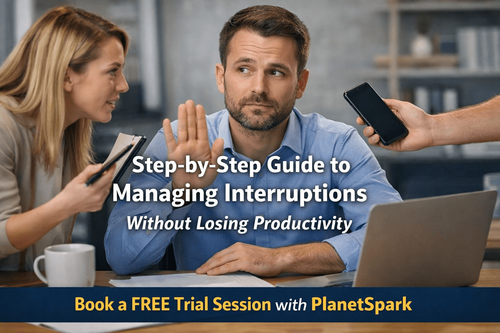

Mastering Focus at Work: A Practical Guide to Managing Interruptions Without Losing Productivity
You start your day with a clear plan. Within minutes, a message pops up. Then another. A colleague stops by. An email marked urgent demands attention. By the end of the day, you have been busy constantly, yet your most important work remains unfinished.
This is not a time management issue. It is an interruption problem.
Most professionals underestimate how deeply interruptions affect their productivity. According to the PlanetSpark guidebook, it takes over 23 minutes to regain focus after a single interruption. Multiply that across dozens of interruptions daily, and your ability to produce meaningful work drops sharply.
This blog transforms that guidebook into a practical system. It shows you how to identify interruption patterns, protect your focus, recover quickly, and build sustainable productivity habits that directly accelerate your career. Book your free trial session today with Planetspark.
Download for more details or PDF file.
Who Is This Blog For?
- Working professionals struggling with constant
interruptions and lack of focus
- Managers handling frequent team queries and reactive workflows
- Consultants balancing multiple clients and deadlines
- Early to mid-career professionals trying to build deep work habits
- Career-focused individuals aiming to improve output quality and consistency.
Why This Topic Matters Today?
Modern workplaces are built for responsiveness, not focus. Constant notifications, instant messaging tools, and open communication cultures create an environment where interruptions are the norm.
The guidebook highlights two critical realities:
- Professionals face 50–60 interruptions per day on average
- Less than 15 percent of these interruptions are actually urgent
This creates a dangerous gap between activity and meaningful progress.
If you cannot protect your focus, you cannot produce high-quality work. And in today’s competitive environment, output quality directly impacts performance, recognition, and career growth.
Core Concept or Framework Explained
The foundation of interruption management is not elimination. It is control.
The guidebook introduces a powerful system built around awareness, protection, and recovery. At its core are three key ideas:
Understanding Your Interruption Landscape
Interruptions are not just external. They fall into three categories:
- External interruptions such as messages, emails, meetings, and colleague requests
- Internal interruptions such as urge to check notifications or switch tasks
- Self-invited interruptions like unnecessary status checks or distraction habits
Recognising these patterns is the first step toward control.
The Three-Layer Protection System
Instead of relying on one tactic, the system uses three layers:
- Environment design to reduce incoming interruptions
- Time architecture to structure your day intentionally
- Response protocols to handle interruptions effectively
This layered approach ensures that even if one layer fails, the others maintain control.
Focus Recovery Protocol
Interruptions are inevitable. What matters is how fast you recover.
The guidebook introduces techniques like the breadcrumb method and a 2-minute re-entry ritual to regain focus quickly and reduce cognitive fatigue.
How This Blog and Guidebook Help You?
This blog and guidebook together help you:
- Identify where your productivity is leaking due to interruptions
- Build systems to protect your deep work time
- Respond to interruptions without losing control of your schedule
- Recover focus faster after disruptions
- Improve work quality, efficiency, and professional reliability
The result is simple. You move from reactive work to intentional execution.
Step-by-Step Breakdown
Step 1: Audit Your Interruption Patterns
Start by tracking your interruptions for two working days.
Record:
- Time of interruption
- Type and source
- Whether it was urgent
- Estimated time lost
This simple audit often reveals a powerful insight. Most interruptions are not urgent and could be delayed without consequences. :contentReference[oaicite:3]{index=3}
Reflection questions help you identify patterns such as peak interruption hours and major sources.
Step 2: Build the Three-Layer Protection System
To manage interruptions effectively, you need structured defence.
Environment Design
- Turn off non-essential notifications
- Use visible signals like headphones
- Remove distractions from your workspace
Time Architecture
- Block deep work hours during peak energy time
- Create fixed communication windows
- Separate focus time from reactive work
Response Protocols
- Decide instantly whether to handle, defer, or decline
- Use quick decision frameworks to avoid overthinking
This layered approach ensures consistent protection of your focus.
Step 3: Design a Focus-First Workday
Your calendar should reflect your priorities, not others’ demands.
A structured day typically includes:
- Morning deep work for high-impact tasks
- Mid-day communication windows
- Afternoon collaboration or meetings
- End-of-day review and planning
Blocking these segments visibly increases accountability and reduces interruptions significantly.
Step 4: Apply the Interruption Triage Matrix
Every interruption should be evaluated quickly.
Ask two simple questions:
- Will something break if I do not respond immediately?
- Am I the only person who can handle this?
Based on this, classify interruptions:
- Urgent and important: handle immediately
- Important but not urgent: schedule
- Urgent but not important: defer
- Neither: decline or delegate
This prevents reactive decision-making.
Step 5: Set Boundaries Without Damaging Relationships
Most professionals avoid setting boundaries due to fear of appearing uncooperative.
The guidebook provides practical scripts:
- Deflect: request a later time
- Batch: group multiple queries into one discussion
- Status signal: show availability clearly
- Team agreement: create shared norms
Clear communication builds respect, not resistance.
Step 6: Optimise Your Digital Environment
Your devices are major sources of interruptions.
Key actions include:
- Disable non-critical notifications
- Check email at scheduled intervals
- Keep your phone out of sight during deep work
- Use website blockers for focus sessions
These changes reduce passive interruptions significantly.
Step 7: Master the Focus Recovery Protocol
Even with systems in place, interruptions will happen.
The guidebook introduces two powerful techniques:
Breadcrumb Technique
Write a quick note before switching tasks. This helps you resume faster.
2-Minute Re-entry Ritual
- Take a few deep breaths
- Revisit your note
- Identify the next action
- Restart immediately
This reduces re-entry time from several minutes to under two minutes.
Step 8: Plan Your Week for Focus
Use a weekly planning template to structure your work.
Define:
- Deep work blocks
- Communication windows
- Key priorities
This shifts your workflow from reactive to proactive.
Step 9: Build a Focus-Friendly Team Culture
Individual efforts are powerful. Team alignment is transformational.
Start with simple actions:
- Model focus behaviour
- Initiate discussions around interruptions
- Co-create team norms
- Review and refine regularly
Shared norms amplify productivity across the team.
Common Mistakes or Pitfalls to Avoid
- Becoming completely unavailable without communication
- Treating all interruptions as equally important
- Misusing focus time for low-value work
- Giving in to guilt when setting boundaries
- Ignoring recovery after interruptions
- Leaving notifications active
- Treating focus as an individual problem instead of a team issue
Avoiding these mistakes strengthens both productivity and professional credibility.
How Should You Use This Guidebook Effectively?
To get maximum value:
- Read the guide once for full understanding
- Complete the interruption audit
- Implement one strategy at a time
- Allocate 2–3 focused hours to set up your system
- Apply one improvement each week
This gradual approach ensures long-term habit formation.
Key Takeaways
- Interruptions are the biggest hidden productivity killer
- Most interruptions are not urgent and can be delayed
- Use a three-layer system to protect your focus
- Design your day intentionally with structured time blocks
- Respond to interruptions strategically, not reactively
- Recovery speed is as important as prevention
- Build team-level norms for sustained impact.
Your Next Step: Accelerate Your Career with PlanetSpark
Creating an impact-driven resume is not just about landing your next job—it’s about owning your professional story and presenting it with clarity, confidence, and credibility. When your resume clearly communicates value, results, and impact, opportunities follow naturally.
At PlanetSpark, we are committed to empowering working professionals with practical, outcome-focused resources that drive real career growth. From resume building and workplace communication to leadership presence and professional writing, our programs are designed to help you succeed in today’s fast-evolving job market.
Visit https://www.planetspark.in/resources to explore:
- Career and resume-building guides
- Workplace communication and professional writing resources
- Skill-development tools curated for working professionals.
Want a deeper, hands-on experience?
You can also book a free trial session to learn more about PlanetSpark’s Working Professional Courses, designed to accelerate your career through personalised coaching, real-world practice, and expert guidance.
Your career deserves more than generic advice.
It deserves clarity, confidence, and measurable impact.
Start building that advantage today—with PlanetSpark.
Personalized Communication Roadmaps
Record a video to get a AI generated personalized communication reports