
Step-by-Step Guide to PAR Interview Answers for Professionals

Use the PAR Framework to Communicate Impact and Ace Interviews, Appraisals, and Client Conversations
You have the experience. You have
delivered results, solved problems, and handled high-pressure situations. Yet, when asked a simple question like “Tell me about a time when…”, your answer feels scattered, incomplete, or underwhelming.
This is a common challenge—not because professionals lack capability, but because they lack structure. In high-stakes situations like interviews, performance reviews, or client presentations, clarity and impact matter more than effort alone.
This is where the Problem–Action–Result (PAR) framework becomes a game-changer. It transforms vague, story-like responses into clear, concise, and outcome-driven communication that highlights your true professional value.
Who Is This Blog For?
This blog and the accompanying guidebook are designed for:
- Early to mid-career professionals preparing for interviews or appraisals
- Career changers who need to present transferable skills effectively
- Consultants, managers, and client-facing professionals
- Job seekers struggling to articulate achievements clearly
- Professionals aiming to improve workplace communication and executive presence
Why This Topic Matters Today?
In today’s fast-paced professional environment, attention spans are short and expectations are high. Whether it is a recruiter, manager, or client, no one has the time to decode long, unfocused answers.
Many professionals struggle with:
- Rambling or unfocused responses
- Forgetting key achievements under pressure
- Sounding generic and indistinguishable from others
- Failing to clearly communicate results and impact
The reality is simple: structured communication is no longer optional. It is a core career skill. Professionals who can clearly articulate problems, actions, and results are perceived as more competent, credible, and confident.
Core Concept or Framework Explained
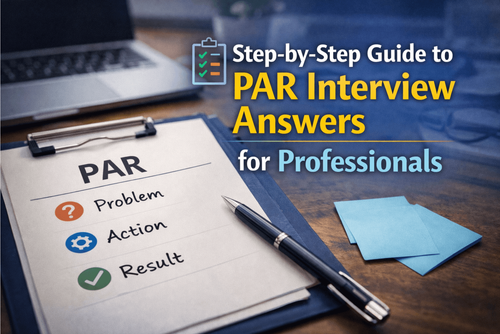
At the heart of this guide is the PAR framework—Problem, Action, Result. It is a structured approach to answering professional questions with clarity and impact.
Instead of narrating unstructured stories, PAR helps you organise your response into three powerful components:
- Problem: What was the challenge or situation? Why did it matter?
- Action: What did you specifically do? What decisions did you make?
- Result: What was the outcome? What changed because of your actions?
This structure ensures that your answers are:
- Clear and easy to follow
- Focused on your contribution
- Backed by measurable or specific outcomes
Over time, PAR becomes more than a framework—it becomes a way of thinking and communicating professionally.
How This Blog and Guidebook Help You?
This blog and guidebook provide a practical, step-by-step system to:
- Identify strong professional stories from your experience
- Structure answers that highlight your individual contribution
- Communicate results with clarity and confidence
- Build a reusable bank of high-impact answers
- Apply structured communication across interviews, meetings, and leadership conversations
The result is a noticeable shift in how others perceive your competence and credibility.
Step-by-Step Breakdown
Step 1: Identify Your Anchor Stories
Before structuring answers, you need the right raw material. Most professionals rely on one or two familiar stories, which limits flexibility and impact.
Instead, build a bank of 7–10 “anchor stories” from your experience. These should be:
- Specific: Real situations with clear context
- Personal: You played a meaningful role
- Transferable: Relevant across roles or industries
Focus on categories such as leadership, problem-solving, conflict resolution, innovation, and delivery under pressure.
A key tip is to write everything down before filtering. Even small experiences can become powerful when structured effectively.
Step 2: Craft a Strong Problem Statement
The problem sets the context and establishes stakes. It answers one key question: what was at risk?
A strong problem statement should:
- Be concise (1–2 sentences)
- Clearly define the challenge
- Highlight why the situation mattered
Weak problem statements are vague and overly detailed. Strong ones are precise and outcome-oriented.
For example, instead of saying there was “an issue with a client,” a strong statement highlights revenue risk, timelines, or operational impact.
Step 3: Build the Action Section Where Your Value Lives
The action section is the most critical part of your response. This is where your contribution becomes visible.
Strong action statements:
- Use “I” instead of “we”
- Focus on decisions, not tasks
- Highlight skills and reasoning
- Show ownership and initiative
For example:
- Weak: “We worked on improving the process”
- Strong: “I analysed the workflow, identified inefficiencies, and redesigned the process to reduce delays”
The goal is to clearly answer: what did YOU do?
Step 4: Deliver Results That Prove Impact
The result is where you establish credibility. It answers the question: what changed because of your actions?
Strong results:
- Include numbers wherever possible
- Show measurable improvement
- Highlight business or team impact
Examples of strong results include:
- Reduced turnaround time by 40 percent
- Improved customer retention by 20 percent
- Delivered a project ahead of schedule
If numbers are unavailable, use specific qualitative outcomes such as client retention, recognition, or process improvements.
Step 5: Integrate the PAR Flow Seamlessly
A strong PAR answer is not three separate parts—it is a cohesive story.
The flow should feel natural:
- Problem introduces the situation
- Action demonstrates your contribution
- Result delivers the impact
Transitions such as “To address this,” or “As a result,” help maintain clarity and engagement.
The ideal answer length is 75–120 seconds when spoken aloud, ensuring clarity without losing attention.
Step 6: Build and Practice Your Answer Bank
To truly benefit from PAR, build a structured answer bank.
- Prepare 5–7 stories across different competencies
- Practice speaking them aloud
- Time your responses
- Refine based on clarity and impact
Recording yourself and reviewing your answers is one of the fastest ways to improve.
Step 7: Apply PAR Beyond Interviews
The PAR framework is not limited to interviews. It is equally powerful in:
- Performance reviews and appraisals
- Client presentations and pitches
- Promotion discussions
- Leadership communication
In all these contexts, structured, outcome-driven communication strengthens your professional image.
Common Mistakes or Pitfalls to Avoid
Even with a strong framework, professionals often fall into predictable traps:
- Spending too much time explaining the problem
- Using “we” instead of owning actions
- Forgetting to mention results
- Giving vague or generic outcomes
- Listing tasks instead of decisions
- Using the same story for every question
- Starting with hesitant or apologetic language
Avoiding these mistakes immediately improves clarity and credibility.
How Should You Use This Guidebook Effectively?
To get maximum value from this guide, follow a structured approach:
- Read the guide once to understand the framework
- Use worksheets to build your story bank
- Draft and refine your PAR answers
- Practice speaking answers aloud
- Allocate 2–3 hours for deep preparation
- Revisit the guide before interviews or important conversations
You can also use it in three modes:
- Quick prep for last-minute interviews
- Deep dive for structured preparation
- Ongoing reference for continuous improvement
Key Takeaways
- Structured communication is a critical career skill
- The PAR framework transforms vague answers into impactful ones
- Strong answers focus on your actions and measurable results
- Build a bank of 7–10 anchor stories for flexibility
- Practice aloud to improve clarity and confidence
- Use PAR across interviews, appraisals, and leadership communication
- Consistency and practice turn this into a long-term professional advantage
Your Next Step: Accelerate Your Career with PlanetSpark
Creating an impact-driven resume is not just about landing your next job—it’s about owning your professional story and presenting it with clarity, confidence, and credibility. When your resume clearly communicates value, results, and impact, opportunities follow naturally.
At PlanetSpark, we are committed to empowering working professionals with practical, outcome-focused resources that drive real career growth. From resume building and workplace communication to leadership presence and professional writing, our programs are designed to help you succeed in today’s fast-evolving job market.
Visit https://www.planetspark.in/resources to explore:
- Career and resume-building guides
- Workplace communication and professional writing resources
- Skill-development tools curated for working professionals
Want a deeper, hands-on experience?
You can also book a free trial session to learn more about PlanetSpark’s Working Professional Courses, designed to accelerate your career through personalised coaching, real-world practice, and expert guidance.
Your career deserves more than generic advice.
It deserves clarity, confidence, and measurable impact.
Start building that advantage today—with PlanetSpark.
Personalized Communication Roadmaps
Record a video to get a AI generated personalized communication reports