
Step-by-Step Guide to Running High-Impact Team Meetings
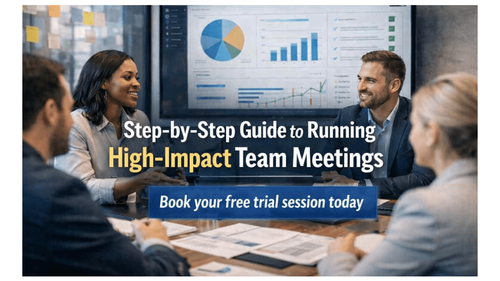

How to Run High-Impact Team Meetings: A Practical Guide for Career Acceleration
Most professionals know the frustration of meetings that drag on without purpose—no clear agenda, too many attendees, and no follow-through. These sessions drain energy and productivity instead of driving alignment and decisions.
The PlanetSpark guidebook “How to Run High-Impact Team Meetings” provides a structured scorecard and toolkit to transform meetings into engines of progress. By focusing on preparation, facilitation, and follow-up, leaders can consistently deliver meetings that matter.
Book your free trial session today with Planetspark.
Download for more details or PDF file.
Who Is This Blog For?
- Team leaders managing recurring syncs
or project reviews
- Mid-level managers seeking to improve meeting efficiency
- Senior professionals responsible for executive or quarterly reviews
- Consultants facilitating cross-functional collaboration
- Professionals frustrated by ineffective, time-wasting meetings
Why This Topic Matters Today?
Meetings are the backbone of collaboration, yet research shows many are ineffective. Poorly designed meetings lack structure, purpose, and accountability. The guidebook highlights that high-impact meetings are engineered for clarity: they start with a defined goal, follow a disciplined framework, and end with documented next steps.
In hybrid and remote environments, intentional meeting design is even more critical. Without structure, discussions drift, dominant voices take over, and decisions fail to translate into action.
Core Concept or Framework Explained
The Meeting Impact Scorecard divides the meeting lifecycle into three phases:
- Before (Preparation): Define objectives, agenda, and attendees.
- During (Facilitation): Manage time, participation, and decision-making.
- After (Follow-up): Document outcomes, assign owners, and track progress.
Each phase is scored on a 1–3 scale, providing leaders with a measurable snapshot of meeting effectiveness. Over time, this structured audit builds a culture of intentional collaboration.
How This Blog and Guidebook Help You?
By applying the scorecard and templates, leaders can:
- Design meetings with clear objectives and agendas
- Facilitate discussions that are inclusive and time-boxed
- Ensure decisions and actions are documented in real time
- Build accountability through structured follow-up
- Tailor meeting formats to purpose and audience
Step-by-Step Breakdown
Step 1: Preparation Before the Meeting
- Define a clear objective in one sentence: “By the end of this meeting, we will have [outcome].”
- Share the agenda at least 24 hours in advance with time allocations.
- Invite only essential attendees using the RACI framework.
- Provide pre-read materials for context.
- Set appropriate duration—avoid defaulting to 60 minutes.
Step 2: Facilitation During the Meeting
- Start on time and state the objective upfront.
- Follow the agenda and time-box each item.
- Use facilitation techniques:
- Parking Lot for off-topic items
- Directed questions to engage quieter voices
- 2-minute warnings for respectful time management
- Decision confirmation to close ambiguity
- Capture decisions and action items visibly.
- End on time or early with a clear summary.
Step 3: Follow-Up After the Meeting
- Send meeting notes within 24 hours.
- Document every action item with owner and deadline.
- Record decisions with rationale.
- Inform relevant non-attendees.
- Schedule next meeting or check-in before leaving.
- Track action items to completion using a shared system.
Step 4: Calibrate by Meeting Type
- Stand-up / Status Update: 15 minutes max, focus on blockers and priorities.
- Decision-Making Meeting: 30–45 minutes, pre-read required, end with documented decision.
- Brainstorm / Ideation: 45–60 minutes, divergent then convergent thinking, document all ideas.
- Quarterly / Executive Review: 60–90 minutes, share data decks in advance, focus on forward-looking decisions.
Step 5: Apply Templates for Consistency
- Agenda Template: Title, date, objective, attendees, topics, pre-read.
- Meeting Notes Template: Objective, decisions, action items, next meeting.
- Quick Slack/Email Follow-Up: One-line decisions, action owners, next touchpoint.
Common Mistakes or Pitfalls to Avoid
- Calling meetings without clear objectives
- Inviting too many attendees “just in case”
- Defaulting to 60-minute blocks unnecessarily
- Allowing status updates to crowd out real discussion
- Skipping follow-up, leaving actions undocumented
How Should You Use This Guidebook Effectively?
- Run the scorecard after every important meeting for 30 days
- Apply templates consistently across all meeting types
- Use facilitation techniques selectively based on context
- Send notes and action items within 24 hours—no exceptions
- Revisit the cheat sheet regularly to reinforce habits
Key Takeaways
- Structure meetings around three phases: Before, During, After
- Define objectives clearly and build agendas from them
- Facilitate inclusively with time discipline and decision confirmation
- Document and track actions to ensure accountability
- Tailor meeting formats to purpose and audience
- Apply templates and scorecards consistently for measurable improvement
Your Next Step: Accelerate Your Career with PlanetSpark
Creating an impact-driven resume is not just about landing your next job—it’s about owning your professional story and presenting it with clarity, confidence, and credibility. When your resume clearly communicates value, results, and impact, opportunities follow naturally.
At PlanetSpark, we are committed to empowering working professionals with practical, outcome-focused resources that drive real career growth. From resume building and workplace communication to leadership presence and professional writing, our programs are designed to help you succeed in today’s fast-evolving job market.
Visit https://www.planetspark.in/resources to explore:
- Career and resume-building guides
- Workplace communication and professional writing resources
- Skill-development tools curated for working professionals
Want a deeper, hands-on experience?
You can also book a free trial session to learn more about PlanetSpark’s Working Professional Courses, designed to accelerate your career through personalised coaching, real-world practice, and expert guidance.
Your career deserves more than generic advice.
It deserves clarity, confidence, and measurable impact.
Start building that advantage today—with PlanetSpark.
Personalized Communication Roadmaps
Record a video to get a AI generated personalized communication reports