
Step-by-Step Guide to Showing Resume ROI for Career Growth
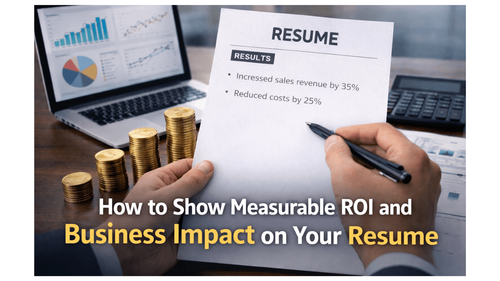

How to Showcase Measurable ROI and Business Impact on Your Resume for Faster Career Growth
Most professionals believe their resumes are
strong because they include solid experience, reputable companies, and clearly defined roles. Yet, despite this, many struggle to get interview calls. The problem is not lack of experience—it is the inability to communicate measurable value.
Recruiters today are not impressed by responsibilities. They are looking for proof—clear, quantified evidence that you can drive business results. Without this, your resume blends into a sea of similar profiles.
This is where demonstrating measurable ROI and business impact becomes a game-changer. This blog, based on a practical guidebook, shows you how to identify, quantify, and present your contributions in a way that immediately captures attention and builds credibility.
Who Is This Blog For?
This blog and guidebook are designed for:
- Working professionals with 0–15 years of experience aiming to strengthen their resumes
- Job seekers struggling with low interview callbacks despite relevant experience
- Career changers who need to reposition their work in terms of impact
- Mid-career professionals targeting promotions or leadership roles
- Consultants, analysts, and specialists who want to highlight business value
Why This Topic Matters Today?
Hiring today is driven by outcomes, not effort. Recruiters and hiring managers are under pressure to identify candidates who can deliver measurable value quickly.
According to the guidebook, a large percentage of resumes fail because they lack quantification. Statements like “managed a team” or “improved performance” do not provide enough clarity or credibility.
In contrast, resumes that clearly show ROI, cost savings, revenue growth, or efficiency improvements immediately stand out. They answer the most critical hiring question: What tangible impact has this candidate delivered?
Core Concept or Framework Explained
The central idea of this guidebook is simple but powerful—every professional contribution can be translated into business impact when viewed through the right lens.
The framework focuses on connecting your actions to measurable outcomes using three layers:
- Activity: What you did
- Outcome: What changed because of your actions
- Impact: The business value created
To strengthen this further, the guidebook emphasises quantification—attaching numbers, percentages, or scale indicators to your results. This transforms vague statements into compelling proof of performance.
How This Blog and Guidebook Help You?
This blog and guidebook help you:
- Identify hidden ROI in your past roles
- Convert everyday work into measurable achievements
- Use metrics that resonate with recruiters
- Write strong, results-driven resume statements
- Position yourself as a high-impact professional
By applying these principles, you create a resume that communicates value within seconds and increases your chances of getting shortlisted.
Step-by-Step Breakdown
Step 1: Shift Your Mindset from Tasks to Value
The first step is changing how you think about your work.
Instead of focusing on what you were responsible for, ask:
- What changed because of my work?
- Did I increase revenue, reduce costs, or improve efficiency?
- Did I solve a problem that saved time or resources?
This mindset shift is essential for identifying impact that may not be immediately obvious.
Step 2: Identify Key Impact Areas
The guidebook outlines key areas where business impact typically occurs:
- Revenue growth through sales, upselling, or new opportunities
- Cost savings by reducing waste, optimising processes, or negotiating better deals
- Efficiency improvements such as time savings or faster delivery
- Customer impact including retention, satisfaction, or engagement
- Risk reduction through compliance, quality improvements, or error reduction
Mapping your work to these areas helps you uncover measurable contributions.
Step 3: Find and Estimate Your Metrics
Numbers are critical, but not always readily available. The guidebook provides practical ways to identify or estimate them:
- Use actual data from reports, dashboards, or performance reviews
- Estimate conservatively based on available information
- Use percentages when absolute numbers are unavailable
- Highlight scale such as team size, project scope, or volume handled
Even approximate numbers are far more powerful than no numbers at all.
Step 4: Write Impact-Driven Statements
Once you have your metrics, structure your statements clearly:
- Start with a strong action verb
- Describe what you did
- Explain how you did it
- End with the quantified result
For example, instead of saying you improved a process, specify how much time or cost was saved and what actions led to that improvement.
Step 5: Highlight ROI Across Different Roles
Different roles create impact in different ways, and your resume should reflect that:
- Sales roles focus on revenue growth and targets achieved
- Operations roles highlight efficiency and cost reduction
- Marketing roles emphasise engagement, conversion, and reach
- Finance roles showcase financial analysis and profitability improvements
- HR roles demonstrate hiring efficiency, retention, and employee engagement
Tailoring your impact statements to your role ensures relevance and clarity.
Step 6: Integrate Impact Across Your Resume
Impact should not be limited to one section. It should appear throughout your resume:
- Professional summary with 1–2 quantified highlights
- Experience section with impact-driven bullet points
- Key achievements section if applicable
This creates a consistent narrative of value and performance.
Step 7: Validate and Refine Your Statements
Before finalising your resume:
- Check that every claim is accurate and defensible
- Ensure numbers are realistic and not exaggerated
- Simplify language for clarity and readability
- Remove vague or redundant statements
This step ensures your resume remains credible and professional.
Common Mistakes or Pitfalls to Avoid
The guidebook highlights several common mistakes:
- Listing responsibilities without showing results
- Using vague terms like “helped” or “assisted”
- Avoiding numbers due to uncertainty
- Overestimating or exaggerating impact
- Ignoring role-specific metrics
Avoiding these mistakes significantly improves the strength of your resume.
How Should You Use This Guidebook Effectively?
To maximise results, follow a structured workflow:
- Read the guide fully to understand the framework
- Audit your current resume for missing impact
- Identify and list your key achievements
- Quantify each achievement using available data
- Rewrite your resume using impact-driven statements
- Allocate 2–3 focused hours for implementation
- Revisit and refine regularly
This approach ensures that learning translates into tangible improvements.
Key Takeaways
- Recruiters prioritise measurable results over responsibilities
- Every role has hidden ROI that can be uncovered
- Quantification adds credibility and clarity
- Use structured statements to present achievements effectively
- Tailor impact based on your role and industry
- Maintain honesty and accuracy in all claims
Your Next Step: Accelerate Your Career with PlanetSpark
Creating an impact-driven resume is not just about landing your next job—it’s about owning your professional story and presenting it with clarity, confidence, and credibility. When your resume clearly communicates value, results, and impact, opportunities follow naturally.
At PlanetSpark, we are committed to empowering working professionals with practical, outcome-focused resources that drive real career growth. From resume building and workplace communication to leadership presence and professional writing, our programs are designed to help you succeed in today’s fast-evolving job market.
Visit https://www.planetspark.in/resources to explore:
- Career and resume-building guides
- Workplace communication and professional writing resources
- Skill-development tools curated for working professionals
Want a deeper, hands-on experience?
You can also book a free trial session to learn more about PlanetSpark’s Working Professional Courses, designed to accelerate your career through personalised coaching, real-world practice, and expert guidance.
Your career deserves more than generic advice.
It deserves clarity, confidence, and measurable impact.
Start building that advantage today—with PlanetSpark.
Personalized Communication Roadmaps
Record a video to get a AI generated personalized communication reports