
Step-by-Step Interview Execution Plan for Working Professionals

Mastering Interview Success
In today’s competitive job market, being qualified is no longer enough. Many professionals walk into interviews with strong resumes, relevant experience, and solid skills—yet walk out without an offer. The reason is simple but often overlooked: interviews are not just evaluations; they are performance moments where how you communicate matters as much as what you know.
Under pressure, even experienced professionals struggle to structure their answers, articulate their value, or confidently close the conversation. Without a clear system, interviews become inconsistent, unpredictable, and stressful. This leads to missed opportunities—not because of capability gaps, but because of execution gaps.
This is exactly where a structured Interview Execution Planner becomes a game-changer. Instead of relying on instinct or last-minute preparation, you follow a repeatable, proven system that helps you prepare strategically, perform confidently, and follow up effectively—turning interviews into offers.
Download these resources and apply them alongside your daily work for improved clarity, productivity, and professional growth. You can also book a free trial to gain expert guidance and enhance your communication, problem-solving, and decision-making skills. The materials are designed in a clear, structured format to help professionals learn efficiently and implement insights with confidence.
Who Is This Blog For?
- Job seekers preparing for multiple
interview rounds
- Working professionals aiming to convert more interviews into offers
- Career switchers entering new industries or roles
- Mid-level professionals targeting promotions or leadership roles
- Ambitious individuals looking to improve interview confidence and communication
Why This Topic Matters Today?
In a hiring landscape where competition is intense, the difference between getting shortlisted and getting selected often comes down to interview performance. Many professionals invest time in updating their resumes or researching companies but overlook structured interview preparation.
The result is a common pattern:
- Rambling or unclear answers under pressure
- Lack of structured storytelling
- Weak openings that fail to create impact
- Missed opportunities to ask strategic questions
- No follow-up or reflection after interviews
Modern hiring decisions increasingly depend on how clearly and confidently you communicate your value. Employers are not just evaluating your experience—they are assessing your thinking, clarity, and ability to perform in real-world scenarios.
A structured interview approach is no longer optional. It is essential.
Core Concept or Framework Explained
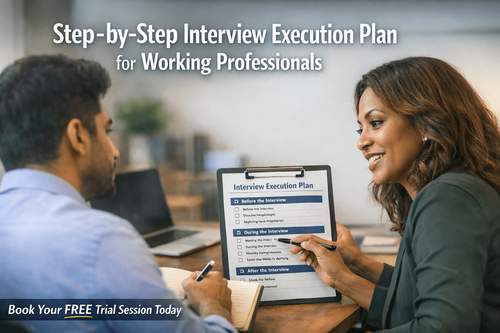
At the heart of effective interview performance is a powerful three-phase execution framework: Before, During, and After the interview. This framework ensures that you are not just reacting in the moment but executing with clarity and intention at every stage.
The Before Phase focuses on preparation. This includes researching the company, understanding the role deeply, and preparing structured career stories. Preparation reduces uncertainty and builds confidence.
The During Phase is where execution happens. This involves delivering a strong opening pitch, answering questions using structured frameworks, actively listening, and closing the conversation with clarity and intent.
The After Phase is where most candidates fail—but it is also where differentiation happens. Following up with a personalised message, reflecting on your performance, and preparing for the next step creates a strong professional impression.
A key tool within this framework is the STAR-L method:
- Situation
- Task
- Action
- Result
- Learning
This structure ensures your answers are clear, concise, and impactful, while also demonstrating self-awareness and growth.
How This Blog and Guidebook Help You?
This blog, based on the Interview Execution Planner, provides you with a complete system to improve your interview outcomes.
It helps you:
- Build structured, compelling answers instead of improvising
- Prepare strategically rather than randomly
- Reduce interview anxiety through clear frameworks
- Communicate your value with clarity and confidence
- Stand out through strong follow-ups and professional behaviour
The result is a consistent, repeatable approach that improves with every interview you attend.
Step-by-Step Breakdown
Step 1: Prepare Strategically Before the Interview
Preparation begins 48–72 hours before the interview.
Focus on:
- Researching the company’s mission, culture, and recent updates
- Analysing the job description and mapping it to your experience
- Preparing 5–7 career stories using a structured format
- Practising your personal pitch aloud
- Planning logistics such as timing, platform, and attire
This stage builds the foundation for everything that follows.
Step 2: Build Your Story Bank
A Story Bank is a collection of your most powerful professional experiences, structured and ready to use.
You should prepare stories around:
- Leadership experiences
- Conflict resolution
- Failures and lessons learned
- High-pressure achievements
- Innovation or change initiatives
Each story should clearly highlight outcomes and learning. Once built, this becomes a reusable asset for all future interviews.
Step 3: Craft a Strong Opening Pitch
Your first impression sets the tone for the entire conversation.
Your opening should:
- Introduce your current role and experience
- Highlight a key achievement
- Explain why you are interested in the role
A well-practised 90-second pitch helps you start confidently and establish credibility early.
Step 4: Execute with Structure During the Interview
During the interview, your focus should shift from thinking to executing.
Key techniques include:
- Using structured storytelling for every answer
- Listening carefully and adapting your responses
- Pausing before answering instead of rushing
- Using bridge phrases when needed
- Asking thoughtful, prepared questions
This ensures your communication remains clear and professional throughout.
Step 5: Ask Strategic Questions
Asking questions is not optional—it demonstrates interest and critical thinking.
Strong questions:
- Show understanding of the role or company
- Reflect long-term thinking
- Encourage meaningful discussion
Avoid generic questions and focus on insights that add value to the conversation.
Step 6: Close the Interview with Intent
Many candidates end interviews passively. This is a missed opportunity.
Instead:
- Reaffirm your interest in the role
- Summarise your fit briefly
- Ask about next steps
A confident closing leaves a lasting impression.
Step 7: Follow Up After the Interview
Within 24 hours, send a personalised thank-you message.
Your message should:
- Reference a specific discussion point
- Reaffirm your interest
- Keep the tone professional and concise
This simple step significantly increases your chances of being remembered.
Step 8: Reflect and Improve
After every interview, take time to reflect.
Capture:
- What went well
- What could be improved
- Questions you found challenging
This creates a feedback loop that strengthens your performance over time.
Step 9: Prepare for Negotiation
If an offer is likely, begin preparing your negotiation strategy.
Research:
- Salary benchmarks
- Role expectations
- Your value proposition
Avoid accepting offers immediately—approach this stage strategically.
Step 10: Use Tools and Checklists for Consistency
Structured tools such as checklists, cue cards, and worksheets help you stay organised and focused.
They:
- Reduce cognitive load during interviews
- Ensure nothing important is missed
- Improve consistency across multiple interviews
Using these tools regularly builds a strong interview habit.
Common Mistakes or Pitfalls to Avoid
Many professionals lose opportunities due to avoidable mistakes.
Common pitfalls include:
- Over-explaining answers without structure
- Failing to prepare stories in advance
- Not asking any questions
- Ending interviews without a clear closing
- Skipping follow-ups entirely
A better approach is to:
- Use structured frameworks for every response
- Prepare thoroughly before the interview
- Communicate with clarity and confidence
- Treat follow-ups as a mandatory step
These small changes create a significant impact.
How Should You Use This Guidebook Effectively?
To maximise the value of the Interview Execution Planner, follow a simple workflow:
- First use: Read the entire planner to understand the system
- Before interviews: Complete the preparation checklist
- During interviews: Use cue cards for quick reference
- After interviews: Fill out the reflection worksheet
- Ongoing: Continuously update your Story Bank
Time investment:
- Initial setup: 60–90 minutes
- Before each interview: 20–30 minutes
- Post-interview reflection: 10–15 minutes
Consistency is the key. Treat every interview as part of a larger learning process.
Key Takeaways
- Interviews are performance events, not just evaluations
- Preparation across all three phases is critical for success
- Structured storytelling improves clarity and impact
- A strong opening and closing create lasting impressions
- Follow-ups significantly increase your chances of success
- Reflection helps you improve with every interview
- Confidence is built through preparation and repetition
Your Next Step: Accelerate Your Career with PlanetSpark
Creating an impact-driven resume is not just about landing your next job—it’s about owning your professional story and presenting it with clarity, confidence, and credibility. When your resume clearly communicates value, results, and impact, opportunities follow naturally.
At PlanetSpark, we are committed to empowering working professionals with practical, outcome-focused resources that drive real career growth. From resume building and workplace communication to leadership presence and professional writing, our programs are designed to help you succeed in today’s fast-evolving job market.
Visit https://www.planetspark.in/resources to explore:
- Career and resume-building guides
- Workplace communication and professional writing resources
- Skill-development tools curated for working professionals
Want a deeper, hands-on experience?
You can also book a free trial session to learn more about PlanetSpark’s Working Professional Courses, designed to accelerate your career through personalised coaching, real-world practice, and expert guidance.
Your career deserves more than generic advice.
It deserves clarity, confidence, and measurable impact.
Start building that advantage today—with PlanetSpark.
Personalized Communication Roadmaps
Record a video to get a AI generated personalized communication reports