
Step-by-Step Mock Interview Plan for Working Professionals
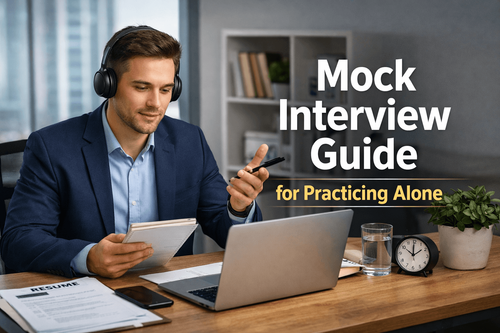

Structure Winning Answers Using a Mock Interview Guide for Practicing Alone
You know your subject. You have
the experience. Your resume is strong. Yet when the interview begins, your mind goes blank, answers feel unstructured, and confidence drops.
This is not a knowledge problem. It is a practice problem.
Most professionals prepare for interviews passively. They read answers, watch videos, or review notes. But interviews are performance situations. Without active rehearsal, even the most capable candidate can underperform.
The Mock Interview Guide for Practicing Alone provides a structured system to simulate real interviews without needing a partner. This blog converts that structured guide into a practical, step-by-step roadmap to help you build clarity, confidence, and control before the actual interview.
Who Is This Blog For?
This blog and guidebook are designed for:
- Working professionals preparing for job interviews independently
- Candidates with limited access to mentors or peer mock sessions
- Introverts who prefer structured solo preparation
- Professionals returning to the workforce after a break
- Anyone who wants to improve answer structure, clarity, and confidence
Why This Topic Matters Today?
Modern interviews are highly competitive and often conducted virtually. Recruiters evaluate:
- Clarity of communication
- Structured thinking
- Confidence under pressure
- Relevance of examples
- Professional presence
Many candidates underestimate how performance-driven interviews have become. Knowing the answer is not enough. Delivering it clearly within 60 to 120 seconds is the real skill.
Without structured practice:
- Answers become lengthy and unfocused
- Key achievements are forgotten
- Nervous habits increase
- Voice tone becomes flat or rushed
Solo mock interviews bridge the gap between knowledge and performance. They transform preparation into rehearsal.
Core Concept or Framework Explained
The central idea of the guide is structured solo simulation.
Instead of waiting for someone to conduct a mock interview, you create a repeatable system that includes:
- Pre-session preparation
- Real-time timed answering
- Recording yourself
- Structured self-evaluation
- Targeted improvement drills
The guide emphasises preparation cycles rather than random practice. Each session follows three stages:
Before the Session
During the Practice
After the Review
This structured loop ensures measurable improvement over time.
The framework also integrates structured answering techniques such as STAR-based responses to maintain clarity and logical flow.
How This Blog and Guidebook Help You?
By following this system, you will:
- Improve answer clarity and structure
- Reduce filler words and rambling
- Build time awareness
- Strengthen storytelling with real examples
- Increase confidence through repetition
- Identify and fix recurring mistakes
Most importantly, you stop guessing whether you are prepared. You see measurable progress.
Step-by-Step Breakdown
Step 1: First-Time Setup – Build Your Practice Foundation
Before beginning regular mock sessions, read the entire guide once to understand the full system.
Prepare:
- A list of common interview questions
- Behavioural and situational questions
- Role-specific technical questions
- A timer
- A recording device such as your phone or laptop
- An evaluation sheet or checklist
This preparation transforms random practice into structured training.
Step 2: Before Each Session – Prepare with Intent
Every mock session should start with focused preparation.
Review:
- Your resume highlights
- Key achievements
- Recent projects
- Strengths and improvement areas
- Structured frameworks like STAR
Select 5 to 8 questions for that session. Avoid practicing too many questions at once. Depth improves quality.
Set clear goals such as:
- Keep answers under 90 seconds
- Eliminate filler words
- Improve voice modulation
- Maintain steady eye contact
Step 3: During Practice – Simulate a Real Interview
Treat the session like a real interview.
- Sit upright at a desk
- Dress professionally if possible
- Start recording
- Read each question aloud
- Pause briefly
- Answer without looking at notes
Maintain structured responses:
Situation
Task
Action
Result
Time each answer. Aim for clarity, not perfection.
Avoid stopping mid-answer unless absolutely necessary. Real interviews do not allow restarts.
Step 4: After Review – Evaluate Objectively
This is the most important step.
Watch your recording and evaluate:
- Was the answer structured?
- Did you clearly state results?
- Did you ramble?
- Were filler words excessive?
- Was your voice confident and steady?
- Did body language look professional?
Use a scoring system for consistency.
Identify 1 to 2 specific improvements for the next session. Avoid overwhelming yourself with too many corrections at once.
Step 5: Create Targeted Improvement Drills
If you ramble, practice answering in exactly 60 or 90 seconds.
If voice sounds monotone, practice reading varied content aloud.
If eye contact is weak, practice speaking while looking directly into the camera.
If confidence drops mid-answer, rehearse power openings such as:
“I led a project where…”
“One significant challenge I solved was…”
Small targeted drills compound into significant performance improvement.
Common Mistakes or Pitfalls to Avoid
- Practicing only in your head
- Memorising scripted answers
- Ignoring timing
- Skipping the recording step
- Being overly self-critical
- Practicing inconsistently
Consistency matters more than perfection.
How Should You Use This Guidebook Effectively?
For best results:
- Practice 3 to 4 times per week
- Keep sessions between 20 to 30 minutes
- Focus on improvement, not volume
- Revisit previous weak questions
- Track progress over 2 to 3 weeks
Interview performance improves dramatically with repetition. Treat it like skill training, not information review.
Key Takeaways
- Interviews are performance situations, not knowledge tests
- Solo mock interviews are highly effective when structured
- Recording yourself accelerates improvement
- Use structured answering methods for clarity
- Focus on one improvement area per session
- Consistency builds confidence
Your Next Step: Accelerate Your Career with PlanetSpark
Creating an impact-driven resume is not just about landing your next job—it’s about owning your professional story and presenting it with clarity, confidence, and credibility. When your resume clearly communicates value, results, and impact, opportunities follow naturally.
At PlanetSpark, we are committed to empowering working professionals with practical, outcome-focused resources that drive real career growth. From resume building and workplace communication to leadership presence and professional writing, our programs are designed to help you succeed in today’s fast-evolving job market.
Visit https://www.planetspark.in/resources to explore:
- Career and resume-building guides
- Workplace communication and professional writing resources
- Skill-development tools curated for working professionals
Want a deeper, hands-on experience?
You can also book a free trial session to learn more about PlanetSpark’s Working Professional Courses, designed to accelerate your career through personalised coaching, real-world practice, and expert guidance.
Your career deserves more than generic advice.
It deserves clarity, confidence, and measurable impact.
Start building that advantage today—with PlanetSpark.