
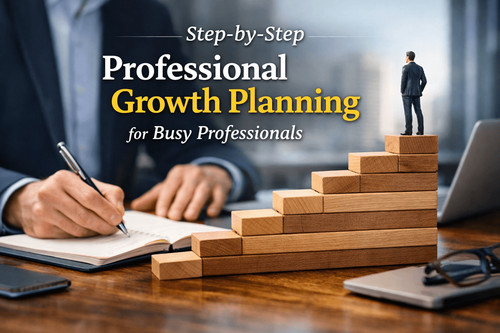
Step-by-Step Professional Growth Planning for Busy Professionals

SEO-Optimised Blog Title
Professional Growth Planning: A Step-by-Step System to Accelerate Your Career Without Burnout
Introduction
Most professionals don’t struggle because they lack talent or ambition. They struggle because they lack a clear, structured plan. Days turn into months, and months into years, filled with hard work—but without intentional direction, meaningful progress feels elusive.
You deliver results, meet expectations, and stay consistent. Yet when asked where your career is heading in the next three years, the answer often feels uncertain. This is not a motivation problem—it’s a system problem.
This is where a structured professional growth plan changes everything. Instead of guessing your way forward, it gives you clarity, direction, and measurable progress. This blog transforms a powerful growth planning checklist into a practical, step-by-step system you can use to take control of your career trajectory.
Who Is This Blog For?
- Working professionals who feel stuck
despite consistent performance
- Early to mid-career individuals aiming for faster progression
- Professionals preparing for leadership roles or role transitions
- Individuals who want structured, intentional career growth
- Anyone looking to build clarity, direction, and long-term career strategy
Why This Topic Matters Today?
Career growth today is no longer linear or predictable. Promotions are not guaranteed by tenure alone, and opportunities increasingly go to professionals who demonstrate clarity, visibility, and strategic value.
Many professionals operate reactively—responding to tasks, deadlines, and expectations set by others. Without a clear growth system, this leads to:
- Stagnation despite effort
- Missed opportunities due to lack of visibility
- Skill gaps that go unaddressed
- Unclear career direction
The checklist highlights a critical reality: professional growth does not happen by accident. It happens when you build a system that aligns your skills, goals, and actions with measurable outcomes.
Core Concept or Framework Explained
At the heart of professional growth planning is a simple but powerful idea: growth must be intentional, structured, and continuously evaluated.
This checklist functions as a complete career operating system built on six key pillars:
- Self-awareness of your current position
- Clarity on your long-term direction
- Identification and prioritisation of skill gaps
- A structured learning and development plan
- Strategic visibility and relationship-building
- Continuous feedback and accountability
Instead of relying on vague ambitions, this framework helps you move from uncertainty to clarity by answering key questions:
- Where am I today?
- Where do I want to go?
- What is stopping me?
- How will I bridge the gap?
- Who needs to see my work?
- How will I measure progress?
This structured approach ensures that your career growth is not left to chance but driven by deliberate action.
How This Blog and Guidebook Help You?
This blog and the underlying checklist help you build a repeatable system for career acceleration by enabling you to:
- Gain clarity on your current strengths, gaps, and professional reputation
- Define a compelling and realistic career direction
- Identify and prioritise high-impact skill gaps
- Create a practical learning plan that fits your schedule
- Build visibility with decision-makers and industry stakeholders
- Establish feedback loops that accelerate improvement
The outcome is not just career movement, but career momentum—consistent, measurable progress toward meaningful goals.
Step-by-Step Breakdown
Step 1: Audit Where You Are Right Now
Growth begins with clarity. Before setting goals, you need an honest and detailed understanding of your current position.
This includes:
- Listing your top hard and soft skills and rating them realistically
- Assessing whether you can clearly explain your role and impact
- Identifying tasks that energise versus those that drain you
- Reviewing feedback from the past year to identify patterns
- Understanding your professional reputation through peer insights
This step often reveals blind spots—skills you overestimate, strengths you undervalue, or perceptions you were unaware of.
Step 2: Define Your Growth Direction
Ambition without direction leads to frustration. This step transforms vague aspirations into a clear, actionable vision.
A strong growth direction includes:
- A clearly defined 3-year professional goal
- Alignment with your personal values, not just external expectations
- Awareness of market trends and role requirements
- Conversations with professionals already in your target role
- A 12-month milestone to track progress
A useful technique is to define your future professional headline. If it excites you and aligns with your strengths, you are on the right path.
Step 3: Map Your Skill Gaps
Once your direction is clear, the next step is identifying what stands between you and your goal.
Skill gaps fall into three categories:
- Critical gaps that must be addressed immediately
- Competitive gaps that differentiate you from peers
- Emerging gaps that will become important in the future
Instead of trying to improve everything, focus on the highest-impact gaps. Prioritisation is what turns effort into results.
Step 4: Build Your Learning and Development Plan
A growth plan without execution is ineffective. This step ensures your learning is structured, realistic, and measurable.
An effective plan includes:
- Selecting the right learning methods such as courses, mentorship, or projects
- Blocking at least 3 hours per week for focused learning
- Defining clear completion criteria for each goal
- Conducting monthly reviews to adjust your approach
The key is consistency. A realistic plan that you follow is far more effective than an ambitious one you abandon.
Step 5: Build Visibility and Strategic Relationships
Performance alone is not enough. Your work must be visible to the right people.
Visibility includes:
- Sharing your work through presentations, reports, or internal updates
- Volunteering for high-impact or cross-functional projects
- Contributing to external platforms such as professional communities
Equally important is building relationships:
- Identify senior professionals who can advocate for you
- Build connections across teams and functions
- Engage in meaningful professional conversations
Visibility ensures that your contributions are recognised, while relationships create opportunities for growth.
Step 6: Seek Feedback and Stay Accountable
Feedback accelerates growth by helping you identify blind spots and improve quickly.
A strong feedback system includes:
- Monthly development-focused check-ins with your manager
- Asking specific, actionable questions
- Partnering with a peer for accountability
- Conducting quarterly self-reviews to assess progress
This step ensures your growth plan remains active, relevant, and continuously improving.
Common Mistakes or Pitfalls to Avoid
Many professionals fail to see results not because they lack effort, but because they make avoidable mistakes:
- Setting vague goals without clear direction
- Trying to improve too many skills at once
- Avoiding visibility due to discomfort with self-promotion
- Consuming learning content without applying it
- Abandoning plans after temporary setbacks
The solution is to stay focused, prioritise effectively, and treat growth as a continuous process rather than a one-time effort.
How Should You Use This Guidebook Effectively?
To get the best results, use the checklist in a structured and disciplined way:
- Start by reading it fully to understand the complete framework
- Work through each step and complete the reflection exercises
- Allocate dedicated time each week for implementation
- Focus on a 90-day growth sprint for measurable progress
- Revisit and refine your plan every quarter
This approach ensures that insights are translated into action and results.
Key Takeaways
- Career growth requires a structured system, not just hard work
- Start with a clear and honest self-assessment
- Define a compelling and realistic career direction
- Focus on closing high-impact skill gaps
- Build a learning plan that is practical and consistent
- Invest in visibility and strategic relationships
- Use feedback and accountability to stay on track
- Review and refine your plan every 90 days
---
Your Next Step: Accelerate Your Career with PlanetSpark
Creating an impact-driven resume is not just about landing your next job—it’s about owning your professional story and presenting it with clarity, confidence, and credibility. When your resume clearly communicates value, results, and impact, opportunities follow naturally.
At PlanetSpark, we are committed to empowering working professionals with practical, outcome-focused resources that drive real career growth. From resume building and workplace communication to leadership presence and professional writing, our programs are designed to help you succeed in today’s fast-evolving job market.
Visit https://www.planetspark.in/resources to explore:
- Career and resume-building guides
- Workplace communication and professional writing resources
- Skill-development tools curated for working professionals
Want a deeper, hands-on experience?
You can also book a free trial session to learn more about PlanetSpark’s Working Professional Courses, designed to accelerate your career through personalised coaching, real-world practice, and expert guidance.
Your career deserves more than generic advice.
It deserves clarity, confidence, and measurable impact.
Start building that advantage today—with PlanetSpark.
Personalized Communication Roadmaps
Record a video to get a AI generated personalized communication reports