
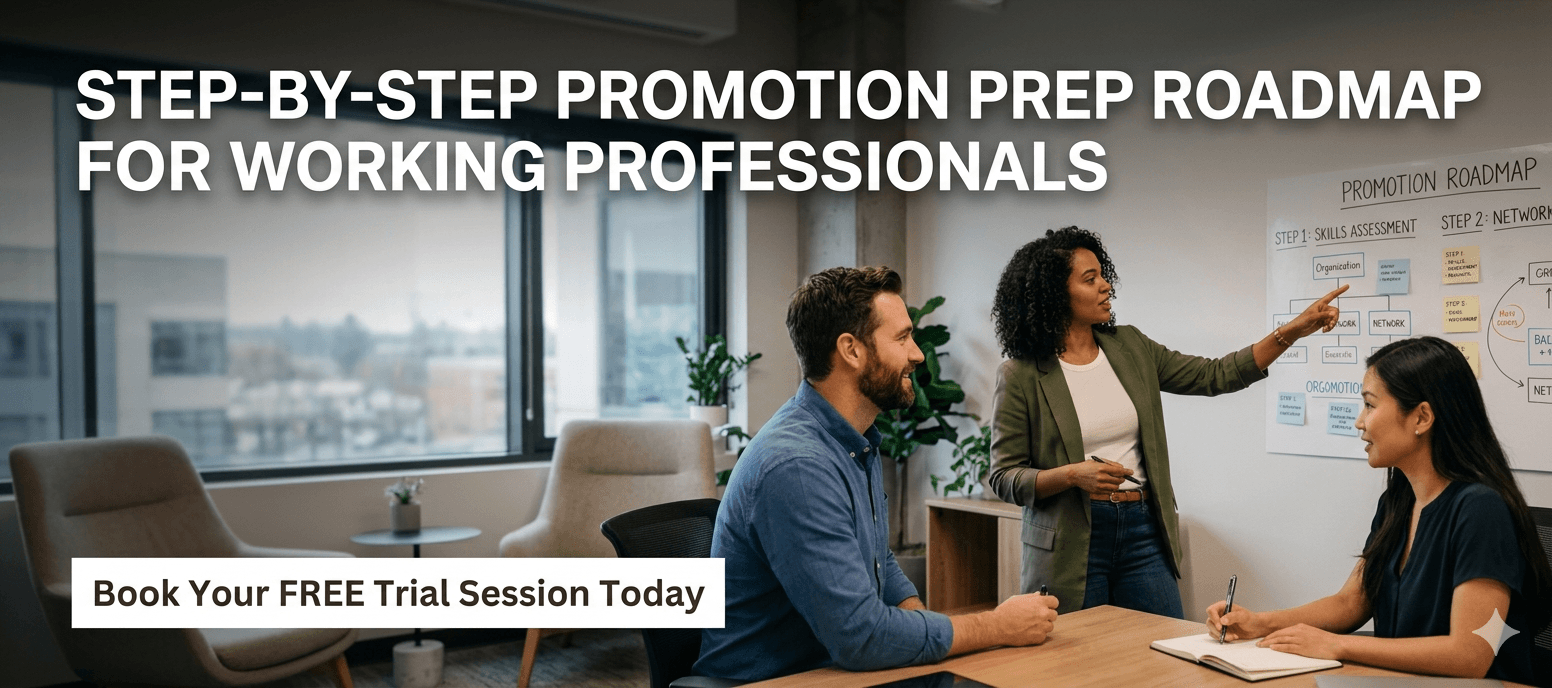
Step-by-Step Promotion Prep Roadmap for Working Professionals


Mastering the Promotion Preparation Checklist: Your End-to-End Guide to the Next Level
You are doing excellent work, meeting every deadline, and consistently delivering results. Yet, when the review cycle rolls around, you find yourself passed over for that senior role you have been eyeing. It is a common professional frustration: the gap between performing well and being recognized for it. Many professionals treat a promotion as a single moment or a lucky break, but the reality is that the most successful career leaps are engineered months before the conversation even begins. If you feel like your impact is being under-documented or your readiness is going unnoticed, you are likely missing the strategic positioning required to move upward. This guide transforms that uncertainty into a clear, actionable path, moving you from hoping for a promotion to proving you deserve one.
Download these resources and apply them alongside your daily work for improved clarity, productivity, and professional growth. You can also book a free trial to gain expert guidance and enhance your communication, problem-solving, and decision-making skills. The materials are designed in a clear, structured format to help professionals learn efficiently and implement insights with confidence.
Book your free trial session today with Planetspark.
Download for more details or PDF file.
Who Is This Blog For?
This guide is specifically designed for:
- Early-to-mid-career contributors looking to step into management
- Career switchers who need to establish credibility in a new field
- Consultants and managers aiming for senior leadership positions
- Professionals who feel invisible despite delivering high-quality work
- Anyone with a performance review approaching in the next three weeks to three months
Why This Topic Matters Today?
In today’s fast-paced corporate environment, doing your job well is simply the baseline. Promotions are increasingly won through deliberate visibility and strategic evidence-building rather than just tenure. Many talented individuals fall into the trap of under-communicating their value, assuming their managers see everything they contribute. They don't. Without a structured approach to documenting impact and securing internal advocacy, even the hardest workers can remain stuck in the same role for years. Understanding how to navigate the political and relational dimensions of a promotion is now a mandatory skill for any professional seeking long-term career acceleration.
Core Concept or Framework Explained
The core philosophy of this guide is that promotions are engineered, not awarded. The framework follows five distinct phases that move you through a logical progression of career advancement:
- Phase 1: Build Your Foundation – Establishing clarity on what the next level requires.
- Phase 2: Document Your Evidence – Creating an undeniable file of business-relevant impact.
- Phase 3: Build Visibility – Ensuring decision-makers are aware of your contributions before the meeting.
- Phase 4: Have the Conversation – Leading a structured, evidence-backed dialogue.
- Phase 5: After the Decision – Navigating the outcome to maintain your career trajectory.
This system moves away from passive hope and toward active career management, focusing on outcomes over outputs and strategic relationships over mere networking.
How This Blog and Guidebook Help You?
This resource acts as your personal career strategist. By following the structured phases, you will:
- Eliminate the guesswork regarding what is expected at the next level
- Learn to speak the language of business by quantifying your achievements
- Build a drumbeat of visibility that makes your promotion feel like a logical next step to leadership
- Gain the confidence to lead high-stakes conversations without feeling like you are asking for a favor
- Develop a resilient mindset that treats every review outcome as valuable data for your next move
Step-by-Step Breakdown
How to Build Your Foundation?
Before you advocate for a promotion, you must know exactly what you are advocating for. This phase focuses on closing the gap between your current performance and the requirements of the target role.
- Understand the Target Role: Obtain the formal job description for the next level. If one does not exist, ask your manager directly: What does success look like at the next level?
- Clarify the Timeline: Identify when the next cycle opens and who the final decision-makers are. Aim to start this process 90 to 180 days in advance.
- Identify Gaps Honestly: Rate yourself on the top 3-5 competencies for the new role. Focus your energy on the areas that are most important and most improvable.
- Secure a Sponsor: Find a senior leader who will mention your name in rooms where decisions are made. This is different from a mentor; a sponsor actively advocates for your advancement.
How to Document Your Evidence?
Promotions must be justified to stakeholders who may not work with you daily. Your evidence needs to be concrete and business-relevant.
- Create an Impact Inventory: For every project in the last 12-18 months, document the Situation, Action, Result, and Scope. Aim for 8-12 strong examples.
- Quantify Everything: Use numbers to describe your impact. Focus on revenue generated, costs saved, time saved, or efficiency improved. If exact numbers are unavailable, provide context-based estimates like "roughly 20 percent faster."
- Categorize Your Proof: Organize your file into Delivery Evidence (completed projects), Influence Evidence (cross-functional leadership), and Leadership Evidence (mentoring or proactive problem-solving).
How to Build Strategic Visibility?
Doing excellent work in silence is a career risk. Strategic visibility is the bridge between your hard work and your reward.
- The Visibility Frequency Framework: Build a consistent drumbeat. Weekly, share an insight in team channels. Monthly, discuss growth with your manager. Quarterly, send a proactive impact summary.
- Volunteer for High-Visibility Initiatives: Choose projects that allow you to present to senior leadership or represent the team in cross-functional settings.
- Demonstrate Next-Level Thinking: Present ideas and solutions rather than just status updates. Show that you are already operating at the level you want to reach.
How to Have the Promotion Conversation?
This is a structured dialogue, not a negotiation ambush. It should position you as someone already performing at the next level.
- Stage 1: Set Context: Request a dedicated meeting specifically for this topic rather than bringing it up at the end of a regular 1:1.
- Stage 2: Present Evidence: Walk through your impact inventory, focusing on measurable results that align with business priorities.
- Stage 3: State Your Ask: Be direct. Use a personal script like: "I am requesting consideration for [Title] in the [Cycle]."
- Stage 4: Agree Next Steps: If the answer is not an immediate yes, ask exactly what needs to change and by when. Avoid vague timelines.
How to Navigate the Outcome?
What you do in the 30 days following a decision shapes your future reputation.
- If You Get the Promotion: Clarify the transition in writing, set 30/60/90-day goals, and thank your advocates. Celebrate, but remember the clock for the next level starts now.
- If You Get a No: Ask for the three most important things to demonstrate in the next six months. Maintain professionalism and avoid withdrawing. Use the feedback as a diagnostic tool to evaluate if the organization remains the right vehicle for your growth.
Common Mistakes or Pitfalls to Avoid
Even high-performing professionals can stall their careers by falling into these traps:
- Starting Too Late: Beginning your prep during the review season is often too late to influence the outcome.
- Being Invisible: Assuming your manager knows everything you have done leads to being overlooked.
- Making a Vague Ask: Phrases like "I want more responsibility" do not lead to promotions; specific requests for specific titles do.
- Outputs Without Outcomes: Telling a manager you "finished a project" is less effective than explaining how that project saved the company money or time.
- Underperforming After a No: Disengaging after a rejection confirms the decision was correct. Your behavior after a "no" is a major test of leadership maturity.
How Should You Use This Guidebook Effectively?
Treat this guide as a working document rather than a passive read. Start with a first pass to identify your biggest gaps in visibility or evidence. As your review date approaches, return to specific sections like the "Promotion Evidence Checklist" to stress-test your narrative.
Expect to invest time weekly in updating your impact inventory. A successful promotion strategy usually requires a 90-day lead time to build the necessary social proof and documentation. Use the provided worksheets to draft your opening statements and prepare for potential objections before you step into the room.
Key Takeaways
- Start preparation at least six months before you feel you are ready.
- Map your evidence directly to the formal criteria of the next level.
- Update your impact inventory weekly to avoid the end-of-year scramble.
- Translate every achievement into the language of business metrics and outcomes.
- Build visibility through consistent, small actions rather than one big push.
- Make specific asks with clear timelines to eliminate ambiguity.
- Treat every "no" as data for your next strategic move.
Your Next Step: Accelerate Your Career with PlanetSpark
Creating an impact-driven resume is not just about landing your next job—it’s about owning your professional story and presenting it with clarity, confidence, and credibility. When your resume clearly communicates value, results, and impact, opportunities follow naturally.
At PlanetSpark, we are committed to empowering working professionals with practical, outcome-focused resources that drive real career growth. From resume building and workplace communication to leadership presence and professional writing, our programs are designed to help you succeed in today’s fast-evolving job market.
Visit https://planetspark.in to explore:
- Career and resume-building guides
- Workplace communication and professional writing resources
- Skill-development tools curated for working professionals
Want a deeper, hands-on experience?
You can also book a free trial session to learn more about PlanetSpark’s Working Professional Courses, designed to accelerate your career through personalised coaching, real-world practice, and expert guidance.
Your career deserves more than generic advice.
It deserves clarity, confidence, and measurable impact.
Start building that advantage today—with PlanetSpark.
Personalized Communication Roadmaps
Record a video to get a AI generated personalized communication reports