
Step-by-Step Risk Analysis Guide for Working Professionals

Master Business Risk Analysis: A Practical Guide to Mitigating Risks for Career Growth
In any professional journey, the ability to identify, evaluate, and manage risks can be the difference between success and failure. Whether you’re launching a new product, transitioning roles, or advising a client, risk is always present. This blog post delves into practical insights from the "Business Risk Analysis Worksheet" that will help you make better, more informed decisions with confidence, reduce uncertainty, and build a strong professional reputation.
Download these resources and apply them alongside your daily work for improved clarity, productivity, and professional growth. You can also book a free trial to gain expert guidance and enhance your communication, problem-solving, and decision-making skills. The materials are designed in a clear, structured format to help professionals learn efficiently and implement insights with confidence.
Who Is This Blog For?
- Working professionals who need to develop a systematic approach to managing business risk
- Managers and leaders tasked with making decisions that impact project or business outcomes
- Consultants and advisors who wish to help clients assess and mitigate business risks effectively
- Career changers seeking to understand the risks involved in new industries or roles
- Entrepreneurs needing a repeatable framework to evaluate business risks
Why This Topic Matters Today?
Business risk is unavoidable in any professional setting. Whether you're evaluating a new business idea, managing a project, or making a career move, understanding and managing risk is crucial. According to the guide, most professionals either ignore risks altogether or get bogged down by analysis paralysis, which stifles effective decision-making. This worksheet offers a structured approach to identifying, evaluating, and managing risks, helping you to take confident, calculated actions rather than relying on guesswork or avoiding risk altogether.
The "Business Risk Analysis Worksheet" empowers professionals to surface risks in a manageable way and make decisions that mitigate those risks without paralyzing indecision. The ability to analyze and address risk clearly and proactively is a skill that sets you apart in any role.
Core Concept or Framework Explained
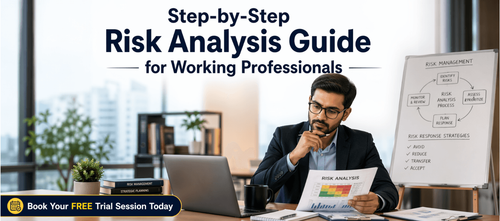
The "Business Risk Analysis Worksheet" uses a 5-Step Risk Analysis Process to help you identify, assess, prioritize, and respond to risks effectively. This method helps transform vague anxiety into actionable insights, leading to a clear and practical risk register.
The five steps are as follows:
1. Identify Risks – Surface all potential risks across different dimensions.
2. Assess Impact & Score – Score each risk on likelihood and impact.
3. Prioritize Risks – Prioritize based on their Risk Priority Score (RPS).
4. Plan Risk Response – Define how to mitigate, transfer, reduce, or accept each risk.
5. Monitor & Review – Continuously track risks and update the plan as necessary.
Each of these steps is designed to make risk management an ongoing, practical exercise that enhances your decision-making capabilities and helps you respond proactively.
How This Blog and Guidebook Help You?
This blog, in conjunction with the worksheet, helps you:
- Identify potential risks in business decisions, whether you’re managing a project or navigating a career change
- Assess the likelihood and impact of those risks, giving you a clear understanding of where to focus your efforts
- Prioritize your risks by identifying which ones are most urgent and likely to cause significant harm
- Develop a comprehensive risk response plan for managing high-priority risks
- Monitor and review your risks consistently to ensure they are being handled effectively
The result is a structured, proactive approach to risk management that positions you as a strategic thinker and decision-maker.
Step-by-Step Breakdown
Step 1 — Identify Your Risks
The first step is to identify all potential risks that could disrupt your plans. This isn’t just about obvious risks—it’s about thinking across multiple dimensions: strategic, operational, financial, legal, human, and reputational. Some Risk Identification Prompts to guide you:
- What assumptions does this plan rely on? What if they're wrong?
- What external forces (market, competition, regulation) could disrupt our progress?
- Where do we depend on systems or partners outside our control?
By using these prompts, you'll generate a comprehensive list of risks that may not have been on your radar. Aim for at least 10–15 risks to start, focusing on quantity over quality before refining your list.
Step 2 & 3 — Assess, Score & Prioritize Risks
Once you’ve identified your risks, it’s time to assess their likelihood and impact. Use the following Risk Scoring Matrix:
- Likelihood (1–5): How likely is this risk to occur?
- Impact (1–5): How significant would the consequences be if it occurred?
Multiply the two scores to get the Risk Priority Score (RPS). Risks with a high RPS should be escalated and addressed immediately.
For example:
- Likelihood 5 + Impact 4 = RPS 20 (Critical Priority)
- Likelihood 2 + Impact 3 = RPS 6 (Low Priority)
This scoring method helps you focus on the risks that matter most and avoid wasting energy on low-priority concerns.
Step 4 — Plan Your Risk Response
With your risks prioritized, the next step is deciding how to respond. The four classic risk response strategies are:
- Avoid: Eliminate the risk by changing the plan.
- Reduce: Take action to reduce the likelihood or impact of the risk.
- Transfer: Shift the burden to a third party (e.g., through insurance or outsourcing).
- Accept: Acknowledge the risk and move forward if it’s manageable.
For instance, if a high RPS risk involves regulatory issues, your strategy may be to transfer it by engaging legal counsel. For a medium RPS risk, you might reduce it by cross-training team members to mitigate key person dependency.
Step 5 — Monitor & Review
Risk analysis is an ongoing process. Once you’ve created a risk register, schedule regular reviews to assess any new risks that have emerged and track the progress of your mitigation efforts. Monthly or quarterly reviews are essential to keeping your risk management plan up to date and ensuring that nothing slips through the cracks.
Common Mistakes or Pitfalls to Avoid
- Only listing obvious risks: Be sure to think broadly and consider all risk categories.
- Scoring risks based on optimism: Always base your likelihood and impact scores on data and precedent.
- Not assigning a named owner for each risk: Assign accountability to ensure risks are managed effectively.
- Building a register and never reviewing it: Schedule regular reviews to keep the register updated.
How Should You Use This Guidebook Effectively?
- Complete the Risk Register for each project or major decision.
- Review regularly to update and manage new risks.
- Share your risk register with stakeholders to communicate the thoughtfulness and proactivity behind your decisions.
Key Takeaways
- Risk analysis is a crucial skill for all professionals—whether you’re making business decisions, advising clients, or managing a project.
- Use a structured process to identify, assess, and respond to risks, and regularly monitor their progress.
- A well-maintained Risk Register demonstrates strategic thinking and builds credibility with stakeholders.
Your Next Step: Accelerate Your Career with PlanetSpark
Creating an impact-driven resume is not just about landing your next job—it’s about owning your professional story and presenting it with clarity, confidence, and credibility. When your resume clearly communicates value, results, and impact, opportunities follow naturally.
At PlanetSpark, we are committed to empowering working professionals with practical, outcome-focused resources that drive real career growth. From resume building and workplace communication to leadership presence and professional writing, our programs are designed to help you succeed in today’s fast-evolving job market.
Visit https://www.planetspark.in/resources to explore:
- Career and resume-building guides
- Workplace communication and professional writing resources
- Skill-development tools curated for working professionals
Want a deeper, hands-on experience?
You can also book a free trial session to learn more about PlanetSpark’s Working Professional Courses, designed to accelerate your career through personalised coaching, real-world practice, and expert guidance.
Your career deserves more than generic advice.
It deserves clarity, confidence, and measurable impact.
Start building that advantage today—with PlanetSpark.
Personalized Communication Roadmaps
Record a video to get a AI generated personalized communication reports