
Step-by-Step Skill Refresh Roadmap for Professionals 2026
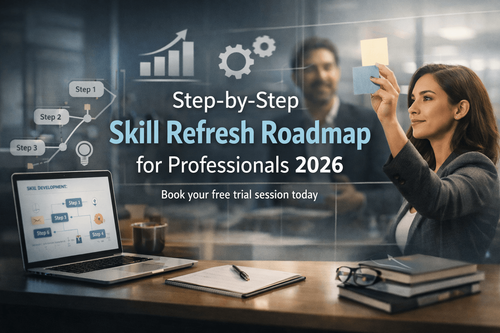

How to Refresh Your Professional Skills for Career Growth: A Complete Step-by-Step Skill Development Roadmap for Working Professionals
Most professionals don’t have a capability problem—they have a visibility and relevance problem. You might already possess valuable skills, but if they’re outdated, misaligned, or not applied in high-impact areas, they won’t translate into career growth. The gap between effort and opportunity often comes down to one thing: whether your skills are aligned with what the market currently rewards. This is why a structured skill refresh is no longer optional—it’s a strategic necessity for staying competitive, credible, and future-ready.They take courses, attend webinars, and consume endless content—but without a clear system, these efforts remain disconnected. The result is a false sense of growth with little to show for it in real career outcomes. What actually moves the needle is not how much you learn, but how intentionally you align, prioritise, and apply what you learn to real-world impact.
A structured skill refresh changes the game completely. It forces you to step back, diagnose what truly matters, and invest your time where it creates measurable returns. Instead of reacting to trends or chasing every new skill, you operate with focus and direction. That shift—from random improvement to strategic capability-building—is what separates professionals who stay relevant from those who consistently move ahead.
The professionals who accelerate fastest are not necessarily the most talented—they are the most intentional. They treat their skill development like a business investment, focusing on high-return areas and cutting out low-impact effort. When you start evaluating your skills through the lens of market demand and career relevance, your growth stops being accidental and starts becoming predictable.
You’re working hard, delivering consistently, and yet something feels off. Promotions slow down. Opportunities pass you by. Conversations at senior levels feel slightly out of reach. The problem isn’t effort—it’s alignment.
This blog is meant for today’s fast-moving professional landscape, the skills that got you here are rarely the ones that will take you forward. Yet most professionals never pause to audit, prioritise, and systematically upgrade their capabilities.
This is exactly where the Professional Skill Refresh Roadmap becomes critical. It provides a structured, practical system to help you identify skill gaps, focus on what matters, and build capabilities that directly accelerate your career growth.
Book your free trial session today with Planetspark.
Download for more details or PDF file.
Who Is This Blog For?
- Working professionals experiencing slow or
stagnant career growth
- Mid-career professionals aiming for leadership or promotion roles
- Career switchers needing to realign skills with new opportunities
- Consultants and specialists wanting stronger professional positioning
- Professionals unsure which skills actually drive career acceleration
Why This Topic Matters Today?
The professional world is evolving faster than most individuals can track. According to the guidebook, skill gaps rarely show up as obvious failures. Instead, they appear as missed opportunities, slower progression, and reduced visibility in high-impact situations.
Employers no longer value knowledge alone. They expect professionals to demonstrate applied capability, communicate value clearly, and adapt continuously. This creates a growing gap between experience and relevance.
Without a structured approach, professionals fall into two traps:
- Over-learning low-impact skills
- Under-investing in high-impact capabilities
The result? Effort without progress.
Core Concept or Framework Explained
The foundation of this roadmap is a structured 5-phase system designed to eliminate guesswork and maximise impact:
Audit → Prioritise → Learn → Apply → Sustain
Each phase solves a specific problem in skill development:
- Audit: Replaces assumptions with clarity
- Prioritise: Eliminates scattered effort
- Learn: Focuses on deliberate skill-building
- Apply: Converts knowledge into performance
- Sustain: Ensures long-term consistency
As highlighted in the framework section (page 3), skipping steps—especially the audit—leads to wasted effort and minimal real-world impact. This is not a checklist. It is a system where each phase strengthens the next.
How This Blog and Guidebook Help You?
This roadmap shifts you from reactive learning to strategic growth by helping you:
- Identify the exact skills that impact your career progression
- Focus on high-leverage improvements instead of random learning
- Build skills using efficient, real-world methods
- Apply learning directly in your work environment
- Create systems that sustain long-term growth
The result is not just improvement—it is visibility, credibility, and accelerated career momentum.
Step-by-Step Breakdown
Step 1: Audit — Know Exactly Where You Stand
Most professionals operate on assumptions about their skills. The audit phase replaces that with data-backed clarity.
You evaluate each skill across three dimensions:
- Current proficiency
- Market demand
- Future trajectory
The guide emphasises using external validation such as job descriptions and peer feedback to avoid bias.
Example:
A professional may feel confident in communication, but feedback reveals gaps in executive-level articulation.
Step 2: Prioritise — Focus Your Energy Where It Counts
Once you identify multiple skill gaps, the instinct is to fix everything. That strategy fails.
The roadmap introduces prioritisation filters:
- Impact vs effort
- Role relevance
Skills are categorised into:
- Urgent: High impact, immediate relevance
- Soon: Medium-term growth
- Later: Long-term development
As shown in the prioritisation matrix (page 7), focus is the real accelerator—not effort.
Step 3: Learn — Build Skills Deliberately, Not Randomly
Most professionals consume content without applying it. That creates the illusion of progress.
Effective learning depends on the type of skill:
- Knowledge skills require structured courses
- Practical skills require hands-on execution
- Communication skills require real-world interaction
The guide introduces a 30-day learning sprint (page 9):
- One skill at a time
- Clear success metric
- Daily focused effort
Example:
Instead of “improve communication,” define: “Deliver structured executive summaries with measurable feedback.”
Step 4: Apply — Turn Learning Into Performance
This is where most development fails. Learning without application leads to zero impact.
The roadmap introduces a practical execution loop (page 10):
- Set a clear application intention
- Apply the skill in real work scenarios
- Reflect within 24 hours
- Seek targeted feedback
Example:
Use a new stakeholder communication approach in a meeting and immediately evaluate outcomes.
Step 5: Sustain — Build a System That Outlasts Motivation
Motivation is unreliable. Systems create consistency.
The guide (page 12) highlights three sustainability drivers:
- Quarterly skill reviews
- Accountability partners
- Weekly progress tracking
Small, consistent actions compound into long-term capability.
Example:
A daily 15-minute practice habit delivers more results than occasional intensive sessions.
Common Mistakes or Pitfalls to Avoid
The guide identifies seven major mistakes that derail skill development (page 15):
- Learning without applying skills
- Trying to develop too many skills at once
- Mistaking content consumption for growth
- Ignoring feedback loops
- Waiting for the “right time”
- Skipping the audit phase
- Stopping when motivation drops
Each of these leads to wasted effort and stalled progress. The fix is simple: follow the system consistently.
How Should You Use This Guidebook Effectively?
To maximise results, follow a structured workflow:
- Start with a complete skill audit
- Identify 1–2 priority skills only
- Design a 30-day learning sprint
- Apply skills immediately in real work
- Track progress weekly
- Reassess every 90 days
Suggested time investment:
- Initial setup: 1–2 hours
- Daily effort: 15–30 minutes
- Weekly review: 10–15 minutes
The guide also provides a 72-hour activation plan (page 19) to kickstart momentum immediately.
Key Takeaways
- Always audit before taking action
- Focus on one high-impact skill at a time
- Learning only matters when applied
- Feedback accelerates growth
- Systems outperform motivation
- Consistency compounds into long-term success
- Strategic focus drives faster career acceleration
Your Next Step: Accelerate Your Career with PlanetSpark
Creating an impact-driven resume is not just about landing your next job—it’s about owning your professional story and presenting it with clarity, confidence, and credibility. When your resume clearly communicates value, results, and impact, opportunities follow naturally.
At PlanetSpark, we are committed to empowering working professionals with practical, outcome-focused resources that drive real career growth. From resume building and workplace communication to leadership presence and professional writing, our programs are designed to help you succeed in today’s fast-evolving job market.
Visit https://www.planetspark.in/resources to explore:
- Career and resume-building guides
- Workplace communication and professional writing resources
- Skill-development tools curated for working professionals
Want a deeper, hands-on experience?
You can also book a free trial session to learn more about PlanetSpark’s Working Professional Courses, designed to accelerate your career through personalised coaching, real-world practice, and expert guidance.
Your career deserves more than generic advice.
It deserves clarity, confidence, and measurable impact.
Start building that advantage today—with PlanetSpark.
Personalized Communication Roadmaps
Record a video to get a AI generated personalized communication reports