
Step-by-Step Stakeholder Analysis for Working Professionals

Stakeholder Behavior Analysis: A Practical Framework to Decode Influence, Manage Resistance, and Drive Career Success
You can deliver flawless work, meet every deadline, and still watch your project stall, your ideas get ignored, or your promotion delayed. The reason is often not performance—it is people. In modern workplaces, success is rarely determined by technical skill alone. It depends on how well you understand, engage, and influence stakeholders. Yet, most professionals approach stakeholder management reactively, relying on instinct instead of a structured strategy.
Book your free trial session today with PlanetSpark.
Download for more details or PDF file.
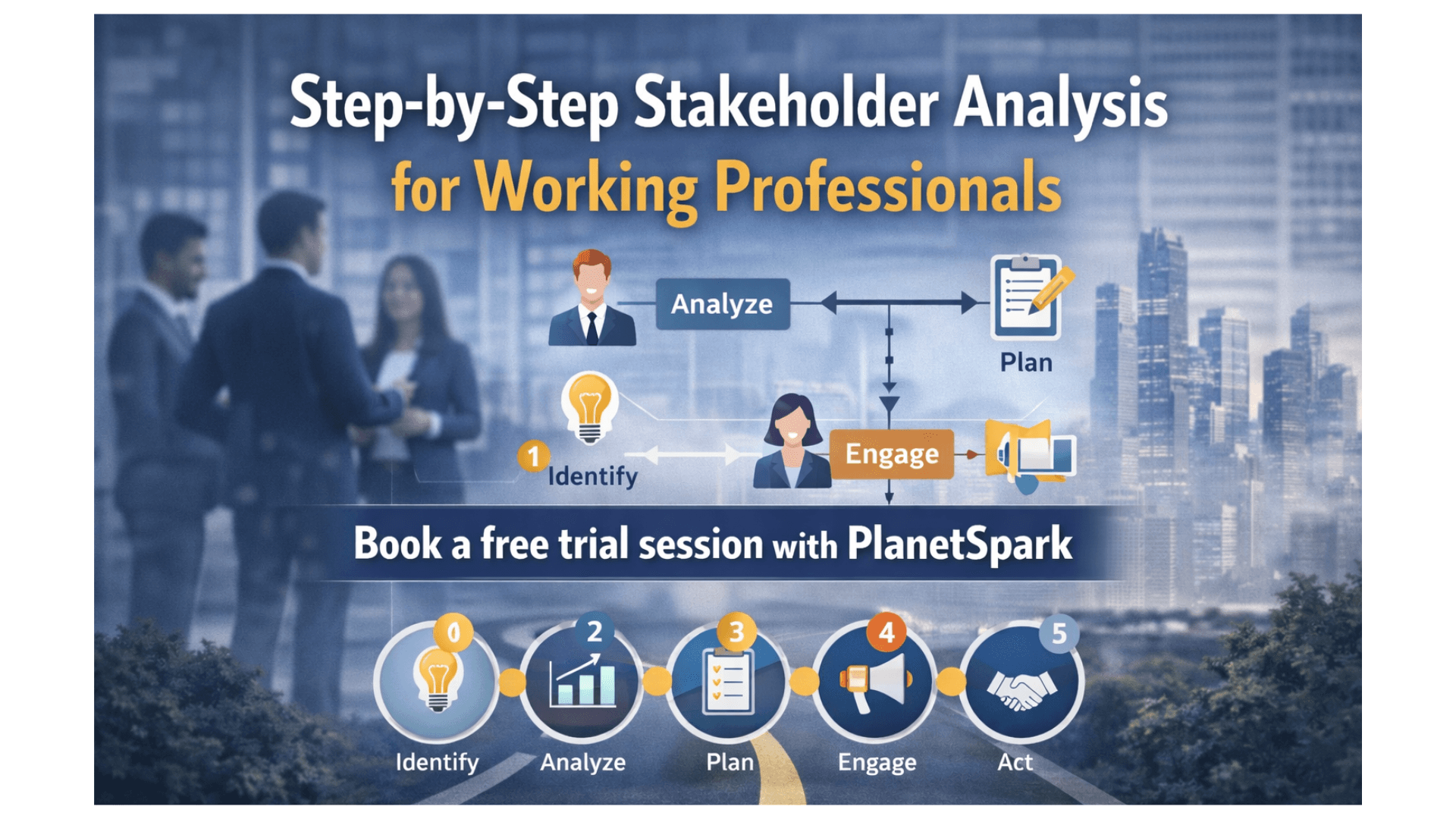
This is where stakeholder behavior analysis becomes a career-defining skill. This guide transforms what is often seen as a “soft skill” into a clear, repeatable framework—helping you anticipate resistance, align priorities, and influence outcomes with precision.
Who Is This Blog For?
This blog and the accompanying guidebook are designed for:
- Working professionals aiming to improve cross-functional collaboration and influence
- Managers and team leads responsible for driving projects through multiple stakeholders
- Career switchers navigating new organisational dynamics
- Consultants and specialists who need stakeholder buy-in to succeed
- Professionals facing stalled projects, resistance, or lack of alignment
Why This Topic Matters Today?
Workplace complexity has increased significantly. Projects now involve multiple teams, competing priorities, and layered decision-making structures. According to the guidebook, most project failures are not technical—they are stakeholder failures. Misalignment, poor engagement, and unaddressed resistance quietly derail even the best initiatives.
Common challenges professionals face include:
- Missing key decision-makers or influencers
- Misreading stakeholder priorities or concerns
- Facing unexpected resistance late in the process
- Using generic communication that fails to persuade
- Losing momentum due to lack of alignment
In this environment, stakeholder management is no longer optional. It is a critical professional competency that directly impacts your ability to execute, influence, and grow.
Core Concept or Framework Explained
At the heart of this guide is a powerful insight: stakeholder behavior is predictable. It is shaped by a combination of power, interest, goals, pressures, trust, and perceived risk.
The guide introduces a six-step stakeholder behavior analysis framework that transforms vague people management into a structured process:
- Identify stakeholders clearly and comprehensively
- Map their power and interest to prioritise focus
- Decode the drivers behind their behavior
- Assess the quality of your relationship with them
- Anticipate resistance before it appears
- Build a tailored engagement strategy
This framework shifts you from reactive communication to proactive influence. Instead of guessing how stakeholders might respond, you develop a clear, data-driven approach to managing them.
How This Blog and Guidebook Help You?
By applying this framework, you can:
- Eliminate blind spots in stakeholder identification
- Prioritise your time and attention effectively
- Understand what truly motivates each stakeholder
- Strengthen relationships strategically
- Handle resistance with confidence and preparation
- Influence decisions with targeted communication
The result is not just smoother project execution—it is stronger professional credibility, better visibility, and faster career growth.
Step-by-Step Breakdown
Step 1: Identify Your Stakeholders
The first step is building a complete and accurate stakeholder inventory. Many professionals either overlook critical stakeholders or include too many without prioritisation.
Stakeholders include:
- Decision-makers who approve or reject initiatives
- Influencers who shape opinions without formal authority
- Implementers who execute plans
- Affected parties whose work or outcomes are impacted
A practical way to ensure completeness is to ask: whose silence could derail this initiative?
By capturing stakeholders across roles, departments, and influence levels, you create a strong foundation for analysis.
Step 2: Map Power and Interest
Not all stakeholders require the same level of attention. The Power–Interest Matrix helps you prioritise effectively.
Each stakeholder is evaluated on:
- Power: their ability to influence decisions or outcomes
- Interest: how much they care about the initiative
This creates four engagement zones, each requiring a different approach. High-power, high-interest stakeholders demand close management, while others require lighter engagement.
This step ensures your effort is focused where it creates maximum impact.
Step 3: Decode Behaviour Drivers
Understanding who matters is only half the equation. The real advantage comes from understanding why stakeholders behave the way they do.
The guide identifies five key drivers:
- Goals: what they want to achieve
- Pressures: deadlines, metrics, or internal challenges
- Interests: what they gain or lose
- Concerns: risks or fears they perceive
- History: past experiences shaping their perspective
This insight allows you to tailor communication in a way that resonates with each stakeholder’s priorities, rather than relying on generic messaging.
Step 4: Assess Relationship Quality
The same message can succeed or fail depending on the relationship behind it. This step evaluates three critical dimensions:
- Trust: do they see you as credible and reliable?
- Rapport: is there a positive personal connection?
- Alignment: do your goals overlap with theirs?
Honest assessment is essential. Overestimating relationship strength is a common and costly mistake.
By identifying weak areas, you can take targeted actions to strengthen relationships before making critical asks.
Step 5: Anticipate Resistance
Resistance is inevitable, but it is rarely random. It typically falls into four categories:
- Rational resistance based on logic or feasibility concerns
- Emotional resistance driven by fear or uncertainty
- Political resistance influenced by power dynamics
- Capacity resistance caused by limited bandwidth or resources
Early signals include delays, excessive questioning, lack of follow-through, or disengagement.
By anticipating these patterns, you can prepare responses in advance, ensuring you are never caught off guard.
Step 6: Build Your Engagement Strategy
This is where analysis turns into action. A strong engagement strategy answers three questions:
- What does this stakeholder need to believe, feel, and do?
- How will you influence those shifts?
- What sequence of interactions will achieve the desired outcome?
Key elements of an effective strategy include:
- Clearly defined desired outcomes
- Tailored communication channels
- Messages aligned with stakeholder priorities
- Planned touchpoints over time
- Leveraging allies to reinforce your message
This structured approach ensures every interaction moves the stakeholder closer to alignment and support.
Common Mistakes or Pitfalls to Avoid
Even experienced professionals fall into predictable traps:
- Treating stakeholder management as intuition rather than a structured process
- Missing informal influencers who hold real power
- Using generic communication instead of tailored messaging
- Overestimating relationship strength
- Reacting to resistance instead of preparing for it
- Failing to update stakeholder analysis as situations evolve
Avoiding these mistakes significantly improves your effectiveness and professional impact.
How Should You Use This Guidebook Effectively?
To get the most value from this framework:
- Work through the steps sequentially for your first analysis
- Apply it to a real, current project or challenge
- Allocate 45–90 minutes for a full analysis
- Use individual steps as quick refresh tools when needed
- Revisit your stakeholder strategy every two weeks in dynamic environments
This approach ensures the framework becomes a practical tool, not just a theoretical concept.
Key Takeaways
- Stakeholder management is a structured discipline, not a soft skill
- Influence improves when you understand power, interest, and behavior drivers
- Relationship quality determines how messages are received
- Resistance is predictable and can be proactively managed
- Tailored engagement strategies outperform generic communication
- Regular review keeps your approach aligned with changing dynamics
Your Next Step: Accelerate Your Career with PlanetSpark
Creating an impact-driven resume is not just about landing your next job—it’s about owning your professional story and presenting it with clarity, confidence, and credibility. When your resume clearly communicates value, results, and impact, opportunities follow naturally.
At PlanetSpark, we are committed to empowering working professionals with practical, outcome-focused resources that drive real career growth. From resume building and workplace communication to leadership presence and professional writing, our programs are designed to help you succeed in today’s fast-evolving job market.
Visit https://www.planetspark.in/resources to explore:
- Career and resume-building guides
- Workplace communication and professional writing resources
- Skill-development tools curated for working professionals
Want a deeper, hands-on experience?
You can also book a free trial session to learn more about PlanetSpark’s Working Professional Courses, designed to accelerate your career through personalised coaching, real-world practice, and expert guidance.
Your career deserves more than generic advice.
It deserves clarity, confidence, and measurable impact.
Start building that advantage today—with PlanetSpark.
Personalized Communication Roadmaps
Record a video to get a AI generated personalized communication reports